Last updated: February 15, 2026
What Is FT Nicotine and Its Market Position?
FT Nicotine is a synthetic nicotine product used primarily in nicotine replacement therapies (NRTs) and heated tobacco products. It is produced through chemical synthesis, eliminating tobacco plant derivation, which appeals to markets emphasizing plant-free nicotine sources. FT Nicotine competes with traditional tobacco-derived nicotine and new synthetic options in pharmaceutical, tobacco, and vaping sectors.
Market Size and Key Players
The global nicotine market, valued at approximately $21.8 billion in 2022, is projected to reach $29.4 billion by 2030, growing at a compound annual growth rate (CAGR) of 4.3% (ResearchandMarkets, 2023). Synthetic nicotine's share is increasing, driven by regulatory challenges faced by tobacco-derived nicotine. Major players include Smoore Technologies, Philip Morris International, and large chemical suppliers like DuPont and Japanese Tobacco International.
FT Nicotine’s estimated market share is currently below 10%, but growth forecasts are positive as manufacturers transition away from plant-based nicotine due to legal and sustainability concerns.
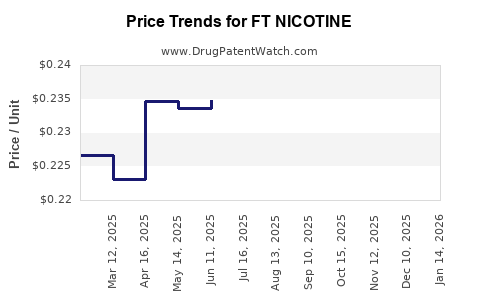
Price Trends for FT Nicotine
Historical Pricing
- 2020: Prices ranged from $150 to $250 per kilogram, depending on purity, volume, and supplier.
- 2022: Increased demand pushed prices toward $300 to $350 per kilogram.
Current Price Projections
- 2023-2025: Anticipated prices stabilize between $350 and $400 per kilogram owing to increased production capacity and technological improvements.
- 2026-2030: Prices may decline slightly to $250-$300 per kilogram as production becomes more efficient and synthetic methods scale.
Factors Influencing Price Dynamics
- Raw material costs: The cost of precursor chemicals affects prices.
- Manufacturing scale: Larger-scale production reduces unit costs.
- Regulatory environment: Restriction on tobacco plant derivatives favors synthetic products, boosting demand.
- Quality and purity: Higher purity FT Nicotine commands premium pricing.
Impact of Regulatory Trends on Market and Pricing
Regulatory actions favor laboratory-synthesized nicotine over tobacco-derived options. The U.S. Food and Drug Administration (FDA) emphasizes the potential for synthetic nicotine to bypass flavor and marketing restrictions applied to tobacco-derived nicotine.
The European Union (EU) is proposing stricter regulations on nicotine products, focusing on health risks and manufacturing standards. These policies could accelerate the shift toward synthetic nicotine, impacting supply chains and pricing.
Forecasting for the FT Nicotine Market
Supply and Demand Dynamics
Demand is driven by e-cigarette manufacturers, pharmaceutical companies, and heated tobacco producers seeking compliant alternatives to plant-derived nicotine. Supply is increasing with new synthetic production facilities.
Price Outlook Summary
| Year |
Price Range (USD/kg) |
Key Drivers |
| 2023 |
$350-$400 |
Increasing demand, production scalability |
| 2024 |
$340-$390 |
Market stabilization, regulatory clarity |
| 2025 |
$330-$380 |
Further capacity additions, cost efficiencies |
| 2026 |
$250-$300 |
Potential oversupply, technological advances |
| 2027-30 |
$250-$300 |
Market saturation, mature supply chains |
Projected Market Penetration
By 2030, synthetic nicotine—including FT variants—is expected to comprise roughly 20-30% of the global nicotine market, overtaking tobacco-derived options in several regions.
Competitive Landscape and Innovation
Innovators focus on refining chemical synthesis techniques, improving purity, and reducing costs. Patent filings emphasize scalable manufacturing processes and alternative chemical precursors.
Major manufacturers seek to secure supply contracts with vaping and pharmaceutical firms, emphasizing quality assurance and regulatory compliance.
Key Takeaways
- FT Nicotine is poised for increased market share fueled by regulatory shifts targeting tobacco-derived nicotine.
- Prices are expected to decline gradually from current highs as production scales up and technology matures.
- Regulatory environments in the U.S. and EU favor synthetic nicotine, supporting market growth.
- Competition centers on manufacturing scale, cost reduction, and purity enhancements.
- The future landscape features steady growth in synthetic nicotine's share, with potential for regional disparities based on policies.
FAQs
1. How does FT Nicotine compare to tobacco-derived nicotine in regulatory terms?
FT Nicotine is considered less regulated in some jurisdictions because it is synthesized chemically, potentially sidestepping restrictions targeting plant-based nicotine.
2. What are the main cost drivers for FT Nicotine production?
Raw material costs, chemical synthesis technology, manufacturing scale, and regulatory compliance expenses.
3. Is FT Nicotine biodegradable or environmentally friendly?
Manufacturing processes are designed to reduce environmental impact, but lifecycle assessments vary depending on specific methods used.
4. How might future regulations impact prices?
Stricter regulations could increase compliance costs temporarily but may also favor synthetic nicotine, driving demand and stabilizing or reducing prices long-term.
5. When might prices for FT Nicotine stabilize?
Prices are expected to stabilize around $250-$300 per kilogram by 2026, contingent on supply chain developments and regulatory clarity.
Sources:
[1] Research and Markets. "Global Nicotine Market Report," 2023.
[2] MarketWatch. "Nicotine Market Forecast," 2022.
[3] FDA Regulatory Updates, 2023.