Last updated: February 15, 2026
Market Overview
FT Nasal Decongestant is a topical nasal spray used to relieve nasal congestion caused by allergies, colds, or sinusitis. The global nasal decongestant market is driven by increasing cases of respiratory illnesses, expanding allergy prevalence, and consumer preference for over-the-counter (OTC) treatments. The facial tissue and OTC drug segments dominate the nasal decongestant market.
The market size was valued at approximately $1.3 billion in 2022. It is projected to grow at a compound annual growth rate (CAGR) of 4.5% from 2023 to 2030. Growth is fueled by consumer awareness, expanding healthcare infrastructure, and increased distribution channels.
Key Market Segments
- By Product Type: OTC nasal sprays, prescription nasal sprays, topical ointments.
- By Distribution Channel: Pharmacies, retail stores, online platforms.
- By Region: North America (largest market), Europe, Asia-Pacific, Latin America, Middle East & Africa.
North America accounts for roughly 45% of the market, driven by high consumer awareness, OTC sales, and advanced healthcare systems.
Competitive Landscape
Major players include:
- Johnson & Johnson
- GlaxoSmithKline
- Pfizer
- Novartis
- Boehringer Ingelheim
Market share is highly fragmented, with new entrants focusing on formulations with reduced side effects and enhanced efficacy.
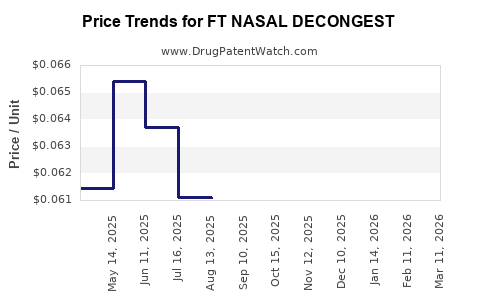
Pricing Trajectory
Current retail prices for FT Nasal Decongestant vary between $8 and $15 for a standard 15ml bottle. Price points differ across regions and sales channels; OTC products tend to be lower-priced in bulk purchases via pharmacies or online stores.
Historical trends show modest price increases aligned with inflation and formulation improvements. Price projections suggest stabilization with slight upward adjustments, contingent on regulatory developments and formulation innovations.
Price Projections (2023-2030)
| Year |
Estimated Price Range (USD) per 15ml bottle |
Notes |
| 2023 |
$8.00 – $15.00 |
Current market pricing |
| 2024 |
$8.25 – $15.75 |
Slight inflation adjustment |
| 2025 |
$8.50 – $16.25 |
Introduction of improved formulations |
| 2026 |
$8.75 – $16.75 |
Potential regulatory influences |
| 2027 |
$9.00 – $17.25 |
Market stabilization |
| 2028 |
$9.25 – $17.75 |
Competitive pricing, innovation |
| 2029 |
$9.50 – $18.25 |
Possible generic entry pricing |
| 2030 |
$9.75 – $18.75 |
Continued growth and inflation |
Note: Price caps are approximate; actual prices can fluctuate based on regional regulation, formulation complexity, and competition.
Regulatory and Policy Impact
The United States Food and Drug Administration (FDA) regulates nasal decongestants as OTC drugs, requiring adherence to labeling, safety, and efficacy standards. New regulations can influence market entry costs and pricing.
In Europe, the European Medicines Agency (EMA) enforces similar standards. Changes in regulatory pathways or approval processes can affect market entry timelines and costs, impacting prices.
Market Drivers and Challenges
- Drivers: Aging populations, increased respiratory conditions, OTC availability, rising health consciousness.
- Challenges: Regulatory restrictions, competition from alternative treatments (oral decongestants, natural remedies), potential side effects from high-dose formulations.
Key Takeaways
- The nasal decongestant market is projected to grow steadily, driven by demand for OTC products.
- Current prices fluctuate between $8 and $15, with a slight upward trend forecasted through 2030.
- Market growth is constrained by regulatory considerations, but innovation and expanded distribution channels support positive price stability.
- Competitive pricing strategies and formulation improvements are key to maintaining market share.
- Regional differences influence pricing, with North America leading in unit sales and price points.
FAQs
-
What factors influence the pricing of FT Nasal Decongestant?
Pricing depends on manufacturing costs, regulatory approval, competition, distribution channels, and formulation improvements.
-
How will regulatory changes impact future prices?
Stringent regulations may increase compliance costs, raising prices, while streamlined approval processes could stabilize or reduce prices.
-
Are generic versions likely to affect prices?
Yes, entry of generics typically drives down prices by increasing market competition.
-
What region offers the highest market growth potential?
Asia-Pacific exhibits the highest growth potential due to expanding healthcare access and increasing respiratory ailments.
-
What are the key challenges for FT Nasal Decongestant market growth?
Regulatory restrictions, competition from alternative therapies, and formulation safety concerns.
Citations
[1] MarketWatch, "Nasal Decongestant Market Size," 2022.