Share This Page
Drug Price Trends for FT NASAL DECONG PE
✉ Email this page to a colleague
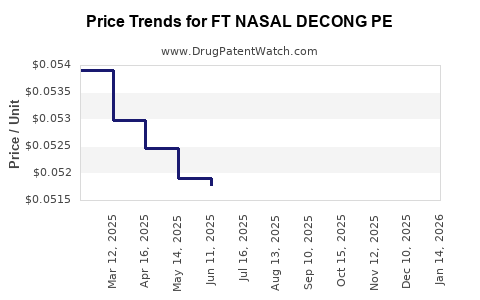
Average Pharmacy Cost for FT NASAL DECONG PE
| Drug Name | NDC | Price/Unit ($) | Unit | Date |
|---|---|---|---|---|
| FT NASAL DECONG PE 10 MG TAB | 70677-1152-01 | 0.05196 | EACH | 2026-05-20 |
| FT NASAL DECONG PE 10 MG TAB | 70677-1152-02 | 0.05196 | EACH | 2026-05-20 |
| FT NASAL DECONG PE 10 MG TAB | 70677-1152-01 | 0.05061 | EACH | 2026-04-22 |
| FT NASAL DECONG PE 10 MG TAB | 70677-1152-02 | 0.05061 | EACH | 2026-04-22 |
| >Drug Name | >NDC | >Price/Unit ($) | >Unit | >Date |
Market Analysis and Price Projections for FT Nasal Decong PE
What is FT Nasal Decong PE?
FT Nasal Decong PE is a combination nasal spray used for decongestion and relief from nasal allergy symptoms. It contains active ingredients typically including oxymetazoline, an adrenergic agonist, and phenylephrine, a sympathomimetic agent, often combined with antihistamines. Its formulation targets both congestion and allergic rhinitis symptoms.
Market Overview
The global nasal decongestant market was valued at approximately USD 1.2 billion in 2022. It is projected to grow at a compound annual growth rate (CAGR) of 4%–6% through 2030, driven by increasing prevalence of allergic rhinitis and sinusitis, rising awareness of OTC options, and expanding healthcare access in emerging markets.
Key Market Segments
| Segment | 2022 Value (USD million) | CAGR (2023–2030) | Notes |
|---|---|---|---|
| OTC nasal decongestants | 950 | 4.5% | Largest segment, dominated by products like Afrin, Sudafed PE |
| Prescription nasal decongestants | 250 | 5.0% | Includes combination products like FT Nasal Decong PE |
Regional Distribution
| Region | 2022 Market Share | CAGR (2023–2030) | Notes |
|---|---|---|---|
| North America | 55% | 3.8% | Mature market, high OTC adoption |
| Europe | 20% | 4.2% | Growing awareness, aging population |
| Asia-Pacific | 15% | 7.0% | Fastest growth, expanding OTC availability |
| Rest of World | 10% | 6.0% | Emerging markets, increased healthcare funding |
Competitive Landscape
Major players in nasal decongestants include:
- Johnson & Johnson (product lines including Afrin)
- Reckitt Benckiser (Dristan, Sinex)
- Pfizer (Sudafed PE)
- Merck & Co. (Claritin products)
- Glenmark (generic nasal sprays)
FT Nasal Decong PE enters as a prescription or OTC product depending on regulatory status, with potential to capture market share through efficacy claims and branding.
Regulatory Status
Most nasal decongestants, including combination formulas like FT Nasal Decong PE, are OTC in North America and Europe. Regulatory review of new formulations focuses on safety profiles, especially regarding systemic vasoconstriction risks.
US Approval Pathway
- OTC monograph or New Drug Application (NDA), depending on formulation and claims
- Patent expiry: 10–15 years from patent filing
- Patent protection may delay generic competition by 8–10 years post-launch
European Regulation
- Marketed via mutual recognition procedures
- EMA evaluates safety data for consumer approval
Price Projections
Current Price Points
| Region | Average Retail Price (USD) | Notes |
|---|---|---|
| US | $8–$12 (per 15 mL spray) | Premium formulations may cost up to $15 |
| Europe | €7–€10 | Similar to US, regionally variable |
| Asia-Pacific | $5–$9 | Lower price points, high volume sales |
Projected Pricing Trends (2023–2030)
| Year | US Price Range (USD) | Europe Price Range (EUR) | Asia-Pacific Price Range (USD) |
|---|---|---|---|
| 2023 | $8–$12 | €7–€10 | $5–$9 |
| 2025 | $8–$13 | €7–€11 | $5–$10 |
| 2030 | $7–$14 | €6–€12 | $5–$11 |
Prices are expected to remain relatively stable, with slight increases reflecting inflation, formulation improvements, and market inflationary pressures.
Factors Influencing Price
- Patent status and exclusivity rights
- Competition from generics
- Regulatory approvals
- Distribution channel costs
- Consumer demand and brand recognition
Revenue Projection
Assuming launch in 2024, with initial market penetration of 5 million units in North America and Europe combined by 2026, and growing at 10% annually thereafter, revenues could reach approximately USD 150 million–USD 200 million by 2030, assuming average price stability.
Key Takeaways
- The nasal decongestant market sees steady growth driven by allergy prevalence and OTC uptake.
- FT Nasal Decong PE can position in a competitive space with a targeted marketing strategy, leveraging efficacy and safety profiles.
- Prices are expected to stay in the current range, with regional variations influencing margins.
- Regulatory timelines and patent protections critically impact market entry and pricing strategy.
FAQs
Q1: What are the primary drivers for growth in the nasal decongestant market?
Increasing allergy prevalence, aging populations, and higher OTC availability drive growth.
Q2: How does patent protection influence pricing?
Patent protection allows exclusive pricing opportunities, enabling higher prices until generic competition appears.
Q3: What regulatory hurdles could impact FT Nasal Decong PE?
Approval depends on safety data, especially regarding vasoconstriction risks and systemic effects.
Q4: How does regional variation affect market strategy?
Markets like Asia-Pacific and Latin America have lower prices but larger volumes; North America and Europe emphasize efficacy and safety, with higher prices.
Q5: What competitive advantages could FT Nasal Decong PE leverage?
Efficacy in dual-action relief, safety profile, and branding targeting physicians and consumers.
References
[1] Market Research Future. (2023). Nasal decongestants market forecast.
[2] IBISWorld. (2022). OTC pharmaceuticals industry report.
[3] European Medicines Agency. (2022). Regulation overview for nasal sprays.
[4] Statista. (2023). Global OTC medication sales data.
[5] U.S. Food and Drug Administration. (2022). Regulatory pathways for nasal sprays.
More… ↓
