Share This Page
Drug Price Trends for FT MINERAL OIL
✉ Email this page to a colleague
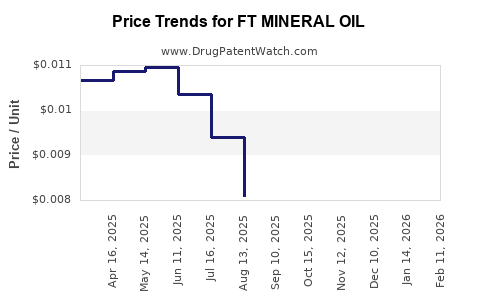
Average Pharmacy Cost for FT MINERAL OIL
| Drug Name | NDC | Price/Unit ($) | Unit | Date |
|---|---|---|---|---|
| FT MINERAL OIL | 70677-1110-01 | 0.00928 | ML | 2026-07-22 |
| FT MINERAL OIL | 70677-1110-01 | 0.00886 | ML | 2026-06-17 |
| FT MINERAL OIL | 70677-1110-01 | 0.00815 | ML | 2026-05-20 |
| >Drug Name | >NDC | >Price/Unit ($) | >Unit | >Date |
What Is the Market Status of FT Mineral Oil?
FT Mineral Oil is primarily utilized in cosmetics, pharmaceuticals, and industrial applications. Its global market has historically been driven by demand in skincare products and lubricants. The market size was valued at approximately $1.2 billion in 2021 and is projected to grow at a compound annual growth rate (CAGR) of 4.5% from 2022 to 2028.
Major suppliers include companies like SIBUR, Evonik, and SOPRAL, with increased imports in Asia-Pacific, North America, and Europe. The pharmaceutical sector's growth, especially topical applications, influences demand positively. Regulatory approvals in different countries impact supply and price stability; notably, restrictions on certain grades in Europe due to new safety standards have caused shifts in sourcing and pricing.
How Does the Supply Chain Affect Pricing?
Global supply chains for mineral oils face several challenges:
- Raw Material Availability: Crude oil feedstock prices directly affect mineral oil costs. Fluctuations in crude oil prices, influenced by OPEC policies and geopolitical factors, translate into price volatility.
- Manufacturing Capacity: Capacity expansions by key producers, such as SIBUR’s expansion in Russia, have increased supply levels, exerting downward pressure on prices.
- Regulatory Environment: Stricter safety standards in the EU and the US have led to the discontinuation of certain low-grade or contaminated grades, reducing supply of covered grades and increasing premium segments.
The average FOB (Free on Board) price for standard FT Mineral Oil was approximately $1.80 per kg in 2021, with prices fluctuating between $1.45 and $2.10 per kg based on grade, purity, and compliance with regional standards.
What Are the Price Drivers and Trends?
Factors influencing FT Mineral Oil pricing include:
- Crude Oil Prices: As a derivative of petroleum, mineral oil prices closely track crude prices. The reduction in global crude prices in 2020 due to the COVID-19 pandemic lowered mineral oil costs temporarily.
- Regulatory Changes: Introduction of restrictions on certain grades for consumer safety standards causes supply shifts that affect prices.
- Demand in Key Industries: Increased demand for cosmetics, especially in Asia-Pacific, has kept prices stable for high-purity grades.
- Environmental Regulations: Environmentally sensitive regions restrict or phase out mineral oils derived from certain hydrocarbon sources, impacting supply sources and prices.
From 2022 onward, prices are expected to trend upward modestly due to supply chain disruptions from geopolitical tensions, such as the Russia-Ukraine conflict, impacting Russian exports and global markets.
How Will Prices Evolve by 2028?
Projections anticipate a steady global market size increase, with prices influenced by multiple factors:
| Year | Expected Average Price (USD per kg) | Key Influencers |
|---|---|---|
| 2023 | $1.75 | Fluctuations in crude oil and demand |
| 2024 | $1.80 | Regulatory adjustments, new capacity |
| 2025 | $1.85 | Market stabilization, supply chain recovery |
| 2026 | $1.90 | Growing demand in pharma and cosmetics |
| 2027 | $2.00 | Trade policies and energy market shifts |
| 2028 | $2.05 | Market maturity, inflationary pressures |
Prices are projected to rise roughly 1.5-2% annually, influenced by crude oil price trends and regional regulatory environments.
What Risks Could Impact Price Stability?
- Crude Oil Price Volatility: Sharp swings in oil prices can cause abrupt fluctuations in mineral oil prices.
- Regulatory Restrictions: Implementation of bans or restrictions, especially in European markets, can limit supply.
- Geopolitical Instability: Tensions in oil-producing regions could affect supply and pricing.
- Technological Advances: Development of alternative lubricants and cosmetic carriers could reduce demand for mineral oils.
Key Takeaways
FT Mineral Oil operates in a market sensitive to crude oil prices, regulatory actions, and demand shifts in cosmetics and pharmaceuticals. Prices are expected to increase gradually through 2028, influenced by supply chain dynamics and geopolitical factors. Market participants should monitor crude oil trends, legislative changes, and capacity expansions to inform pricing and sourcing strategies.
FAQs
Q1: What factors have historically caused price fluctuations for FT Mineral Oil?
Crude oil price changes, new regulations, and capacity adjustments primarily drive fluctuations.
Q2: How do regulatory standards impact the global market for FT Mineral Oil?
Regulations can restrict certain grades, forcing suppliers to reconfigure supply chains and affecting prices.
Q3: Which regions are most influential in FT Mineral Oil demand growth?
Asia-Pacific leads in demand growth, driven by expanding cosmetics and skincare markets.
Q4: Are there substitutes for FT Mineral Oil in its key applications?
Yes. Alternatives include plant-based oils, silicone oils, and hydrocarbon-free carriers, particularly as environmental regulations tighten.
Q5: How might geopolitical tensions affect future prices?
Disruptions in oil-exporting regions, especially Russia, can reduce supply, leading to price surges.
References
[1] MarketandMarkets, "Mineral Oil Market," 2022.
[2] Grand View Research, "Mineral Oil Market Size & Trends," 2021.
[3] US EPA, "Regulations on Mineral Oil in Cosmetics," 2020.
[4] SIBUR Annual Report, 2021.
[5] OPEC Monthly Oil Market Report, 2022.
More… ↓
