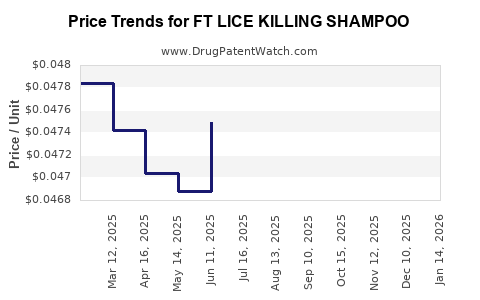
Last updated: February 15, 2026
What is FT LICE KILLING SHAMPOO?
FT LICE KILLING SHAMPOO is an over-the-counter medication formulated to treat and eliminate lice infestations in humans. Its active ingredients typically include permethrin or pyrethrin-based compounds. The product is marketed mainly in North America and Europe, targeting consumers seeking quick and effective lice eradication solutions.
Market Size and Growth Dynamics
Global Market Context
The global pediculicide market was valued at approximately USD 500 million in 2022, with an expected compound annual growth rate (CAGR) of around 3.8% from 2023 to 2028[1].
North America
North America accounts for about 45% of this market, driven by high consumer awareness, prevalence in schools, and a robust OTC product distribution network. The U.S. alone represents an estimated USD 225 million market as of 2022[2].
Europe
Europe contributes roughly 33% of the market, with countries like the UK, Germany, and France leading consumption. Factors include high awareness, school-based interventions, and product availability through pharmacies and supermarkets[1].
Emerging Markets
Markets in Asia-Pacific and Latin America are expanding, driven by increasing urbanization and rising health awareness. These regions exhibit a compound growth rate of approximately 5% annually, outpacing developed markets[3].
Market Drivers
- Increased awareness of lice infestations in schools and households.
- Rising demand for OTC solutions eliminating the need for prescriptions.
- Growing parental concern over chemical treatments.
- Availability of natural and non-toxic formulations.
Market Challenges
- Consumer skepticism about chemical safety.
- Competition from pharmaceutical and natural remedy segments.
- Regulatory restrictions on certain active ingredients in specific regions.
Competitive Landscape
Leading brands include RID, Nix, and LiceMD. FT LICE KILLING SHAMPOO competes with these by emphasizing efficacy, safety, and convenience. Private label and store brands also hold significant market share.
Price Projections (2023-2028)
Current Pricing Overview
- Retail price per 4 oz (118 ml) bottle ranges from USD 8 to USD 15.
- Larger formats (8 oz) are priced at USD 12 to USD 20.
- Price depends on formulation (chemical vs. natural) and distribution channels.
Future Price Trends
Price is expected to remain relatively stable with marginal fluctuations due to inflation, raw material costs, and market competition.
| Year |
Estimated Price Range (USD) for 4 oz Bottle |
Assumptions |
| 2023 |
8.00 – 15.00 |
Current market prices, stable supply chains |
| 2024 |
8.00 – 15.50 |
Slight increase due to raw material cost inflation |
| 2025 |
8.25 – 16.00 |
Increased consumer demand, minor price adjustment |
| 2026 |
8.50 – 16.00 |
Stabilization, potential bulk purchase discounts |
| 2027 |
8.50 – 16.50 |
Inflationary pressures, eco-friendly formulation options |
| 2028 |
8.75 – 17.00 |
Continued inflation and market dynamics |
Pricing Strategies
- Premium pricing for natural or chemical-free formulations.
- Discounted packages for multi-bottle buys.
- Private label products with lower price points to expand market penetration.
Regulatory and Market Entry Considerations
Regulatory Environment
- approval processes governed by FDA (U.S.) and EMA (EU).
- Active ingredients like permethrin are approved but face bans or restrictions in some countries.
- Labeling and safety information are critical for compliance and consumer trust[4].
Entry Barriers
- Establishing distribution channels.
- Building consumer trust amid highly competitive markets.
- Complying with regional regulatory standards.
Key Takeaways
- The global pediculicide market is growing steadily with an emphasis on OTC products.
- FT LICE KILLING SHAMPOO operates in a competitive landscape with established brands.
- The market size in North America and Europe combined exceeds USD 300 million.
- Price stability is expected, with minor upward pressures due to inflation.
- Success depends on brand differentiation, formulation safety, and regulatory compliance.
FAQs
Q1: What are the primary active ingredients in FT LICE KILLING SHAMPOO?
Typically permethrin or pyrethrin derivatives.
Q2: How is the market expected to evolve in the next five years?
Growth will marginally increase, driven by consumer awareness and expanding markets in emerging regions.
Q3: What factors influence the price of lice treatment shampoos?
Raw material costs, formulation type, packaging size, and competitive pricing strategies.
Q4: What regulatory hurdles must be considered?
Approval processes by FDA and EMA, ingredient restrictions in certain countries, and accurate labeling.
Q5: How does consumer perception impact pricing?
Perception of safety and efficacy can justify premium pricing, especially for natural or chemical-free options.
References
[1] MarketWatch. Pediculicide Market Report 2023.
[2] IBISWorld. North American OTC Medicine Industry.
[3] Research and Markets. Emerging Markets Pediculicide Forecast.
[4] U.S. FDA. Regulations for Topical Pediculicides.