Share This Page
Drug Price Trends for FT IBUPROFEN PM
✉ Email this page to a colleague
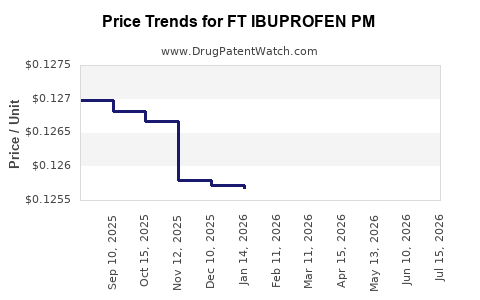
Average Pharmacy Cost for FT IBUPROFEN PM
| Drug Name | NDC | Price/Unit ($) | Unit | Date |
|---|---|---|---|---|
| FT IBUPROFEN PM 200-38 MG CPLT | 70677-1131-01 | 0.13127 | EACH | 2026-07-22 |
| FT IBUPROFEN PM 200-38 MG CPLT | 70677-1131-01 | 0.12930 | EACH | 2026-06-17 |
| FT IBUPROFEN PM 200-38 MG CPLT | 70677-1131-01 | 0.12716 | EACH | 2026-05-20 |
| FT IBUPROFEN PM 200-38 MG CPLT | 70677-1131-01 | 0.12493 | EACH | 2026-04-22 |
| FT IBUPROFEN PM 200-38 MG CPLT | 70677-1131-01 | 0.12495 | EACH | 2026-03-18 |
| FT IBUPROFEN PM 200-38 MG CPLT | 70677-1131-01 | 0.12543 | EACH | 2026-02-18 |
| >Drug Name | >NDC | >Price/Unit ($) | >Unit | >Date |
What is FT IBUPROFEN PM?
FT IBUPROFEN PM is a combination pharmaceutical product used for short-term relief of occasional sleeplessness coupled with pain or fever. It combines ibuprofen, a non-steroidal anti-inflammatory drug (NSAID), with diphenhydramine, an antihistamine with sedative properties. The product targets consumers seeking both pain relief and sleep aid in a single dose.
Market Size and Segment
The global analgesics market was valued at approximately USD 26.2 billion in 2022 and is projected to reach USD 36 billion by 2027, growing at a CAGR of 6.5%.[1] Within this, OTC combination products like FT IBUPROFEN PM account for a rising share due to consumer preference for convenience.
The sleep aid segment within OTC analgesics is emerging. The demand for combination products that address multiple symptoms simultaneously has increased, especially with aging populations and rising prevalence of chronic pain conditions.
In the United States, OTC pain management and sleep aid markets grew by 3.8% in 2022, driven by increased health awareness and self-medication trends.[2] FT IBUPROFEN PM's primary markets are North America and Europe, with potential expansion into Asia-Pacific and Latin America.
Competitive Landscape
Major competitors include:
- Advil PM: Contains ibuprofen and diphenhydramine; dominant in North America.
- Nurofen PM (UK/Europe): Similar composition, but market share is fragmented.
- Unbranded generics: Numerous local brands with comparable formulations.
Market differentiation relies on brand recognition, formulation stability, and regulatory positioning.
Regulatory Status and Entry Barriers
In the U.S., FT IBUPROFEN PM would require over-the-counter (OTC) monograph or New Drug Application (NDA) approval from FDA. The combination’s safety profile, particularly concerning sedative effects and interactions with other medications, influences registration timelines.
Europe follows EMA guidelines, and approval depends on compliance with the Human Medicines Regulations and similarity to existing OTC products.
Barriers include:
- Demonstrating safety and efficacy for combined molecules.
- Ensuring packaging constraints for combination medications.
- Managing labeling for dual indications.
Price Projection and Profitability
Current Pricing Landscape
In the U.S., OTC combination pain and sleep aids retail at approximately USD 8–12 per package (30–40 capsules). In the UK, similar products retail at GBP 7–10.
Price Trends
Pricing is influenced by brand strength, patent status, and regulatory approval. With patent expiration, generics typically reduce prices by 40–60%. FT IBUPROFEN PM, if marketed as a brand, could command a premium of 15-25% over generics due to perceived quality and formulation.
Revenue Estimates
Assuming a conservative market share capture of 5% in the OTC sleep/NSAID segment in North America by year 3 post-launch:
| Metric | Value |
|---|---|
| Estimated total OTC pain/sleep market (2026) | USD 12 billion |
| Segment share for combination products | 15% (USD 1.8 billion) |
| Target market share for FT IBUPROFEN PM | 5% (USD 90 million) |
| Average selling price per package | USD 10 |
| Units sold annually | 9 million packages |
Profitability depends on manufacturing costs (~USD 1.50–2 per pack), marketing expenditure, and distribution margins.
Pricing Strategy
For initial entry, a premium pricing of USD 9.99–10.99 per package can position FT IBUPROFEN PM as a trusted brand. Volume discounts, bundling with other OTC medications, and targeted marketing to primary care and pharmacy channels can sustain growth.
Risks and Opportunities
Risks
- Regulatory delays or rejection based on safety concerns.
- Market saturation by existing products.
- Consumer skepticism about combined sedative/pain relief safety.
Opportunities
- Growing demand for combination OTC products.
- Potential for line extensions into formulations like lower-dose variants.
- Expansion into emerging markets with increasing OTC regulation.
Key Takeaways
- The global OTC analgesics market is expanding, with an increasing share for combination products.
- FT IBUPROFEN PM can leverage existing demand for pain and sleep aid combination therapies.
- Entry barriers include regulatory approval, safety demonstration, and market differentiation.
- Price projections suggest a stable revenue stream with scope for premium positioning.
- Market risks include regulatory hurdles and competitive pressure; opportunities lie in product differentiation and expanding consumer segments.
FAQs
1. What regulatory hurdles does FT IBUPROFEN PM face?
It must demonstrate safety, efficacy, and appropriate labeling, either through OTC monographs or NDA submissions to agencies like the FDA or EMA.
2. How does patent status affect pricing for FT IBUPROFEN PM?
Patent protections enable premium pricing initially. Once expired, generic competition drives prices down by up to 60%, impacting revenue potential.
3. What are key safety concerns for this combination product?
Potential sedation from diphenhydramine, interactions with other medications, and NSAID-related gastrointestinal risks.
4. What is the competitive advantage for FT IBUPROFEN PM?
A differentiated formulation with proven safety, effective dosing, and brand recognition.
5. Which markets offer the best growth opportunities?
North America and Europe have mature markets; Asia-Pacific and Latin America offer emerging opportunities with expanding OTC regulation.
Sources:
[1] Grand View Research, "Analgesics Market Size, Share & Trends Analysis," 2022.
[2] IQVIA, OTC Market Data, 2022.
More… ↓
