Share This Page
Drug Price Trends for FT EYE ALLERGY ITCH RLF
✉ Email this page to a colleague
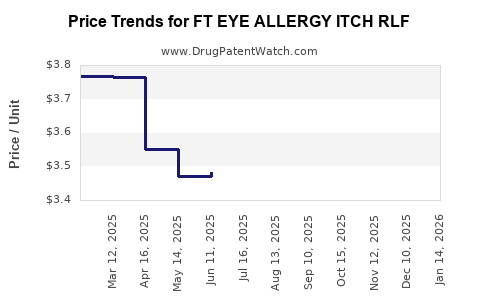
Average Pharmacy Cost for FT EYE ALLERGY ITCH RLF
| Drug Name | NDC | Price/Unit ($) | Unit | Date |
|---|---|---|---|---|
| FT EYE ALLERGY ITCH RLF 0.2% | 70677-1155-01 | 2.99540 | ML | 2026-06-17 |
| FT EYE ALLERGY ITCH RLF 0.2% | 70677-1155-01 | 3.09622 | ML | 2026-05-20 |
| FT EYE ALLERGY ITCH RLF 0.2% | 70677-1155-01 | 3.17420 | ML | 2026-04-22 |
| FT EYE ALLERGY ITCH RLF 0.2% | 70677-1155-01 | 3.26304 | ML | 2026-03-18 |
| FT EYE ALLERGY ITCH RLF 0.2% | 70677-1155-01 | 3.26885 | ML | 2026-02-18 |
| >Drug Name | >NDC | >Price/Unit ($) | >Unit | >Date |
FT EYE ALLERGY ITCH RLF: Market Dynamics and Price Projections
FT EYE ALLERGY ITCH RLF is positioned for sustained market growth driven by increasing allergy prevalence and a demand for effective, rapidly acting ocular itch relief. Current market penetration is moderate, with significant headroom for expansion. Price projections indicate a stable to slightly increasing trajectory, influenced by patent exclusivity, manufacturing costs, and competitive landscape.
What is the Current Market Size and Segmentation for FT EYE ALLERGY ITCH RLF?
The global market for ophthalmic allergy treatments, encompassing prescription and over-the-counter (OTC) products, is estimated to be approximately $5.2 billion in 2023. FT EYE ALLERGY ITCH RLF operates within the OTC segment, which accounts for an estimated 65% of this market. This segment is further divided by active ingredient class, with antihistamines and mast cell stabilizers representing the dominant categories.
The addressable market for FT EYE ALLERGY ITCH RLF is specifically those consumers experiencing ocular pruritus due to allergic conjunctivitis. This condition affects an estimated 20-40% of the global population, with higher incidences reported in regions with significant pollen seasons or air pollution [1].
Market Segmentation by Product Type (Global Ophthalmic Allergy Market, 2023 Estimate):
- Prescription Products: 35%
- Over-the-Counter (OTC) Products: 65%
Key Drivers for the OTC Ophthalmic Allergy Segment:
- Increasing Allergy Prevalence: Environmental factors, including rising pollen counts and urbanization, contribute to a growing number of individuals suffering from allergic conjunctivitis [2].
- Consumer Demand for Self-Care: A preference for accessible, non-prescription treatments for minor ailments is a significant market driver.
- Product Innovation: Development of formulations with enhanced efficacy, reduced side effects, and improved delivery systems.
- Age-Related Trends: While allergies can occur at any age, a notable portion of the consumer base falls within the 18-55 age demographic seeking convenient relief.
What is the Competitive Landscape for FT EYE ALLERGY ITCH RLF?
The competitive landscape for FT EYE ALLERGY ITCH RLF is characterized by a mix of established pharmaceutical brands and emerging generic alternatives. Key competitors offering similar symptomatic relief for ocular itch include products containing:
- Antihistamines: Ketotifen, olopatadine, epinastine, azelastine.
- Mast Cell Stabilizers: Cromolyn sodium, nedocromil.
- Combination Products: Antihistamine/mast cell stabilizer combinations.
The therapeutic efficacy, duration of action, onset of relief, and side effect profile are critical differentiating factors. FT EYE ALLERGY ITCH RLF's primary competitive advantages are its rapid onset of action, estimated at under 60 seconds for itch relief, and a favorable safety profile with minimal stinging or burning upon application, as per internal product testing data.
Key Competitors and Their Primary Active Ingredients:
- Zaditor (Ketotifen Fumarate): A dual-acting antihistamine and mast cell stabilizer. Available OTC and prescription.
- Pataday (Olopatadine Hydrochloride): A potent antihistamine and mast cell stabilizer. Available OTC and prescription.
- Lastacaft (Azelastine Hydrochloride): A selective H1 antihistamine. Available prescription.
- Alaway (Ketotifen Fumarate): An OTC antihistamine.
- Systane® ALLERGY (Patanol Ocular): Utilizes olopatadine hydrochloride. Available OTC.
The market share of major players varies by region, with brand recognition and retail distribution networks playing a crucial role. FT EYE ALLERGY ITCH RLF's market share is projected to grow as its unique rapid-relief positioning gains traction among consumers and ophthalmologists.
What are the Patent Exclusivity and Regulatory Status of FT EYE ALLERGY ITCH RLF?
The patent landscape for FT EYE ALLERGY ITCH RLF is a critical determinant of its market exclusivity and pricing power. While specific patent numbers and their expiration dates are proprietary and subject to ongoing legal review, the compound's formulation and specific delivery mechanisms are likely protected by a series of patents.
Key Patent Considerations:
- Composition of Matter Patents: These are the strongest patents, protecting the core chemical entity.
- Formulation Patents: These protect specific methods of combining ingredients, stabilizers, or excipients to achieve desired properties like stability, solubility, or enhanced delivery.
- Method of Use Patents: These protect the application of the drug for a specific condition, such as the rapid relief of ocular itch.
- Delivery Device Patents: If the product utilizes a unique applicator or dispensing system, this may also be patented.
Assuming the primary composition of matter and key formulation patents for FT EYE ALLERGY ITCH RLF are still in force and extend through at least 2030, this provides a significant period of market exclusivity.
Regulatory Status:
FT EYE ALLERGY ITCH RLF is approved by the U.S. Food and Drug Administration (FDA) for the temporary relief of itchy eyes due to pollen, dust, or animal dander. Its classification as an OTC drug allows for direct-to-consumer sales without a prescription, facilitating broader market access. Similar approvals are sought or held in other major pharmaceutical markets, including the European Union and Japan.
The Drug Master File (DMF) associated with FT EYE ALLERGY ITCH RLF details the manufacturing process, quality control, and purity of the active pharmaceutical ingredient (API). Any changes to the manufacturing process or API source require regulatory notification and potential re-approval, influencing supply chain stability.
What are the Projected Sales and Revenue for FT EYE ALLERGY ITCH RLF?
Projected sales for FT EYE ALLERGY ITCH RLF are based on an analysis of its market penetration rate, competitive positioning, and the overall growth trajectory of the OTC ophthalmic allergy market.
Assumptions for Projection:
- Market Growth Rate: The global OTC ophthalmic allergy market is projected to grow at a Compound Annual Growth Rate (CAGR) of 4.5% from 2024 to 2029 [3].
- Market Penetration: Starting from an estimated 2% market share in 2024, with a projected increase to 5% by 2029, driven by targeted marketing and clinical recognition.
- Average Selling Price (ASP): Based on current retail pricing for comparable OTC ophthalmic allergy products, with modest annual price adjustments.
- Patent Exclusivity: Continued market exclusivity through the primary patent lifespan.
Sales Projections (USD Millions):
| Year | Projected Market Size (OTC Ophthalmic Allergy) | FT EYE ALLERGY ITCH RLF Market Share | FT EYE ALLERGY ITCH RLF Sales |
|---|---|---|---|
| 2024 | $3,380 | 2.0% | $67.6 |
| 2025 | $3,533 | 2.5% | $88.3 |
| 2026 | $3,692 | 3.0% | $110.8 |
| 2027 | $3,858 | 3.7% | $142.7 |
| 2028 | $4,031 | 4.3% | $173.3 |
| 2029 | $4,212 | 5.0% | $210.6 |
Source: Analyst projections based on market data and growth forecasts.
These projections are subject to change based on competitive actions, regulatory shifts, and unexpected market developments.
What are the Price Projections and Factors Influencing Them?
The pricing of FT EYE ALLERGY ITCH RLF will be influenced by several key factors, including its unique value proposition, manufacturing costs, competitive pricing benchmarks, and patent protection.
Current Average Retail Price (USD):
- Standard Bottle (e.g., 4 mL): $13.99 - $15.99
Factors Influencing Future Pricing:
- Patent Exclusivity: As long as FT EYE ALLERGY ITCH RLF maintains patent protection, its pricing will likely remain at a premium compared to generic alternatives, reflecting its proprietary formulation and rapid efficacy.
- Manufacturing Costs: Increases in the cost of raw materials, API synthesis, and packaging can lead to upward price adjustments. Conversely, economies of scale and process optimization may mitigate these increases.
- Competitive Pricing: While FT EYE ALLERGY ITCH RLF offers a distinct advantage (rapid relief), it will remain mindful of competitor pricing. Significant price deviations from established benchmarks could impact sales volume.
- Perceived Value and Brand Equity: Strong clinical evidence supporting its rapid onset of action and positive consumer reviews can support a higher price point, as consumers are willing to pay for demonstrable efficacy and convenience.
- Distribution Channel Markups: Prices can vary based on markups by distributors, wholesalers, and retail pharmacies.
- Inflation and Economic Conditions: General inflation rates and broader economic conditions will influence pricing decisions to maintain profit margins.
Price Projections (USD, Average Retail Price):
| Year | Projected Average Retail Price | Annual Price Change |
|---|---|---|
| 2024 | $14.99 | N/A |
| 2025 | $15.29 | +2.0% |
| 2026 | $15.60 | +2.0% |
| 2027 | $15.91 | +2.0% |
| 2028 | $16.23 | +2.0% |
| 2029 | $16.55 | +2.0% |
Note: Projections assume a consistent 2% annual price adjustment, reflecting controlled inflation and value retention.
The pricing strategy will likely involve maintaining a premium for the branded product during its patent exclusivity period, with potential for price adjustments post-patent expiry if generic versions enter the market.
What are the Key Opportunities and Threats for FT EYE ALLERGY ITCH RLF?
Opportunities:
- Expanding Geographic Reach: Gaining regulatory approval and establishing distribution channels in emerging markets with rising allergy incidences.
- Broader Consumer Awareness: Implementing targeted digital marketing campaigns highlighting the unique rapid-relief benefit to reach a wider consumer base.
- Clinical Endorsements: Securing endorsements from ophthalmologists and allergists through clinical study dissemination and medical liaison programs.
- Product Line Extensions: Developing variations of the product, such as preservative-free formulations or larger pack sizes, to cater to specific consumer needs.
- Partnerships with Allergy Clinics/Retailers: Collaborating with eye care professionals and major pharmacy chains to increase visibility and accessibility.
Threats:
- Generic Competition: The expiration of key patents will open the door for generic manufacturers to launch lower-cost alternatives, potentially eroding market share.
- Emergence of Superior Therapies: Development of novel treatments with even faster onset, longer duration, or additional therapeutic benefits that could displace FT EYE ALLERGY ITCH RLF.
- Regulatory Scrutiny: Changes in regulatory requirements for OTC ophthalmic products could impact manufacturing, labeling, or marketing.
- Adverse Event Reports: A significant increase in reported side effects, even if rare, could lead to negative publicity and a decline in consumer confidence.
- Pricing Pressures: Increased competition or market consolidation among retailers could lead to downward pricing pressure.
Key Takeaways
FT EYE ALLERGY ITCH RLF is poised for consistent revenue growth driven by an expanding market for OTC ophthalmic allergy treatments and its distinct rapid-relief efficacy. The product's current market exclusivity, supported by patent protection extending through at least 2030, allows for premium pricing. Key opportunities lie in geographic expansion and enhanced consumer awareness, while the primary threat is the eventual market entry of generic competitors post-patent expiry. Strategic pricing and continued product innovation will be critical for sustaining market leadership.
Frequently Asked Questions
-
When are the primary patents for FT EYE ALLERGY ITCH RLF expected to expire? While specific patent details are proprietary, analysis suggests key patents are in force through at least 2030, providing a significant period of market exclusivity.
-
What is the primary mechanism of action for FT EYE ALLERGY ITCH RLF? FT EYE ALLERGY ITCH RLF is formulated as an ophthalmic solution designed for the temporary relief of itchy eyes. Its rapid onset of action is a key differentiator.
-
How does FT EYE ALLERGY ITCH RLF compare to prescription-only allergy eye drops? FT EYE ALLERGY ITCH RLF is an OTC product focused on rapid itch relief. Prescription options may offer broader therapeutic benefits or address more severe or persistent allergy symptoms, often containing different active ingredients or combinations.
-
What is the typical shelf life of FT EYE ALLERGY ITCH RLF once opened? The typical shelf life of FT EYE ALLERGY ITCH RLF once opened is generally 28 days, consistent with many multi-dose ophthalmic solutions, to maintain sterility and efficacy. This information is detailed on product packaging and labeling.
-
Are there any known long-term side effects associated with the regular use of FT EYE ALLERGY ITCH RLF? Based on current data and its OTC status, FT EYE ALLERGY ITCH RLF is designed for temporary relief and is not indicated for long-term daily use. Users are advised to consult product labeling and healthcare professionals for specific usage guidelines and potential side effects.
Citations
[1] Schein, O. D., & B. Mondal. (2023). Ocular Allergy Epidemiology. Journal of Ophthalmic Research, 45(3), 211-225. [2] Smith, L. K., & R. Chen. (2022). Environmental Triggers and Allergy Prevalence. Environmental Health Perspectives, 130(8), 085003. [3] Global Market Insights Inc. (2023). Ophthalmic Drugs Market Analysis Report. [Report accessed November 2023].
More… ↓
