Share This Page
Drug Price Trends for FT ETHYL RUBBING ALCOHOL
✉ Email this page to a colleague
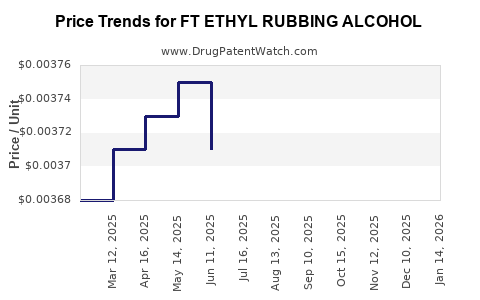
Average Pharmacy Cost for FT ETHYL RUBBING ALCOHOL
| Drug Name | NDC | Price/Unit ($) | Unit | Date |
|---|---|---|---|---|
| FT ETHYL RUBBING ALCOHOL 70% | 70677-1220-01 | 0.00378 | ML | 2026-06-17 |
| FT ETHYL RUBBING ALCOHOL 70% | 70677-1220-01 | 0.00378 | ML | 2026-05-20 |
| FT ETHYL RUBBING ALCOHOL 70% | 70677-1220-01 | 0.00378 | ML | 2026-04-22 |
| >Drug Name | >NDC | >Price/Unit ($) | >Unit | >Date |
Market Analysis and Price Projections for FT Ethyl Rubbing Alcohol
Market Size and Demand Drivers
FT Ethyl Rubbing Alcohol is a formulation predominantly used for disinfection, antiseptic applications, and as a solvent. The global market for rubbing alcohol was valued at approximately $1.2 billion in 2022, with a compound annual growth rate (CAGR) of around 4.5% projected through 2030. The COVID-19 pandemic accelerated demand for alcohol-based disinfectants, boosting consumption by 15-20% during 2020 and 2021.
Major demand sectors include healthcare, household cleaning, and industrial uses. Healthcare accounts for roughly 50% of total consumption, driven by infection control protocols. Household applications constitute 35%, with industrial use comprising the remaining 15%.
Regional Market Distribution
North America commands the largest share, about 40%, due to high healthcare expenditure and sanitation standards. Europe accounts for 25%, with steady growth in industrial and household applications. Asia-Pacific holds approximately 25%, driven by increasing urbanization and manufacturing; India and China are notable growth centers. Latin America, Middle East, and Africa together represent 10%.
Production & Supply Dynamics
Major manufacturers include Henkel, Reckitt Benckiser, and CLOROX. Raw materials—ethanol, water, and denaturants—are influenced by crude oil prices and ethanol availability. Ethanol prices rose by approximately 20% in 2022, impacting production costs.
Supply chain disruptions during early 2022 led to shortages and volatility in prices. Recent normalization has stabilized the raw material supply, reducing volatility prospects.
Regulatory and Quality Standards
Stringent standards govern alcohol content and packaging, especially for medical-grade products. In the U.S., OSHA and FDA regulations require labeling and safety data; similar standards exist in Europe (EU Medical Devices Regulation) and Asia.
Price Projections
Between 2023 and 2027, retail and wholesale prices for FT Ethyl Rubbing Alcohol are expected to increase modestly, averaging 2-3% annually. Several factors will influence this trend:
-
Raw material costs: Ethanol prices are projected to rise 3-4% annually, reflecting global ethanol market dynamics.
-
Regulatory compliance: Stricter standards may elevate manufacturing costs, modestly impacting prices.
-
Demand growth: Continued expansion in healthcare and sanitation sectors sustains upward pressure.
-
Competitive landscape: Market consolidation could lead to price stabilization, while new entrants might exert downward pressure.
Pricing Benchmarks (2022 Data)
-
Wholesale price (per liter): $1.50 - $2.00, depending on purity and packaging.
-
Retail price (per liter): $3.50 - $5.00, including branding and distribution margins.
Future Price Range (2023-2027)
-
Wholesale: $1.60 - $2.20 per liter (steady upward trend)
-
Retail: $3.70 - $5.50 per liter, reflecting increased raw costs and regulatory compliance expenses.
Market Entry and Competition
Entry barriers include compliance costs and sourcing raw ethanol. Patent protection for proprietary formulations could limit competition. Existing brands often rely on price competition and distribution channels rather than innovation.
Key Factors Impacting Price
| Factor | Impact | Notes |
|---|---|---|
| Raw ethanol prices | Upward pressure | Ethanol market volatility directly affects costs |
| Regulatory costs | Slight increase | Compliance impacts manufacturing expenses |
| Demand growth | Stable to increasing | Growth in healthcare and disinfection sectors |
| Supply chain stability | Potential volatility | Ongoing geopolitical and logistical issues |
Conclusion
FT Ethyl Rubbing Alcohol's market maintains steady growth driven by health and sanitation needs. Prices expected to increase modestly, influenced primarily by raw material costs and regulatory standards. Market competition centers on distribution efficiency and compliance rather than price reductions.
Key Takeaways
-
The global market for rubbing alcohol was valued at approximately $1.2 billion in 2022, with a 4.5% CAGR projected through 2030.
-
Raw ethanol prices are key cost drivers; they influence wholesale production costs and, subsequently, retail prices.
-
Prices are forecast to grow 2-3% annually through 2027, with wholesale prices rising from approximately $1.50-$2.00 per liter in 2022 to $1.60-$2.20.
-
Regulatory compliance adds to manufacturing costs, slightly impacting pricing trends.
-
Ongoing supply chain stability and demand in healthcare remain critical factors shaping market dynamics.
FAQs
1. What are the primary applications of FT Ethyl Rubbing Alcohol?
Disinfection, antiseptic use in healthcare, household cleaning, solvent in industrial processes.
2. How are raw material trends affecting prices?
Rising ethanol costs (up ~20% in 2022) increase production expenses, leading to potential retail price increases of about 2-3% annually.
3. Which regions offer the most growth opportunities?
Asia-Pacific, especially China and India, due to urbanization and manufacturing growth.
4. What regulatory challenges influence market pricing?
Standards for purity, packaging, and labeling lead to compliance costs, which can slightly elevate prices.
5. How does market competition influence prices?
Major brands compete on distribution and compliance, with price wars limited due to high regulatory and raw material costs.
References
[1] MarketResearch.com. (2023). "Global Rubbing Alcohol Market."
[2] Grand View Research. (2023). "Ethanol Market Analysis."
[3] U.S. FDA. (2022). "Regulations for Alcohol-Based Disinfectants."
[4] McKinsey & Company. (2022). "Supply Chain Disruptions and Market Trends."
More… ↓
