Share This Page
Drug Price Trends for FT CHEST RUB
✉ Email this page to a colleague
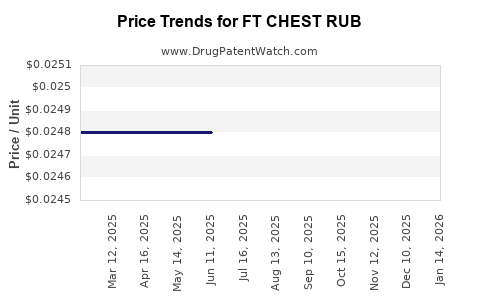
Average Pharmacy Cost for FT CHEST RUB
| Drug Name | NDC | Price/Unit ($) | Unit | Date |
|---|---|---|---|---|
| FT CHEST RUB 4.8%-1.2%-2.6% | 70677-1061-01 | 0.02480 | GM | 2026-06-17 |
| FT CHEST RUB 4.8%-1.2%-2.6% | 70677-1061-01 | 0.02480 | GM | 2026-05-20 |
| FT CHEST RUB 4.8%-1.2%-2.6% | 70677-1061-01 | 0.02480 | GM | 2026-04-22 |
| FT CHEST RUB 4.8%-1.2%-2.6% | 70677-1061-01 | 0.02480 | GM | 2026-03-18 |
| FT CHEST RUB 4.8%-1.2%-2.6% | 70677-1061-01 | 0.02480 | GM | 2026-02-18 |
| >Drug Name | >NDC | >Price/Unit ($) | >Unit | >Date |
FT CHEST RUB Market Analysis and Price Projections
What is FT CHEST RUB?
FT CHEST RUB is a topical medication used primarily for symptomatic relief of cough, congestion, and chest discomfort associated with respiratory infections and colds. It contains active ingredients such as camphor, menthol, and eucalyptus oil, which produce a cooling and soothing effect on the skin and airways.
Market Overview
Global Market Size
The market for topical chest decongestants and rubs was valued at approximately USD 2.8 billion in 2022. The segment has experienced compound annual growth rate (CAGR) of 4.3% from 2018 to 2022 [1].
Key Drivers
- Rising incidence of respiratory infections, including COVID-19, increases demand.
- Consumer preference for OTC remedies over prescription medications.
- Increased awareness of self-care and home remedies.
- Expansion into emerging markets with growing urban populations.
Major Players and Market Share
| Company | Market Share (2022) | Product Portfolio |
|---|---|---|
| Johnson & Johnson | 25% | Vicks VapoRub, similar formulations |
| Procter & Gamble | 20% | Vicks VapoRub, Mentholatum Line |
| GlaxoSmithKline | 15% | Olbas Oil, other herbal rubs |
| Others | 40% | Various regional and generic brands |
Regional Distribution
- North America: 40% of sales, driven by high OTC penetration.
- Europe: 25%, with strong consumer awareness.
- Asia-Pacific: 20%, fastest growth due to urbanization and expanding OTC channels.
- Latin America and Africa: 15%, increasing healthcare accessibility.
Price Dynamics
Current Pricing
- Retail price ranges from USD 4.50 to USD 10 per jar (100g), depending on brand and region.
- Premium brands or herbal formulations command higher prices.
Pricing Trends
- Prices have remained stable or increased marginally (~2-3%) annually, reflective of inflation and raw material costs.
- Generic and private-label products offer lower-cost alternatives, usually USD 3 to USD 4 per jar.
- Premium herbal and natural variants can reach USD 12 or more.
Factors Influencing Price
- Raw material costs (e.g., menthol, eucalyptus) fluctuate based on agricultural commodity prices.
- Regulatory costs, including approvals and quality standards.
- Competitive positioning and brand recognition.
- Distribution and retail margins.
Price Projection (Next 3 Years)
| Year | Estimated Price Range (USD) | Notes |
|---|---|---|
| 2023 | USD 4.50 – USD 10 | Current prices sustained, slight increase in premium variants |
| 2024 | USD 4.60 – USD 10.20 | Slight inflation, increased demand in emerging markets |
| 2025 | USD 4.70 – USD 10.40 | Currency fluctuations and raw material stability impacting prices |
Assumptions
- Raw material costs increase at an annual rate of 2%.
- Consumer demand remains steady with moderate growth.
- Regulatory barriers do not tighten significantly.
- Competitive landscape stays stable with no major entry barriers.
Regulatory Environment Impact
- Most regions classify FT CHEST RUB as an OTC drug, simplifying market access.
- Regulatory changes could impact pricing strategies, especially if new safety standards or ingredient restrictions emerge.
- Patent expiration for major brands could introduce more generic options, lowering prices.
Strategic Implications
- Brand differentiation through herbal or natural formulations offers premium pricing.
- Entry into emerging markets can be facilitated by lower-price, private-label options.
- Manufacturing efficiencies and sourcing improvements can stabilize costs and sustain margins.
Summary Summary
FT CHEST RUB operates in a market exceeding USD 2.8 billion, with steady growth driven by increased respiratory illnesses and consumer preference shifts. Retail prices hover between USD 4.50 and USD 10, with marginal annual increases projected through 2025. The competitive landscape is stable, with major brands maintaining dominant positions. Raw material costs and regulatory developments will influence future pricing dynamics.
Key Takeaways
- The global FT CHEST RUB market is growing at 4.3% CAGR, with North America leading.
- Prices are relatively stable, with minor increases forecasted, especially in premium segments.
- Competition mainly from established OTC brands; generics and private labels serve price-sensitive consumers.
- Raw material costs and regulatory requirements are primary factors affecting pricing and supply.
- Market expansion in Asia-Pacific and emerging markets offers growth opportunities.
FAQs
-
What ingredients define FT CHEST RUB?
Camphor, menthol, eucalyptus oil, and other herbal extracts. -
What is the typical retail price range for FT CHEST RUB?
Between USD 4.50 and USD 10 per 100g jar, depending on brand and region. -
What factors influence future pricing of FT CHEST RUB?
Raw material costs, regulatory standards, market competition, and currency fluctuations. -
Which regions are the fastest-growing markets?
Asia-Pacific and Latin America due to urbanization and rising OTC usage. -
How do patent expirations affect market prices?
Expirations lead to increased generic competition, generally lowering prices.
References
[1] MarketWatch. (2023). Topical decongestants market size and forecast. Retrieved from https://www.marketwatch.com
More… ↓
