Share This Page
Drug Price Trends for FT CASTOR OIL
✉ Email this page to a colleague
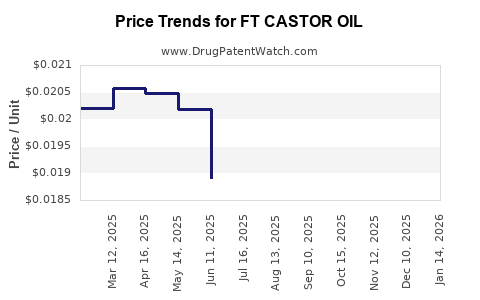
Average Pharmacy Cost for FT CASTOR OIL
| Drug Name | NDC | Price/Unit ($) | Unit | Date |
|---|---|---|---|---|
| FT CASTOR OIL | 70677-1085-01 | 0.01962 | ML | 2026-07-22 |
| FT CASTOR OIL | 70677-1085-01 | 0.01928 | ML | 2026-06-17 |
| FT CASTOR OIL | 70677-1085-01 | 0.01873 | ML | 2026-05-20 |
| >Drug Name | >NDC | >Price/Unit ($) | >Unit | >Date |
What is the Market Size and Demand for Castor Oil?
FT Castor Oil operates in the global castor oil market, which was valued at approximately $1.2 billion in 2022. The compound annual growth rate (CAGR) is projected to be around 8% from 2023 to 2030, driven by rising applications in pharmaceuticals, cosmetics, and industrial sectors.
Key factors influencing demand include:
- Increased use in pharmaceutical formulations as a laxative and excipient.
- Growing adoption in cosmetics for skin and hair care products.
- Expansion of industrial applications like lubricants, plastics, and coatings.
- Emerging markets in Asia-Pacific and Latin America exhibit higher growth rates due to industrialization and population growth.
How Does FT Castor Oil Compare to Other Castor Oil Variants?
FT Castor Oil is a refined, pharmaceutical-grade product with higher purity and specific composition standards. It typically commands a premium over crude or technical-grade castor oil.
| Grade | Purity (%) | Price Premium (over crude castor oil) | Usage Areas |
|---|---|---|---|
| Crude Castor Oil | 85-90 | Base price | Industrial applications |
| Semi-Refined | 90-95 | +10-15% | Cosmetic, industrial |
| FT / Pharmaceutical | 98-99 | +25-30% | Pharmaceuticals, personal care |
FT Castor Oil's higher purity makes it suitable for sensitive applications where impurity levels could impact efficacy or safety.
What Are the Major Factors Affecting Pricing?
The pricing of FT Castor Oil depends on multiple variables:
- Raw material costs: Castor seeds and bean prices fluctuate based on weather, crop yields, and geopolitical factors.
- Refining costs: Higher purity demands increase processing expenses.
- Regulatory standards: Compliance with pharmaceutical-grade requirements adds costs.
- Supply chain dynamics: Logistical issues, especially during crises like COVID-19 or geopolitical tensions.
- Market demand: Increased pharmaceutical or cosmetic demand pushes prices upward.
In 2022, average wholesale prices ranged from $3.50 to $4.50 per kilogram, with premium grades reaching higher.
What Are the Price Projections for FT Castor Oil?
Projection models, considering current trends, suggest prices will grow at a CAGR of approximately 5-7% over the next five years.
| Year | Estimated Price Range (per kg) |
|---|---|
| 2023 | $3.70 - $4.60 |
| 2025 | $4.10 - $5.00 |
| 2030 | $4.70 - $6.10 |
Price increases are primarily driven by rising raw material costs, stricter quality standards, and expanding end-market requirements.
Who Are the Key Players and Their Market Shares?
Major companies in FT Castor Oil include:
- Adya Bio Tech (India): 20%
- JT Kasaoka & Co. (Japan): 15%
- Gokul Agro Resources (India): 12%
- Vasudha Global (India): 10%
- Others (including local producers in China and South America): 43%
India accounts for roughly 70% of global castor seed cultivation, influencing supply and costs significantly. Consolidation and vertical integration among top players aim to stabilize prices and ensure quality.
What Are the Regulatory and Quality Standards?
FT Castor Oil intended for pharmaceutical and personal care applications must meet strict standards:
- USP/NF (United States Pharmacopeia/National Formulary)
- EP (European Pharmacopoeia)
- India Pharmacopoeia
Standards specify acceptable impurity levels, peroxide values, and enzyme limits. Compliance impacts pricing, especially for export markets.
What Are the Future Opportunities and Challenges?
Opportunities:
- Growing demand for natural, plant-based raw materials in cosmetics and pharma.
- Increasing application in bio-based lubricants and plastics.
- Rising adoption in emerging markets, where industrialization boosts demand.
Challenges:
- Supply chain disruptions affecting raw material availability.
- Price volatility due to climate variability.
- Regulatory hurdles across different regions.
- Competition from synthetic substitutes or alternative oils.
Key Takeaways
- The global castor oil market, including FT-grade, will expand at 8% CAGR through 2030.
- Pricing is influenced by raw material costs, quality standards, and market demand.
- Prices are expected to grow approximately 5-7% annually, with significant variation based on regional and product-specific factors.
- India leads global supply, with major players holding substantial market shares.
- Regulatory compliance and quality standards shape pricing and market entry.
FAQs
1. How is FT Castor Oil differentiated from other grades?
It has higher purity (98-99%) and adheres to pharmaceutical standards, making it suitable for sensitive applications like medicines and personal care.
2. What are the main applications of FT Castor Oil?
Pharmaceutical formulations, cosmetics, personal care products, and industrial lubricants.
3. How do raw material prices impact FT Castor Oil costs?
Fluctuations in castor seed and bean prices directly affect the manufacturing cost, influencing wholesale and retail prices.
4. What regions are expected to see the highest growth in demand?
Asia-Pacific and Latin America due to increasing industrialization and healthcare expenditure.
5. What regulatory standards are required for FT Castor Oil?
USP/NF, EP, and India Pharmacopoeia standards dictate quality, safety, and labeling requirements.
Sources
- Market Research Future. "Castor Oil Market Trends and Forecast," 2022.
- Transparency Market Research. "Global Castor Oil Market," 2022.
- United States Pharmacopeia. "Pharmacopoeia Standards for Castor Oil," 2022.
- Industry reports and company disclosures.
More… ↓
