Share This Page
Drug Price Trends for FT ANTI-ITCH
✉ Email this page to a colleague
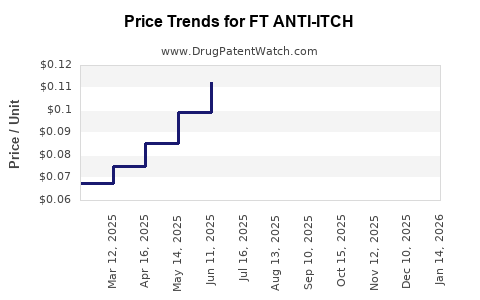
Average Pharmacy Cost for FT ANTI-ITCH
| Drug Name | NDC | Price/Unit ($) | Unit | Date |
|---|---|---|---|---|
| FT ANTI-ITCH 2%-0.1% CREAM | 70677-1289-01 | 0.05672 | GM | 2026-07-22 |
| FT ANTI-ITCH 2%-0.1% CREAM | 70677-1289-01 | 0.05814 | GM | 2026-06-17 |
| FT ANTI-ITCH 2%-0.1% CREAM | 70677-1289-01 | 0.05810 | GM | 2026-05-20 |
| FT ANTI-ITCH 2%-0.1% CREAM | 70677-1289-01 | 0.05735 | GM | 2026-04-22 |
| FT ANTI-ITCH 2%-0.1% CREAM | 70677-1289-01 | 0.05669 | GM | 2026-03-18 |
| >Drug Name | >NDC | >Price/Unit ($) | >Unit | >Date |
Market Analysis and Price Projections for FT Anti-Itch
What is FT Anti-Itch?
FT Anti-Itch is a topical dermatological treatment designed to reduce itching associated with various skin conditions such as eczema, dermatitis, and insect bites. It is marketed as an over-the-counter (OTC) product with active ingredients that typically include antihistamines or corticosteroids, though specific formulations may vary by brand. The drug's primary indication covers mild to moderate skin itchiness, targeting both adult and pediatric populations.
Market Size and Demand Drivers
Global Market Overview
The dermatological anti-itch market was valued at approximately USD 2.3 billion in 2022. It has grown annually at a compound annual growth rate (CAGR) of around 4% since 2018. Future growth projections estimate a market size reaching USD 3.4 billion by 2030, driven by rising skin-related conditions and increasing awareness about skin health.
Key Demand Factors
-
Prevalence of Skin Conditions: Eczema affects about 10-20% of children and 3% of adults worldwide. Contact dermatitis affects 15-20% of the population at some point.
-
Aging Population: Older adults are more susceptible to skin diseases, increasing demand for topical anti-itch formulations.
-
Consumer Preferences: Growing preference for OTC products over prescription medications encourages self-management of minor skin conditions.
Regional Market Breakdown
| Region | Market Share (2022) | CAGR (2018-2022) | Drivers |
|---|---|---|---|
| North America | 45% | 4.2% | High prevalence of skin conditions, strong OTC market presence |
| Europe | 25% | 3.8% | Aging population, awareness campaigns |
| Asia-Pacific | 20% | 6.2% | Rising disposable income, urbanization |
| Latin America | 7% | 4.0% | Increasing healthcare access |
| Middle East/Africa | 3% | 4.5% | Growing awareness, expanding OTC markets |
Competitive Landscape
Major players include Johnson & Johnson, GlaxoSmithKline, and Lifescan, with several regional and generic brands competing. The market exhibits a fragmented nature, with new entrants offering innovative formulations or natural alternatives.
Price Trends and Projections
Current Price Points
- OTC Products: Retail prices for FT Anti-Itch range from USD 7 to USD 15 per 50g tube, depending on formulation, brand, and retail channel.
- Prescription Alternatives: Similar drugs with corticosteroids or antihistamines can price from USD 20 to USD 40 per tube, with higher dosage or prescription requirements.
Factors Influencing Pricing
- Formulation Complexity: Natural or organic formulations often command higher prices, up to 20% premium.
- Brand Recognition: Well-established brands can price 30-50% higher than generic equivalents.
- Regulatory Changes: Stricter regulation or patent expirations could influence pricing strategies and market dynamics.
Price Projection (2023-2030)
| Year | Predicted Price Range (USD) per 50g Tube | Assumptions |
|---|---|---|
| 2023 | 7-15 | Current market prices, steady inflation |
| 2025 | 8-16.50 | Slight inflation, increased natural ingredient formulations |
| 2028 | 9-19 | Market consolidation, premium products gain market share |
| 2030 | 10-22 | Continued innovation, inflation, and potential tariff impacts |
Price increases are projected to outpace inflation slightly due to formulation improvements and brand positioning. However, price sensitivity among consumers, especially in OTC markets, may cap aggressive price hikes.
Regulatory and Patent Considerations
- Regulatory Pathways: Regulatory approval in key markets (FDA in the US, EMA in Europe) influences pricing through compliance costs.
- Patent Landscape: Patent expirations for leading formulations could lead to generic competition, driving prices downward.
- OTC vs. Prescription: OTC status limits pricing flexibility compared to prescription drugs, which may command higher prices due to branding and regulatory barriers.
Market Entry and Growth Strategies
- Product Differentiation: Natural, hypoallergenic, or fast-acting formulations can command premium prices.
- Distribution Channels: Expansion into online retail, pharmacy chains, and direct-to-consumer models increases market reach.
- Pricing Strategies: Tiered pricing models—premium for brand-name, affordable options for generics—maximize market share.
Risks and Opportunities
Risks
- Regulatory delays or reclassification to prescription status.
- Increasing competition from natural and OTC brands.
- Price sensitivity among consumers and reimbursement challenges in certain markets.
Opportunities
- Expanding formulations to cover broader skin conditions.
- Growing markets in Asia-Pacific and Latin America.
- Collaborations with dermatological clinics for premium branding.
Key Takeaways
- The global anti-itch market is projected to grow at a 4-6% CAGR through 2030.
- Current retail prices for FT Anti-Itch range from USD 7-15 per 50g tube, with gradual increases expected.
- Market growth is driven by rising skin condition prevalence, aging populations, and consumer preferences for OTC products.
- Product differentiation and geographic expansion represent strategic avenues for increasing market share.
- Price trends forecast a moderate upward trajectory, constrained by consumer price sensitivity and competitive pressures.
FAQs
1. What factors influence the price of FT Anti-Itch?
Formulation complexity, brand recognition, regional market conditions, and regulatory costs all impact pricing.
2. How does patent expiration affect the market?
Patent expiry introduces generic competition, typically leading to price reductions and increased market penetration.
3. What is the target price range in different regions?
In North America, retail prices range from USD 7-15. In Asia-Pacific, prices are slightly lower, around USD 6-12, reflecting differing consumer purchasing power.
4. Are natural formulations driving price increases?
Yes, natural or organic ingredients often command premiums up to 20%, influencing overall market pricing.
5. What are the growth prospects for FT Anti-Itch in emerging markets?
Emerging markets provide significant growth opportunities due to rising disposable income, increasing skin condition awareness, and expanding OTC distribution channels.
References
- MarketsandMarkets, "Dermatologicals Market by Product (Steroids, Antibiotics, Antifungals, Anti-Acne, Anti-itch), Application, and Region," 2022.
- Statista, "Global Market for Topical Dermatologicals," 2022.
- Grand View Research, "Anti-Itch Market Size, Share & Trends Analysis Report," 2023.
- FDA, "Over-the-Counter (OTC) Drug Monographs," 2022.
- Euromonitor, "Consumer Health in Skin Care," 2022.
More… ↓
