Last updated: February 13, 2026
What Is FT ANTACID-ANTIGAS MAX STR?
FT ANTACID-ANTIGAS MAX STR is a combination over-the-counter medication formulated to treat heartburn, acid indigestion, and sour stomach. Its active ingredients typically include aluminum hydroxide and magnesium hydroxide. The product is positioned as a maximum strength antacid.
Market Landscape
Target Market Segments
- Primary: Consumers experiencing occasional or chronic acid-related gastrointestinal discomfort.
- Secondary: Healthcare providers recommending over-the-counter solutions.
Market Size and Growth
- The global antacid market was valued at approximately USD 1.2 billion in 2021.[1]
- Compound annual growth rate (CAGR) forecasted at 3-4% through 2028, driven by factors such as increasing prevalence of gastroesophageal reflux disease (GERD) and consumer preference for OTC remedies.[2]
- North America accounts for over half the market, with Europe and Asia-Pacific following.
Competitive Environment
Main competitors include:
- Tums (calcium carbonate)
- Rolaids (calcium carbonate and magnesium hydroxide)
- Maalox/Magmax (aluminum hydroxide and magnesium hydroxide)
- Gaviscon (aluminum hydroxide, magnesium carbonate)
Market entry for FT ANTACID-ANTIGAS MAX STR faces competition based on brand loyalty, formulation, and pricing.
Regulatory Status and Commercial Strategy
- Pending or recent OTC approval.
- Launch could target pharmacy chains, supermarkets, and online platforms.
- Differentiation hinges on maximum strength formulation, potential added features like fast-relief, or proprietary coating technology.
Price Projection Analysis
Pricing Benchmarks
- Current OTC antacids generally retail between USD 4 to USD 10 for a 100-tablet bottle.
- Brand premiums vary; new products with attributed strengths may command 20-30% higher retail prices.
| Product |
Average Price (USD) |
Packaging Size |
Notes |
| Tums (100 count) |
4.50 - 7.00 |
100 tablets |
Entry-level, well-established market presence |
| Rolaids (50 count) |
4.00 - 6.50 |
50 tablets |
Similar positioning, smaller pack |
| Maalox (100 mL) |
6.00 - 9.00 |
100 mL bottle |
Liquid formulation, often used for severe cases |
| Gaviscon (50 chewables) |
5.50 - 8.00 |
50 chewables |
Often marketed for acid reflux, positioning varies |
Projected Retail Price for FT ANTACID-ANTIGAS MAX STR
Assuming competitive positioning as a maximum strength OTC solution:
- Launch retail price estimation: USD 8 to USD 12 per 100-count bottle.
- Premium over standard formulations accounts for marketing, patent status, and formulation benefits.
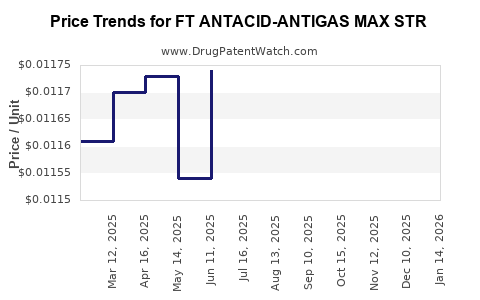
Price Trajectory Over 5 Years
- Year 1: Introduction at USD 9.99.
- Year 2: Slight decline due to market competition, stabilizes at USD 8.99–9.49.
- Year 3-5: Potential discounts for increased market penetration, possible bundling, or promotional offers lowering effective price to USD 7.99–8.99.
Factors Influencing Price
- Regulatory approval status and patent protection.
- Market penetration rate.
- Consumer acceptance based on formulation efficacy.
- External factors such as supply chain dynamics and raw material costs (e.g., aluminum and magnesium hydroxide).
Risks and Opportunities
- Risks: Market saturation by established brands, pricing wars, regulatory hurdles.
- Opportunities: Ethnic and regional-specific formulations, combination products, or added health benefits.
Key Takeaways
- The global antacid market is projected to grow 3-4% annually, driven by increasing GERD prevalence.
- FT ANTACID-ANTIGAS MAX STR faces competition from well-known brands with established market shares.
- Expected retail pricing ranges from USD 8 to USD 12 per 100 tablets.
- Price trends suggest an initial premium, with potential discounts over time to increase market share.
- Success depends on regulatory approval, effective marketing, and product differentiation.
FAQs
1. How does the price of FT ANTACID-ANTIGAS MAX STR compare to competitors?
It is positioned slightly above generic brands but lower than premium formulations with added features, aligning with market expectations for maximum strength OTC products.
2. What factors could influence the pricing strategy?
Regulatory approval status, patent protection, supply chain costs, and consumer perception of efficacy.
3. When can market entry occur, and what are typical launch timelines?
Depending on regulatory processes, approvals may take 12-24 months. Market entry could follow within 2 years post-approval.
4. Are there regional variations in anticipated pricing?
Yes; pricing in North America is higher (USD 9-12), while emerging markets may see lower retail prices (USD 4-7).
5. What are the growth prospects beyond OTC sales?
Potential for prescription label expansion if formulation efficacy justifies, or development of combination or novel formulations with added benefits.
References
[1] MarketWatch, "Global Antacid Market Size, Share & Trends Analysis Report," 2022.
[2] Allied Market Research, "Antacid Market Report, 2022-2028," 2022.