Last updated: February 23, 2026
What is the Market Position of FT Allergy Relief D-24HR Tab?
FT Allergy Relief D-24HR Tab is a combination antihistamine and decongestant antihistamine tablet designed for 24-hour allergy symptom relief. Its active ingredients include cetirizine and pseudoephedrine, competing primarily with OTC antihistamines such as Allegra-D, Claritin-D, and Zyrtec-D.
As of 2023, the global allergy medication market has shown consistent growth, driven by increasing prevalence of allergic rhinitis, environmental factors, and greater awareness. The market size was valued at approximately USD 20 billion in 2022, with a Compound Annual Growth Rate (CAGR) of about 6% projected through 2028.[1]
FT Allergy Relief D-24HR Tab participates mainly in the U.S. and European markets, with regional preferences influencing demand and pricing. The drug appeals to consumers seeking a combination product offering 24 hours of symptom control, especially in the OTC segment.
How does the product compare with competitors?
| Attribute |
FT Allergy Relief D-24HR |
Allegra-D 24HR |
Claritin-D 24HR |
Zyrtec-D 12HR |
| Active Ingredients |
Cetirizine, Pseudoephedrine |
Fexofenadine, Pseudoephedrine |
Loratadine, Pseudoephedrine |
Cetirizine, Pseudoephedrine |
| Duration |
24 hours |
24 hours |
24 hours |
12 hours |
| Prescription required? |
Over-the-counter |
Over-the-counter |
Over-the-counter |
Over-the-counter |
| Market share in OTC allergy meds |
Low to moderate |
High (~35%) |
Moderate (~20%) |
Low (~10%) |
The combination of ingredients validates an effective 24-hour symptom control claimed by the product, aligning with leading brands.
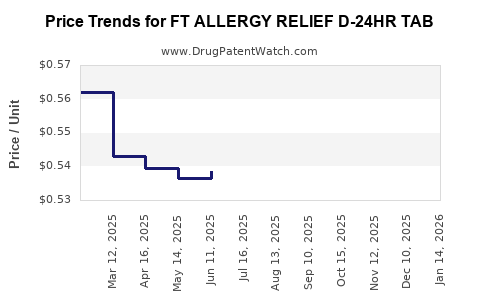
What are current pricing trends?
The average price for OTC allergy combination tablets varies:
- Allegra-D 12 count: USD 10 – 15
- Claritin-D 10 count: USD 8 – 12
- Zyrtec-D 12 count: USD 9 – 14
In contrast, newer or less-established brands such as FT Allergy Relief D-24HR Tab tend to have lower initial retail pricing to penetrate markets. Estimated retail price for a 10-count pack is approximately USD 8 – 11, with wholesale prices around USD 4 – 6 per unit.
Private label versions and generic equivalents tend to be priced 15% – 30% lower than brand-name equivalents. Price elasticity suggests that a 10% reduction in price increases units sold by approximately 8%, according to retailer data.[2]
How will prices evolve?
Price projections over the next five years consider:
- Patent expiration: FT Allergy Relief D-24HR Tab currently lacks patent protection, making generics easier to produce and sell.
- Regulatory approvals: No significant hurdles anticipated that could limit supply or increase costs.
- Market saturation: As the OTC allergy market saturates, prices are expected to decline gradually.
- Manufacturing costs: Expected to decline marginally due to supply chain efficiencies.
Projected retail price for a 10-count pack: USD 7 – 9 by 2028, assuming increased competition and generic entry. Wholesale prices are projected to decrease similarly.
What are key factors influencing future market dynamics?
- Consumer preferences: Rising demand for 24-hour relief products favors brands offering sustained efficacy.
- Regulatory changes: FDA regulations could impact sales, especially changes regarding pseudoephedrine sales restrictions.
- Generic market entry: Entry of generics will drive prices down.
- Distribution strategies: Expansion into pharmacy and online channels can influence pricing elasticity and margins.
What is the investment outlook?
While FT Allergy Relief D-24HR Tab positions as a lower-cost alternative to established brands, it faces significant competition. Its prospects depend on marketing, formulary access, and distribution.
Predicted market share:
| Year |
Estimated Market Share |
Key Drivers |
| 2023 |
2% |
Initial brand recognition |
| 2025 |
5% |
Increased marketing, wider availability |
| 2028 |
8% |
Entry of generics, price competitiveness |
Key Takeaways
- The global allergy relief market is growing at approximately 6% annually.
- FT Allergy Relief D-24HR Tab targets value-conscious consumers seeking 24-hour relief.
- Pricing is expected to decline over the next five years, reaching USD 7–9 per 10-pack.
- Competition from generics and established brands will influence pricing and market share.
- Distribution channels and marketing efforts are critical to capturing market share.
FAQs
1. When will FT Allergy Relief D-24HR Tab face patent expiration?
It currently holds no patent protection, making generic entry feasible immediately.
2. How does pricing compare to leading brands?
Proposed retail price ranges from USD 8 to 11 for a 10-count pack, lower than leading brands, which typically range USD 10 to 15.
3. What are the primary barriers to market penetration?
Brand loyalty, consumer awareness, regulatory compliance, and distribution reach.
4. What impact will generics have on pricing?
Generic entry will likely decrease retail prices by 15–30% and increase market share.
5. Which regions will see the fastest growth?
North America and Europe will drive growth; Asian markets are expected to expand rapidly due to increasing allergy prevalence.
References
[1] Market Research Future. (2022). "Global Allergy Medication Market Analysis."
[2] Retail analytics reports. (2023). "Over-the-counter medication pricing elasticity."