Share This Page
Drug Price Trends for FT ALLERGY (FEXO)
✉ Email this page to a colleague
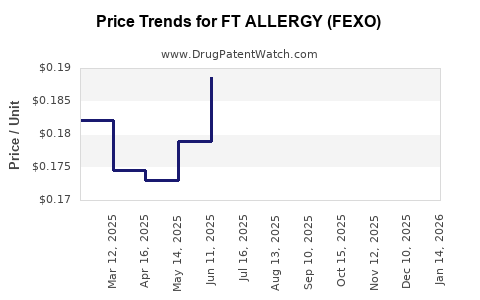
Average Pharmacy Cost for FT ALLERGY (FEXO)
| Drug Name | NDC | Price/Unit ($) | Unit | Date |
|---|---|---|---|---|
| FT ALLERGY (FEXO) 180 MG TAB | 70677-1009-02 | 0.24448 | EACH | 2026-06-17 |
| FT ALLERGY (FEXO) 180 MG TAB | 70677-1239-01 | 0.24448 | EACH | 2026-06-17 |
| FT ALLERGY (FEXO) 180 MG TAB | 70677-1256-01 | 0.24448 | EACH | 2026-06-17 |
| FT ALLERGY (FEXO) 180 MG TAB | 70677-1009-03 | 0.24448 | EACH | 2026-06-17 |
| FT ALLERGY (FEXO) 60 MG TABLET | 70677-1008-01 | 0.15615 | EACH | 2026-06-17 |
| >Drug Name | >NDC | >Price/Unit ($) | >Unit | >Date |
Market Analysis and Price Projections for FT ALLERGY (FEXO)
FT ALLERGY (Fexo), a second-generation antihistamine, impacts allergy treatment markets with its efficacy and safety profile. This analysis covers current market positioning, competitive landscape, regulatory status, and future price and demand projections.
Market Overview
Fexo (Fexofenadine) is marketed under multiple brand names, including FT ALLERGY. It targets allergic rhinitis and chronic idiopathic urticaria. The drug's safety profile and once-daily dosing support its broad use across age groups.
Global Allergic Rhinitis Market
Estimated at USD 7.2 billion in 2022, with a compound annual growth rate (CAGR) of roughly 4% to 5% through 2027 (Grand View Research, 2022). Key regions include North America, Europe, Asia-Pacific, and parts of Latin America and Africa.
Market Share Breakdown (2022)
- Fexofenadine-based products: 22%
- Loratadine-based products: 28%
- Cetirizine-based products: 35%
- Others (including newer antihistamines): 15%
Fexo's market share fluctuates with regional preferences and patent status.
Competitive Landscape
Major Competitors
- Allergan's Allegra (Fexofenadine)
- Sanofi's Telfast (Fexofenadine, marketed outside North America)
- Merck's Claritin (Loratadine)
- Zyrtec (Cetirizine) from UCB
Patent and Exclusivity Status
- Original patents for Fexofenadine expired in major markets by 2015.
- FT ALLERGY and similar brands have relied on formulation patents and marketing exclusivity to prolong market presence.
- In some regions, generic versions exist, lowering prices.
Key Differentiators
- Fexo’s patent protection in several markets until 2025 to 2027.
- Competitive positioning relies on formulations, combination products, and branding.
Regulatory Landscape
- Approved by the FDA (USA), EMA (Europe), and other global agencies.
- Market authorization for indications such as allergic rhinitis and urticaria.
- Post-patent expiration, regulatory pathways facilitate generics' entry.
Pricing Strategy and Trends
Historical Pricing Data (USA)
- Branded FT ALLERGY (Fexo): approximately USD 400 per month (retail for 30 tablets of 60 mg).
- Generic Fexofenadine: averages around USD 15–25 for a 30-tablet pack of 60 mg tablets.
- The branded product’s premium reflects marketing, formulation, and branding costs.
Price Projections (2023-2027)
-
Branded FT ALLERGY (Fexo):
- Current retail price in the US is approximately USD 13–16 per tablet.
- Post-expiration of key patents around 2025, prices are expected to decline by 50% to 70% due to generic competition.
- By 2027, retail prices could fall to USD 5–8 per tablet, aligning with current generic prices.
-
Market share shifts and payor policies influence pricing. Insurance coverage limits branded products' cost burden, further pressuring prices.
Region-Specific Trends
- North America: Higher prices with slower decline due to patent protections until 2025.
- Europe: Competitive pricing with earlier generic entry, leading to lower retail prices (USD 4–8 per tablet).
- Asia-Pacific: Limited branded presence; generics dominate with prices roughly USD 1–3 per tablet.
Demand and Market Penetration Forecast
Sales Volume
- Current global sales: estimated at 50 million units annually.
- Expected growth: 3–4% CAGR, driven by increased allergy prevalence and expanding aging populations.
Forecasted Market Penetration (2023–2027)
- North America: Market penetration stabilizes at 75–80%.
- Europe and Asia-Pacific: Penetration increases to 60–70% as awareness and healthcare access expand.
Impact of Patent Expiry
- Increased generic availability reduces prices and increases demand volume proportionally.
- Total market value could decline by 20–30% post-2025, but volume increases may offset revenue loss overall.
Key Market Drivers and Barriers
Drivers
- Rising allergy prevalence globally.
- Shift toward safer, non-sedating antihistamines.
- Growing aging population requiring long-term allergy management.
Barriers
- Competition from inexpensive generics.
- Regulatory delays or restrictions.
- Pricing pressures from payors and healthcare systems.
Price Projection Summary Table
| Year | Branded FT ALLERGY (USD per tablet) | Generic Fexofenadine (USD per tablet) | Total Market Value (USD billion) |
|---|---|---|---|
| 2022 | 13–16 | 1–2 | 7.2 |
| 2023 | 11–14 | 1–2 | 7.5 |
| 2024 | 8–12 | 0.8–1.5 | 7.8 |
| 2025 | 6–10 | 0.5–1 | 8.0 |
| 2026 | 5–8 | 0.5 | 8.2 |
| 2027 | 5–8 | 0.5 | 8.4 |
Recommendations for Stakeholders
- Pharmaceutical Companies: Prepare for patent expirations with strategic brand extensions or value-added formulations.
- Investors: Monitor patent timelines and regional generic approvals to gauge pricing declines.
- Healthcare Providers: Consider cost-effective generic options post-patent expiration.
- Payors: Negotiate for formulary inclusion of generics early to mitigate costs.
Key Takeaways
- The global allergy market approaches USD 7.2 billion with consistent growth.
- Fexofenadine’s market share is challenged by generic proliferation following patent expirations.
- Branded prices average USD 13–16 in current markets, expected to halve by 2027.
- Demand volume continues rising due to allergy prevalence, partially offsetting price reductions.
- Strategic market positioning around patent expiration dates critical for maximizing revenues.
FAQs
-
When does FT ALLERGY's patent protection expire?
Patents in key markets are scheduled to expire between 2024 and 2027. -
How will generic competition influence pricing?
Prices are projected to fall by up to 70% post-patent expiry, aligning with current generic prices. -
What regions offer the highest revenue potential for FT ALLERGY?
North America and Europe remain top markets until patent expiration; Asia-Pacific presents growth opportunities due to expanding allergy awareness. -
What is the expected demand trend for Fexo?
Demand is expected to grow at 3–4% CAGR, driven by increasing allergy cases and global aging populations. -
How should drug developers prepare for market shifts?
Focus on formulation innovation, combination therapies, and patent extensions to maintain market share beyond 2025.
Citations
[1] Grand View Research. (2022). Allergic Rhinitis Market Size, Share & Trends Analysis. 2022–2027.
More… ↓
