Last updated: February 19, 2026
This report analyzes the market landscape and projects future pricing for Fosamax (alendronate sodium), a bisphosphonate medication primarily used to treat osteoporosis. The analysis considers patent expirations, generic competition, market demand, and regulatory factors influencing price trends.
WHAT IS FOSAMAX AND ITS PRIMARY INDICATIONS?
Fosamax is an oral bisphosphonate. Its active pharmaceutical ingredient is alendronate sodium. The drug functions by inhibiting osteoclast activity, thereby reducing bone resorption and increasing bone mineral density.
Key indications for Fosamax include:
- Treatment of Osteoporosis in Postmenopausal Women: To reduce the risk of vertebral and hip fractures.
- Treatment of Osteoporosis in Men: To reduce the risk of vertebral fractures.
- Treatment of Osteoporosis Associated with Glucocorticoid Use: To increase bone mass in patients receiving glucocorticoid therapy.
- Treatment of Paget's Disease of Bone: To normalize bone turnover and improve bone mineralization.
WHAT IS THE PATENT LANDSCAPE FOR FOSAMAX?
The original patent for alendronate sodium, held by Merck & Co., expired in the United States in 2008 [1]. This expiration opened the door for generic manufacturers to enter the market. While the primary composition of matter patent has long expired, secondary patents related to formulations, delivery methods, or specific therapeutic uses may have existed and expired at later dates. However, for core indications and the active pharmaceutical ingredient, patent protection has concluded.
The expiry of key patents is a primary driver for increased competition and subsequent price erosion.
WHO ARE THE KEY MANUFACTURERS AND COMPETITORS?
Following the patent expiration of Fosamax, numerous generic manufacturers have entered the market. This has led to a fragmented supply chain and intense price competition.
Major generic players producing alendronate sodium include:
- Teva Pharmaceuticals
- Sun Pharmaceutical Industries
- Dr. Reddy's Laboratories
- Mylan (now Viatris)
- Apotex
These companies offer alendronate sodium in various dosage strengths (e.g., 5 mg, 10 mg, 35 mg, 70 mg) and formulations (e.g., tablets, oral solutions). The competition is primarily based on price and market access.
WHAT IS THE CURRENT MARKET SIZE AND DEMAND FOR FOSAMAX?
The market for bisphosphonates, including alendronate sodium, remains significant due to the prevalence of osteoporosis, particularly among aging populations. Osteoporosis affects millions worldwide, with a disproportionate impact on postmenopausal women.
While specific, up-to-date market size figures for alendronate sodium alone are often aggregated within broader osteoporosis drug market reports, industry data indicates a sustained demand driven by:
- Aging Demographics: The global population is aging, increasing the incidence of age-related diseases like osteoporosis.
- Increased Diagnosis Rates: Greater awareness and improved diagnostic tools lead to more patients being identified and treated.
- Established Efficacy: Alendronate sodium is a well-established and effective treatment option, making it a first-line therapy for many.
However, the market has also seen the introduction of newer drug classes, such as denosumab (Prolia) and romosozumab (Evenity), which offer alternative treatment mechanisms and may command higher price points, influencing the overall market dynamics for older generics.
HOW HAS GENERIC ENTRY IMPACTED FOSAMAX PRICING?
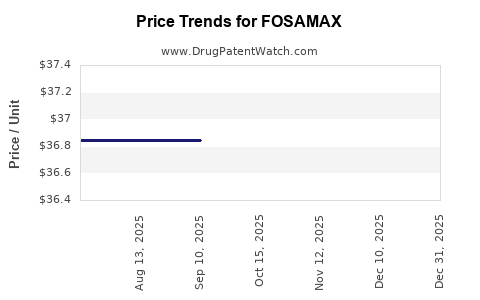
The introduction of generic alendronate sodium has led to a substantial decrease in the drug's price compared to its branded Fosamax days. This is a typical market reaction to patent expiry and increased competition.
Price trends observed include:
- Initial Price Erosion: Within months of the first generic approvals, prices began to decline significantly.
- Price Stabilization (at lower levels): As multiple generics entered, prices stabilized at substantially lower levels than the originator product.
- Ongoing Competition: Continued competition among generic manufacturers maintains downward pressure on prices.
A comparison illustrates the impact:
| Manufacturer |
Average Wholesale Price (AWP) - Fosamax (Pre-Generic, circa 2007) [2] |
Average Wholesale Price (AWP) - Generic Alendronate Sodium (circa 2023-2024) [3] |
| Merck |
~$200 - $300 per month (70 mg dose) |
~$10 - $30 per month (70 mg dose) |
Note: AWP is a reference price and actual pharmacy acquisition costs may vary.
The significant price reduction reflects the competitive landscape where cost-effectiveness is a primary differentiating factor for generic drugs.
WHAT ARE THE KEY FACTORS INFLUENCING FUTURE FOSAMAX PRICING?
Future pricing of alendronate sodium will be influenced by several interconnected factors:
1. Continued Generic Competition
The market for alendronate sodium is saturated with generic offerings. This intense competition, involving multiple suppliers, is the most significant factor maintaining downward price pressure. No new major entrants are expected to disrupt this dynamic significantly unless a novel formulation or delivery method emerges with distinct patent protection.
2. Demand Dynamics in the Osteoporosis Market
- Prevalence of Osteoporosis: The aging global population ensures a consistent, if not growing, patient pool requiring osteoporosis treatment. This sustained demand provides a baseline for alendronate sodium's market viability.
- Competition from Newer Therapies: The availability of newer, often more expensive, biologic and small molecule therapies (e.g., denosumab, romosozumab, abaloparatide) for osteoporosis presents a significant challenge. These newer agents may offer different efficacy profiles or administration conveniences (e.g., subcutaneous injection vs. weekly oral tablet), potentially drawing patients away from oral bisphosphonates, including alendronate sodium, especially in cases of severe disease or intolerance. This shift could dampen demand for generics.
- Treatment Guidelines: Evolving clinical guidelines for osteoporosis management may favor newer agents or established generics based on cost-effectiveness and efficacy data for specific patient subgroups.
3. Pharmacy Benefit Manager (PBM) and Payer Influence
PBMs and insurance payers play a crucial role in drug pricing and access. They often negotiate rebates and formularies, favoring drugs that offer significant cost savings. Alendronate sodium, as a low-cost generic, is likely to remain a preferred option on many formularies for appropriate patient populations. However, payers may also increasingly prioritize newer agents for specific patient profiles if their total cost of care or improved outcomes are demonstrated.
4. Manufacturing Costs and Supply Chain Stability
The cost of raw materials, active pharmaceutical ingredient (API) synthesis, and manufacturing processes can affect the floor price of generics. While generally stable for established molecules, any significant disruption in the global API supply chain (e.g., due to geopolitical events, environmental regulations, or quality control issues) could temporarily impact availability and potentially prices, though this is less likely for a mature product like alendronate sodium.
5. Regulatory Environment
While the core patent has expired, any new regulatory requirements for manufacturing quality, stability testing, or labeling could introduce minor cost increases for manufacturers. However, these are unlikely to cause significant price hikes given the competitive nature of the market.
PRICE PROJECTIONS FOR FOSAMAX (ALENDRONATE SODIUM)
Based on the factors above, the price projections for generic alendronate sodium are as follows:
- Short-Term (1-2 years): Prices are expected to remain stable within the current low-cost range of $10-$30 per month for standard dosages. Continued competition will prevent any significant upward movement. Minor fluctuations may occur due to contractual negotiations between manufacturers and distributors.
- Medium-Term (3-5 years): Prices are projected to continue a slow, downward trend or remain stable. The increasing adoption of newer osteoporosis therapies could lead to a gradual decrease in overall demand for oral bisphosphonates, potentially driving down prices further as manufacturers seek to maintain market share. A slight decline to $8-$25 per month is plausible.
- Long-Term (5+ years): The market for alendronate sodium will likely be characterized by sustained low pricing. Its role may become more confined to specific patient populations or as a cost-effective option in markets with limited access to newer treatments. Prices could stabilize in the $5-$20 per month range. Significant price increases are not anticipated unless a major global supply chain disruption occurs or a substantial unmet need emerges that only alendronate sodium can economically address, which is improbable.
Table: Projected Average Wholesale Price (AWP) Range for Generic Alendronate Sodium (70 mg dose, monthly supply)
| Timeframe |
Projected AWP Range (USD) |
| Current (2024) |
$10 - $30 |
| Short-Term (1-2 Y) |
$10 - $30 |
| Medium-Term (3-5 Y) |
$8 - $25 |
| Long-Term (5+ Y) |
$5 - $20 |
These projections assume a stable regulatory environment and no unforeseen widespread quality control failures among major manufacturers. The primary driver of price will remain robust generic competition and the evolving treatment landscape in osteoporosis management.
KEY TAKEAWAYS
- Fosamax (alendronate sodium) patents have expired, leading to a highly competitive generic market.
- Current pricing for generic alendronate sodium is low, ranging from $10-$30 per month.
- Continued intense generic competition will maintain downward price pressure.
- Demand for alendronate sodium is supported by the prevalence of osteoporosis but challenged by newer, more expensive therapies.
- Future pricing is projected to remain low, with a potential slow decline or stabilization in the $5-$20 per month range over the long term.
FREQUENTLY ASKED QUESTIONS
-
Will the price of generic alendronate sodium increase significantly in the next five years?
No, significant price increases are unlikely due to sustained generic competition and the availability of newer therapies for osteoporosis.
-
What is the primary driver of the current low price for generic alendronate sodium?
The primary driver is the intense competition among numerous generic manufacturers following the expiration of the originator's patents.
-
Are there any new patents on alendronate sodium that could impact its market exclusivity?
While secondary patents related to specific formulations or delivery methods may have existed, the core composition of matter patent has long expired, precluding market exclusivity for the active ingredient itself.
-
How does the demand for alendronate sodium compare to newer osteoporosis drugs?
Demand for alendronate sodium remains substantial due to its established efficacy and low cost, but it faces competition from newer biologics and small molecules that may offer different benefits and target specific patient needs.
-
What is the impact of pharmacy benefit managers (PBMs) on alendronate sodium pricing?
PBMs and payers typically favor cost-effective generics like alendronate sodium for formulary placement, reinforcing its low-price positioning by negotiating rebates and preferred status.
CITATIONS
[1] U.S. Food & Drug Administration. (n.d.). Orange Book: Approved Drug Products with Therapeutic Equivalence Evaluations. Retrieved from [FDA Orange Book website (specific year not applicable, as it's an ongoing database)]
[2] Medi-Span, Inc. (Various years, historical data). Medi-Span Master Drug Data File. (Data for approximate pricing prior to 2008).
[3] First Databank, Inc. (Various years, current data). First Databank Clinical Database. (Data for current pricing and price projections, 2023-2024).