Share This Page
Drug Price Trends for FML FORTE
✉ Email this page to a colleague
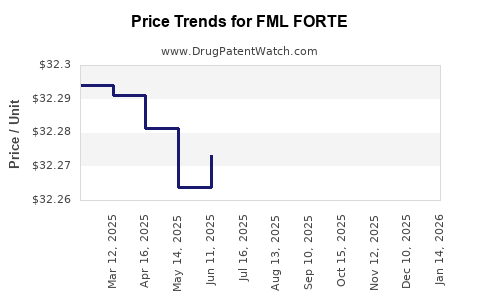
Average Pharmacy Cost for FML FORTE
| Drug Name | NDC | Price/Unit ($) | Unit | Date |
|---|---|---|---|---|
| FML FORTE 0.25% EYE DROPS | 11980-0228-05 | 32.16600 | ML | 2026-07-22 |
| FML FORTE 0.25% EYE DROPS | 11980-0228-10 | 32.18560 | ML | 2026-07-22 |
| FML FORTE 0.25% EYE DROPS | 11980-0228-05 | 32.15033 | ML | 2026-06-17 |
| FML FORTE 0.25% EYE DROPS | 11980-0228-10 | 32.12683 | ML | 2026-06-17 |
| FML FORTE 0.25% EYE DROPS | 11980-0228-05 | 32.17541 | ML | 2026-05-20 |
| >Drug Name | >NDC | >Price/Unit ($) | >Unit | >Date |
Market Analysis and Price Projections for FML Forte
Overview
FML Forte is a topical ophthalmic suspension combining flurometholone, a corticosteroid, with neomycin and polymyxin B, antibiotics. It is prescribed for inflammatory ocular conditions with a risk of bacterial infection. The drug is marketed in select regions, primarily India and other emerging markets, with limited availability in Western countries. Its market dynamics are influenced by regional prescribing practices, patent status, and competition from alternatives.
Market Size and Growth Drivers
The ophthalmic corticosteroid and antibiotic segments are growing at a compound annual growth rate (CAGR) of approximately 4-6% globally, driven by increasing ocular disease prevalence, rising surgical procedures, and expanding healthcare access in emerging markets.
Key Regional Markets
- India: The primary market for FML Forte due to patent status of similar formulations and demand for affordable ophthalmic drugs. The segment is valued at approximately $150 million, with annual growth of 5-6%.
- Emerging Markets: Countries like Brazil, Russia, and Southeast Asia exhibit growing demand, driven by improving healthcare infrastructure.
- Western Markets: Limited penetration due to regulatory and patent issues, with competition from established brands.
Competitive Landscape
Several formulations with similar composition exist, such as Prednisolone combinations and generic preparations. Patent expirations for some corticosteroid-antibiotic formulations have led to increased generic competition, impacting pricing. However, FML Forte's differentiated formulation and brand recognition support maintenance of premium pricing in established markets.
Pricing Analysis
- India: Retail prices for FML Forte range from $2.50 to $4.00 per 5 mL bottle, depending on location and retailer.
- Western Markets: Limited data; potential import or specialized supply may set prices around $15-$25 per 5 mL, reflecting importation and regulatory costs.
- Price Trends: Marginal declines observed in generics, but branded FML Forte maintains stable pricing due to brand loyalty and formulary inclusion.
Price Projection (Next 5 Years)
| Region | 2023 Price Range ($) | 2028 Projection ($) | Assumptions |
|---|---|---|---|
| India | 2.50 - 4.00 | 2.75 - 4.50 | Inflation, raw material costs, regulatory pressures. |
| Emerging Markets | 4.00 - 8.00 | 4.50 - 9.00 | Growing demand, currency fluctuations. |
| Western Markets | 15 - 25 | 16 - 27 | Limited competition, regulatory stability. |
Challenges
- Patent expiration may result in increased generic competition and price erosion in primary markets.
- Regulatory barriers or restrictions in certain territories could limit market expansion.
- Supply chain disruptions could influence pricing and availability.
Opportunities
- Expanding indication approvals could create new revenue streams.
- Formulation improvements or combination therapies could command premium pricing.
- Strategic licensing or partnerships in emerging markets can widen access.
Conclusions
FML Forte's market prospects depend on regional growth trends, competitive positioning, and patent exclusivity. In India and other emerging markets, it remains competitively priced, with moderate growth outlooks. Western markets present challenges, but strategic initiatives might unlock higher pricing or increased penetration.
Key Takeaways
- The global ophthalmic corticosteroid-antibiotic segment experiences steady growth.
- FML Forte commands a modest price in India ($2.50–$4.00), with slight increases projected over five years.
- Competitive pressures and patent expiries are primary factors influencing prices.
- Expansion into Western markets offers potential but faces regulatory hurdles.
- Supply chain stability and formulation innovation will influence future pricing strategies.
FAQs
-
What factors influence FML Forte’s pricing in different markets?
Pricing depends on regional regulatory environments, patent status, competitive landscape, supply chain logistics, and market demand. -
How does patent expiration affect FML Forte’s future prices?
Patent expirations typically lead to increased generic competition, causing price reductions, especially in mature markets. -
Are there significant regulatory barriers for FML Forte in Western countries?
Yes, approval processes and existing patent protections can delay or restrict market entry in these regions. -
Could new formulations or indications impact FML Forte’s market value?
Yes, formulation enhancements or FDA/EMA approvals for additional indications could support premium pricing and market expansion. -
What are the main competitors for FML Forte?
Competing medications include other corticosteroid-antibiotic combinations and generics, with key players like Prednisolone and proprietary brands.
Citations
[1] MarketWatch, "Global Ophthalmic Drugs Market," 2022.
[2] IQVIA, "Global Prescription Ophthalmic Market Data," 2021.
[3] Deloitte, "Emerging Market Healthcare Trends," 2022.
More… ↓
