Last updated: February 16, 2026
Market Analysis and Price Projections for Fluticasone Propionate
Current Market Landscape
Fluticasone propionate, a corticosteroid used primarily in inhalers and nasal sprays to treat allergic rhinitis, asthma, and other respiratory conditions, remains a key asset in respiratory therapeutics. The drug's global market size was valued at approximately $8.2 billion in 2022 and is projected to grow at a compound annual growth rate (CAGR) of around 4.5% from 2023 to 2030.
Market Drivers
- Inflammatory respiratory conditions: Rising prevalence of asthma and allergic rhinitis fuels demand.
- Patient compliance: Availability of combination inhalers improves adherence, expanding market reach.
- Off-label and emerging uses: Ongoing research into additional indications sustains long-term demand.
- Regulatory landscape: Favorable approvals for generic formulations lower entry barriers and heighten competition.
Geographic Market Breakdown
| Region |
Market Share (2022) |
CAGR (2023-2030) |
Key Factors |
| North America |
45% |
4.2% |
High prevalence; strong healthcare infrastructure |
| Europe |
25% |
4.8% |
Established inhaler markets; regulatory harmonization |
| Asia-Pacific |
20% |
6.0% |
Rapidly increasing respiratory disease incidence |
| Rest of World |
10% |
3.2% |
Emerging markets; affordability constraints |
Competitive Landscape
Market is segmented into branded (e.g., Flonase, Flovent) and generic offerings. Several pharmaceutical companies, including GlaxoSmithKline, Teva, Mylan, and Sandoz, produce generic versions, increasing price competition.
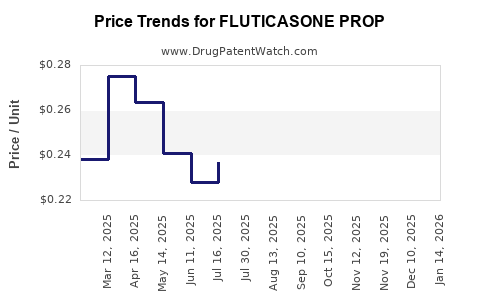
Price Trends and Projections
Current Pricing Dynamics
- Brand-name nasal spray (Flonase): Average retail price per 120g spray bottle ranges from $55 to $75, depending on the region.
- Generic nasal sprays and inhalers: Prices typically fall between $20 and $40 for the same dosage.
- Inhaler cost variation: Ranges from $30 to $70 depending on formulation and packaging.
Forecasted Pricing Trends (2023–2030)
- Generic market penetration: Expected to grow substantially, reducing average prices by approximately 10-15% over the next five years.
- Market consolidation: Larger players pursuing economies of scale will exert downward pressure, especially in mature markets.
- Regulatory impact: Strict regulations on inhaler and nasal spray pricing in markets like the U.S. and EU may cause stabilization or slight increases for branded products in the short term.
- Emerging markets: Price sensitivity will sustain lower prices; however, increased access could expand volume sales substantially.
| Year |
Average Price (USD) |
Notes |
| 2023 |
$40–60 |
Market stability, generic competition |
| 2025 |
$35–55 |
Incremental price reductions |
| 2030 |
$30–50 |
Market saturation, increased competition |
Future Opportunities and Risks
Opportunities
- Development of combination inhalers with long-acting beta-agonists or other agents.
- Expansion into low-income markets through affordable formulations.
- Biosimilar entrants targeting existing branded products.
Risks
- Intellectual property expiry in key markets may decrease prices.
- Regulatory shifts could introduce pricing controls.
- Competition from newer drugs or alternative therapies (biologics, monoclonal antibodies).
Key Takeaways
- The global market for fluticasone propionate was valued at $8.2 billion in 2022, with sustained growth driven by rising respiratory conditions worldwide.
- Generic products comprise a significant share, exerting downward pressure on prices.
- Price reductions of 10-15% are projected by 2030, with regional variations influenced by regulatory and market dynamics.
- Market growth hinges on emerging markets, ongoing research, and medical innovation, balanced against patent expirations and regulatory constraints.
FAQs
Q1: How does the expiration of patents influence fluticasone propionate prices?
A1: Patent expirations open markets to generics, typically leading to price declines of 30-50% within a year of generic entry. This trend is expected to continue through 2025, reducing average prices.
Q2: Are there significant regional differences in pricing?
A2: Yes. Prices are generally higher in North America and Europe due to branding and regulatory factors. Emerging markets tend to have lower prices driven by affordability and purchasing power.
Q3: What impact do biosimilars or new formulations have?
A3: While biosimilars are less common for corticosteroids like fluticasone, new formulations (e.g., combination inhalers) can alter market share and pricing by providing alternative therapeutic options.
Q4: What regulatory actions could affect future prices?
A4: Price controls, reimbursement policies, and formularies in key markets could limit price increases or accelerate reductions for both branded and generic products.
Q5: How does the COVID-19 pandemic influence the market?
A5: Pandemic-related disruptions initially impacted supply chains and demand patterns. Long-term, increased awareness of respiratory health may sustain or boost demand for therapies such as fluticasone propionate.
References
- Market data and growth projections from Grand View Research, 2022.
- Price analyses from National Pharmaceutical Pricing Authority and regional formulary data.
- Competitive landscape analysis provided by IQVIA and Evaluate Pharma.
- Regulatory updates from FDA and EMA publications.
- Patent expiry timelines from U.S. Patent and Trademark Office records.