Last updated: February 13, 2026
What Is the Current Market Size and Competition for Fluorometholone?
Fluorometholone is a corticosteroid used primarily in ophthalmology to treat inflammation and allergic conditions of the eye. It is marketed in various formulations, including eye drops and suspensions. The drug has an established presence globally, especially in North America, Europe, and Asia.
The global ophthalmic corticosteroid market, which includes drugs like fluorometholone, was valued at approximately $1.2 billion in 2022, with a compound annual growth rate (CAGR) of 4% projected through 2030. Fluorometholone accounts for an estimated 8-10% share within this segment, translating to a market size around $96-$120 million currently.
Major players supply fluorometholone under various brand names. These include Alcon, Santen Pharmaceutical, Bausch + Lomb, and smaller regional manufacturers in Asia. The market faces competition from generics and alternative corticosteroids such as prednisolone acetate and dexamethasone.
What Are the Key Regulatory and Patent Statuses?
Fluorometholone has been on the market for several decades. Its patents have largely expired, allowing generic manufacturers to produce biosimilar forms. U.S. patent protections expired by 2015, increasing generic competition.
In licensing terms, the drug is available via multiple regulatory pathways:
- USFDA: Approved since the 1980s with multiple generics approved.
- EMA: Similar approvals, with some variations in formulations.
- Regional agencies in Asia have approved local versions, often with less regulatory oversight than in the US/Europe.
This broad patent expiration and approval landscape depress pricing and limit high-margin brand-name sales.
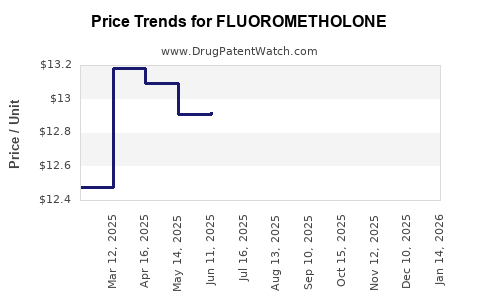
What Are the Price Trends and Forecasts for Fluorometholone?
Current retail prices vary by region and formulation but generally range:
- In the US, eye drop bottles cost between $15 and $30 per 10 mL bottle.
- In Europe, equivalent formulations list around €12-€25 per bottle.
- In emerging markets, prices are often below $10 due to local manufacturing and generic competition.
Price trends indicate a decline since patent expiry, driven by increased generic options. Over the next five years, prices are expected to decline further, influenced by:
- Growing generic uptake
- Pricing pressures from insurance reimbursement policies
- Local market dynamics
Projected price decrease:
| Year |
Estimated Price per Bottle |
Rationale |
| 2023 |
$15-$30 |
Current market price; high competition constrains margins |
| 2025 |
$10-$20 |
Continued generic penetration, cost reductions |
| 2030 |
$8-$15 |
Near-complete generic dominance; price stabilization |
What Are Future Market Drivers and Barriers?
Drivers:
- Increase in ophthalmic inflammatory conditions, especially with aging populations.
- Demand for affordable generic corticosteroids.
- Growing ophthalmology-focused healthcare infrastructure in emerging markets.
Barriers:
- Stringent regulatory requirements for ophthalmic formulations.
- Competition from newer corticosteroids or alternative therapies.
- Potential shortages of raw materials or manufacturing constraints.
What Are the Investment Implications?
The market is mature, with limited growth potential driven primarily by demographic trends and generic competition. Companies able to reduce manufacturing costs could maintain profitability despite falling prices. Brand-name manufacturers might focus on formulations with unique delivery mechanisms or enhanced efficacy to sustain premium pricing.
For new entrants, direct market invasion faces challenges due to existing generic dominance. Niche differentiation would require superior formulations or delivery systems.
Key Takeaways
- Fluorometholone is a long-established ophthalmic corticosteroid with a sizable, mature market.
- Patent expiries and regional approvals have prompted extensive generic competition, compressing prices.
- Current retail prices range from $8 to $30 per bottle, with forecasts indicating continued decline.
- Market growth is limited but driven by aging populations and ophthalmology needs.
- Future profitability depends on cost management, differentiation, and regional market strategies.
FAQs
1. Is fluorometholone still protected by patents?
No. Patents expired in key markets such as the US around 2015, leading to widespread generic availability.
2. How competitive is the fluormetholone market?
Highly competitive, dominated by generics with multiple suppliers—pricing pressures are significant.
3. Are there recent innovations or formulations for fluorometholone?
Limited; most developments focus on generic formulations. Some niche products explore new delivery systems, but none are standard.
4. Which regions present the highest growth opportunities?
Emerging markets in Asia and Latin America, where ophthalmic healthcare infrastructure expands and affordability increases.
5. What are the main barriers to higher prices?
Patent expiration, availability of generics, price sensitivity among consumers, and reimbursement policies.
Citations
- MarketWatch. Global ophthalmic corticosteroids market report, 2022.
- U.S. FDA. Drug approvals and patent statuses, 2022.
- Grand View Research. Ophthalmic drugs market size, 2022-2030.
- Santen Pharmaceutical. Product portfolio and regional markets, 2022.
- European Medicines Agency. Regulatory pathways for ophthalmic corticosteroids, 2022.