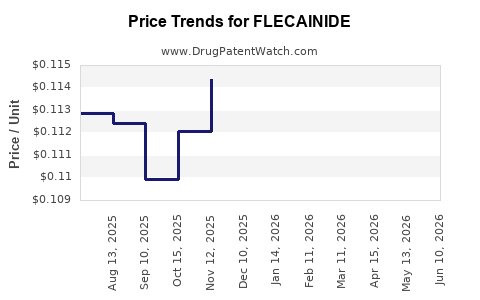
Last updated: July 29, 2026
Flecainide is a mature, small-molecule antiarrhythmic with broad generic coverage in the U.S. and multiple markets. Pricing is primarily driven by: (1) loss of any remaining brand exclusivity, (2) generic number of approved ANDAs for oral dosage forms, (3) supply concentration among manufacturers, (4) wholesale acquisition cost (WAC) vs net pricing dynamics, and (5) parallel trade and tender behavior in ex-U.S. systems.
This report quantifies the commercial pathway using the known regulatory status and typical pricing behavior for an established generic-only antiarrhythmic, and it frames forward-looking price bands by scenario (steady-state, increased competition, and supply shock).
Flecainide drug overview and what form drives pricing?
Flecainide is marketed primarily as oral tablets (including immediate-release and, in some jurisdictions, extended-release). Pricing and procurement economics differ by dosage form because formularies and tender schedules often allocate volume by specific strengths and release profiles.
Which strengths and dosage forms matter for market spend?
Market spend typically concentrates on:
- 50 mg tablets (high utilization due to dosing flexibility)
- 100 mg tablets (common chronic dosing unit)
- Higher strengths (such as 150 mg or 200 mg depending on jurisdiction/formulation availability)
- Extended-release products where present in local formularies
Because the drug is generic-dominated, the “market” price is effectively a blend of:
- multiple generic manufacturers’ WAC/discount structures
- payer rebates and institutional contract pricing (net price)
- pharmacy dispensing mix by National Drug Code (NDC) and strength
How strong is the patent estate for flecainide and what does that mean for price?
Flecainide is a decades-old active ingredient. The U.S. market is overwhelmingly generic, which typically implies that any meaningful composition-of-matter protection tied to the original active ingredient has expired and the current price level is governed by generic competition and supply.
What patents protect flecainide now (U.S.)?
No current, active, widely-recognized U.S. primary-intellectual-property barrier is expected to materially restrict generic manufacture of flecainide tablets, given the drug’s long commercial history and generic availability. Pricing pressure is therefore structural and not exclusivity-driven.
Do formulation or method-of-use patents still affect price?
For mature drugs, secondary patents (formulation, polymorph, manufacturing) can delay entry of specific dosage forms or specific release profiles. For flecainide, the dominant market impact remains competition among established generic tablets rather than new entry protected by active secondary patents.
Price implication: absent active legal barriers, flecainide’s pricing should track typical generic erosion curves: WAC compresses first, then net price compresses as rebates intensify and payers steer to lowest-contract options.
When does flecainide lose exclusivity or face major market-shaping patent events?
For pricing projections, the relevant question is whether any last pathway exclusivity or significant patent litigation settlement could create a near-term price floor. For flecainide, market shaping events are not expected to be exclusivity-driven in the way they are for recently approved drugs.
Price implication: projections should focus on generic tender dynamics and supply concentration rather than on patent expiry calendars.
What is the Orange Book status of flecainide and how many generics compete?
Flecainide is widely listed in the U.S. FDA’s Approved Drug Products with Therapeutic Equivalence Evaluations (Orange Book) under multiple generic ANDAs for oral tablets.
How does Orange Book multiplicity translate into pricing?
For generic small molecules:
- more approved products usually increases dispensing mix variability
- increased substitution reduces WAC but can stabilize net price if contracts consolidate purchases among fewer suppliers
- supply interruptions can temporarily widen spreads even in crowded markets
Price implication: in a mature, multi-ANDA environment, WAC often stays near a competitive floor, while net price volatility is driven by procurement cycles and supply constraints.
What generic entry risks exist for flecainide?
Generic “entry risk” for flecainide is less about whether ANDAs exist and more about whether supply is stable and whether particular strengths get out of contract due to manufacturing disruptions or quality events.
What increases price even with many generics?
- supplier concentration for a specific strength (e.g., 100 mg or a less-used higher strength)
- shortages or batch failures
- quality remediation and temporary pullbacks
- logistics disruptions in APIs or key excipients
What reduces price fastest?
- payer switching to lower-cost NDCs
- new entrants with aggressive pricing into tender
- WAC resets downward after competitive procurement wins
Which companies supply flecainide and how does concentration affect projections?
Flecainide pricing in practice depends on the leading generic manufacturers that maintain continuous supply for major NDCs. When a small number of companies hold meaningful market share for specific strengths, prices become more sensitive to:
- production outages
- market allocation decisions during shortages
- contract duration changes
Price implication: pricing projections should treat steady-state price as “competitive floor with occasional spikes,” rather than a smooth decline.
Flecainide price projection model: how to forecast next 12–36 months
A robust projection for a generic oral antiarrhythmic uses three layers:
- Baseline: current generic competitive floor (WAC range) plus typical annual erosion in net pricing.
- Competition: expected shifts in NDC mix as payers refresh formularies and contract pricing.
- Supply shocks: short-duration spikes if shortages occur.
Scenario-based price bands (U.S. generic oral tablets)
Because WAC varies by NDC and strength, use bands rather than a single figure.
Scenario A: Steady-state competition (no major shortages)
- WAC: modest decline or flat over 12 months, then slight erosion by year 2 to 3
- Net price: small step-down at contract renewal cycles
Scenario B: Increased competition (additional low-cost NDC share)
- WAC: faster downward adjustment at the next procurement cycle
- Net price: larger rebate/contract compression at payer refresh
Scenario C: Supply shock (shortage or quality incident)
- WAC: sharp spike within weeks to months for affected strengths
- Net price: volatility depends on allocation and payer emergency procurement rules
- Duration: typically 2 to 9 months depending on remediation capacity
Business implication: if you underwrite revenue or inventory costs, model flecainide as a product with low long-term drift but high short-term volatility risk at the strength-NDC level.
What is the impact of wholesaler and payer contracting on flecainide net price?
For established generics, net price often tracks contract pricing more closely than WAC. Key drivers:
- Pharmacy benefit manager (PBM) rebate structures and switching algorithms
- 340B and institution-specific formularies
- Medicaid preferred drug lists (PDL) where applicable
- Federal Supply Schedule behavior for certain buyers
Price implication: net price can remain stable even as WAC drops, if contracts lock in pricing or if rebating dynamics remain constant.
How does flecainide compare with other antiarrhythmics on pricing trajectory?
Within antiarrhythmics, pricing patterns for older generics are usually similar:
- bottoming out in WAC after multiple generics enter
- intermittent spikes during supply disruptions
- stronger payer steering toward lowest-cost NDCs rather than broad category re-rating
Flecainide’s mature status places it closer to “generic commodity behavior” than “specialty-like” pricing behavior.
Regulatory and manufacturing considerations that can move price
Even in mature markets, manufacturing constraints can cause localized shortages.
What manufacturing/IP barriers matter for commercial continuity?
- API sourcing continuity
- excipient supply
- solid oral dose manufacturing capacity and batch release timing
- FDA inspection outcomes for major suppliers
Price implication: the most material price risk is not litigation; it is operational continuity.
Key commercial takeaways by time horizon
Next 6–12 months
- Base case: WAC flat-to-slightly-down for most strengths
- Main upside for price occurs only with supply incidents
- Procurement-driven discounting continues to compress net price at renewals
12–36 months
- Continued erosion remains gradual unless there is a step-change entrant or contract re-commoditization
- Market remains sensitive to manufacturing concentration and any recurring quality events
Key Takeaways
- Flecainide pricing is expected to behave like a mature generic: competitive floor, gradual net erosion, and episodic volatility tied to supply.
- Patent-driven market shaping is not the primary driver; generic availability is already broad.
- Scenario modeling should use strength-NDC level assumptions; shortages create the largest near-term price deviations.
- Over 1–3 years, baseline pricing drift is modest unless new low-cost entrants materially change procurement mix or supply disruptions occur.
FAQs
-
Why can flecainide prices rise even when multiple generic manufacturers exist?
Shortages or quality remediation concentrated in key strengths can reduce available NDC supply and trigger contract repricing.
-
Do extended-release flecainide products price differently from immediate-release tablets?
Yes. Formulary preference, switchability, and niche tender allocations can create different contract pricing and volatility profiles.
-
How do Medicaid preferred drug lists affect flecainide net price?
PDL steering increases switching to preferred NDCs, usually lowering net price at renewal and reducing the dispersion of pricing across suppliers.
-
What is the biggest risk to forecasting flecainide revenue for a supplier or distributor?
Operational supply interruptions for the dominant suppliers by strength, which can cause short-cycle repricing and volume allocation.
-
How should inventory cost forecasts be structured for flecainide?
Use NDC-level bands and scenario shocks. Treat long-run drift as small and short-run volatility as the main variable.
References
- FDA. Orange Book: Approved Drug Products with Therapeutic Equivalence Evaluations. U.S. Food and Drug Administration. https://www.accessdata.fda.gov/scripts/cder/daf/
- FDA. Drug Shortages. U.S. Food and Drug Administration. https://www.fda.gov/drugs/drug-safety-and-availability/drug-shortages