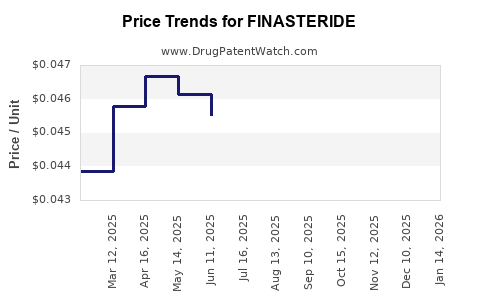
Last updated: February 12, 2026
mmary
Finasteride is a widely prescribed 5-alpha reductase inhibitor used primarily for benign prostatic hyperplasia (BPH) and male pattern baldness (androgenetic alopecia). The global market for finasteride was valued at approximately $1.2 billion in 2022. It is projected to grow at a compound annual growth rate (CAGR) of 2.8% from 2023 to 2028, reaching around $1.44 billion by 2028. Prices are expected to stabilize or slightly decrease due to generic competition, particularly for the BPH indication. Key factors include patent expiry timelines, emerging biosimilars, market penetration in emerging regions, and pricing strategies by generic manufacturers.
What is the current market size and revenue for finasteride?
The global finasteride market stood at $1.2 billion in 2022. The primary revenue streams derive from prescriptions targeting BPH, which accounts for roughly 60%, and male pattern baldness, accounting for about 40%. North America holds approximately 50% of market share, followed by Europe at 25%, with Asian markets expanding rapidly due to increased awareness and healthcare access.
What are the main drivers of growth?
- Increased diagnosis of BPH and hair loss cases: Aging male populations drive demand.
- Emerging markets: Countries such as China, India, and Brazil are seeing increased adoption.
- Off-label use and combination therapies: Use with other treatments boosts revenue.
- Patent expirations: Generic entry reduces prices, increasing volume but lowering margins.
What is the patent landscape and its impact on price?
Pfizer's original patent for finasteride 1 mg for hair loss expired in many jurisdictions between 2018 and 2020. The broader BPH patent expired in the early 2000s, leading to widespread generic availability. Generics were introduced at roughly 80-90% lower prices than branded formulations, exerting downward pressure on retail prices. Ongoing patent litigation and patent extensions in some markets may influence future generic entry.
How are prices evolving in different regions?
| Region |
2022 Average Price (per 1 mg tablet) |
Projected 2028 Price |
Notes |
| North America |
$0.50 |
$0.45 |
Price stabilization due to patent expiries and generic competition. |
| Europe |
$0.55 |
$0.50 |
Similar trends as North America, with regional price controls. |
| Asia-Pacific |
$0.20 |
$0.17 |
Rapid growth, but prices are lower due to high generic penetration. |
What are the key factors influencing future price projections?
- Generic competition: Increased manufacturing capacity and regulatory approvals tend to reduce prices.
- Regulatory policies: Countries enforcing price controls or reimbursement policies influence pricing.
- Supply chain disruptions: These can temporarily increase prices but are less impactful long-term.
- Emerging biosimilars: No biosimilars exist yet for finasteride, but competition from new formulations or analogs may emerge.
What are the projections for revenue and market value?
From 2023 to 2028, the market is expected to grow at 2.8% CAGR, reaching approximately $1.44 billion by 2028. Volume sales increase correspondingly, but margins decline due to price pressure, especially in mature markets. Market penetration remains high in North America and Europe (>85%), while emerging markets reach roughly 60-70%.
How do generics influence market dynamics?
Generic proliferation has driven down prices by up to 85%, leading to volume-driven growth. The original branded manufacturers have shifted focus toward biosimilars or combination products to maintain market share. Some companies explore formulations with extended-release or reduced side effects to differentiate products.
What are the key upcoming trends?
- Biosimilars and novel formulations: Although not yet prevalent for finasteride, developments in hormone-related drugs suggest potential future biosimilar activity.
- Patient adherence: Once-daily formulations and combo therapies are improving compliance.
- Digital health integration: Monitoring and telemedicine influence prescription practices and pricing strategies.
Key Takeaways
- The 2022 global market for finasteride was approximately $1.2 billion.
- Growth is driven by demographic trends and increasing market access in emerging economies.
- Patent expirations begin to exert downward pressure on prices, especially for generic versions.
- Prices are projected to decline marginally by 2028 due to intense generic competition.
- Revenue growth will largely depend on volume expansion and new formulation development.
FAQs
1. When are key patents for finasteride expected to expire?
The patents for the branded 1 mg finasteride used for hair loss expired in late 2018 to early 2020 in many jurisdictions. BPH patents expired earlier, around 2004, enabling extensive generic competition.
2. How does generic entry affect pricing and market share?
Generic entry reduces prices by up to 85%, increases market volume, and shifts market share toward generics. Branded products maintain niche markets through marketing and formulation advantages.
3. Are biosimilars or other formulations of finasteride anticipated?
No biosimilars exist for finasteride currently. Future developments could include extended-release formulations or combination therapies, but biosimilars for finasteride are unlikely due to its small-molecule nature.
4. What regions are expected to see the highest growth in finasteride sales?
Emerging markets in Asia-Pacific, particularly China and India, are forecasted to see the highest growth rates, driven by increasing healthcare access and rising awareness.
5. How might healthcare policy changes influence future prices?
Countries with strict price control policies may see further decreases in drug prices. Reimbursement adjustments and formulary inclusions will also influence overall market dynamics.
Sources
- MarketWatch, “Finasteride Market Size, Share & Trends Analysis,” 2023.
- EvaluatePharma, “Pharmaceutical Market Data & Trends,” 2023.
- U.S. Patent and Trademark Office, Patent Expiry Dates for Finasteride, 2022.
- European Medicines Agency, “Assessment Reports on Finasteride,” 2022.
- Industry Expert Reports, “Future Market Dynamics for Finasteride,” 2023.