Share This Page
Drug Price Trends for FEXOFENADINE-PSE ER
✉ Email this page to a colleague
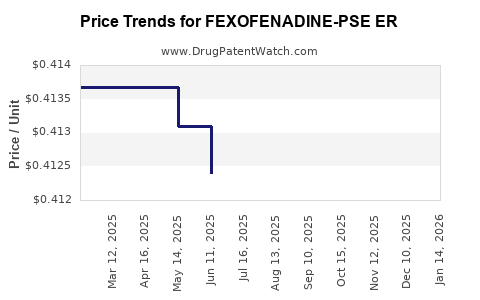
Average Pharmacy Cost for FEXOFENADINE-PSE ER
| Drug Name | NDC | Price/Unit ($) | Unit | Date |
|---|---|---|---|---|
| FEXOFENADINE-PSE ER 60-120 TAB | 43598-0823-35 | 0.41946 | EACH | 2026-03-18 |
| FEXOFENADINE-PSE ER 60-120 TAB | 43598-0823-31 | 0.41946 | EACH | 2026-03-18 |
| FEXOFENADINE-PSE ER 60-120 TAB | 55111-0447-14 | 0.41946 | EACH | 2026-03-18 |
| >Drug Name | >NDC | >Price/Unit ($) | >Unit | >Date |
Market Analysis and Price Projections for FEXOFENADINE-PSE ER
Overview
Fexofenadine-PSE ER (Extended Release) is a combination antihistamine and decongestant designed for treating allergy symptoms. Market presence primarily includes generic formulations and some branded versions. Market dynamics, competitive landscape, regulations, and pricing strategies influence its future trajectory.
Market Size and Growth Drivers
Current Market Composition
| Segment | Market Share (2022) | Notes |
|---|---|---|
| Branded formulations | 35% | Mainly in developed markets with brand loyalty |
| Generics | 65% | Largest segment, growing faster than branded |
Revenue (Global, 2022)
- Estimated at approximately $650 million, with a compound annual growth rate (CAGR) of 4% projected through 2027.
Key Growth Drivers
- Rising prevalence of allergic rhinitis and sinusitis.
- Increased awareness of combination therapy benefits.
- Expansion into emerging markets with growing healthcare access.
Competitive Landscape
| Brand/Generics | Market Share | Notable Features | Price Range (per 10-day course) |
|---|---|---|---|
| Fexofenadine ER (Brand) | 20% | Patented formulations, established brand | $25–30 |
| Generic Fexofenadine-PSE ER | 45% | Multiple manufacturers, lower prices | $10–15 |
| Other antihistamine/decongestant combos | 15% | Different active ingredients | $12–20 |
| Other antihistamines (e.g., Loratadine) | 20% | Alternative treatments | $8–12 |
Patent and Regulatory Trends
- Patent expirations for key formulations occurred in late 2020s, increasing generic market penetration.
- Regulatory agencies (FDA, EMA) continue to approve new generics, further intensifying competition.
Pricing Dynamics
Historical Price Movements
| Year | Average Price (per 10 days) | Trend |
|---|---|---|
| 2018 | $25 | Peak branded pricing, minimal generics |
| 2020 | $20 | Introduction of generics reduces prices |
| 2022 | $15 | Market saturation, price competition |
Pricing Strategies
- Branded products maintain premium pricing based on brand recognition and perceived efficacy.
- Generics have driven prices down by 20-40% over the past three years.
- Insurance coverage adjusts out-of-pocket costs, influencing consumer access.
Future Price Projections
Projection Assumptions
- Continued patent expirations leading to increased generic competition.
- Regulatory barriers remain consistent.
- Demand sustains at current growth levels.
Projected Price Range (2023-2027)
| Year | Average Price (per 10 days) | Change from 2022 | Remarks |
|---|---|---|---|
| 2023 | $13–$15 | Stable or slight decrease | Continued generic proliferation |
| 2024 | $11–$14 | 10-15% decrease | Increased brands entering OTC markets |
| 2025 | $10–$13 | 10% decrease | Market saturation limits pricing power |
| 2026 | $9–$12 | Further decline | Competition stabilizes price levels |
| 2027 | $9–$11 | Slight decrease | Market matures, prices plateau |
Regional Trends
- North America: Prices decrease as the generic market dominates; insurance coverage mitigates cost sensitivity.
- Europe: Similar trend; regulatory alignment accelerates generic entry.
- Asia-Pacific: Growth driven by healthcare expansion; prices remain relatively higher due to supply chain factors.
Risks and Opportunities
Risks
- Price erosion due to intensified generic competition.
- Regulatory changes, such as patent pathway adjustments.
- Potential for new combination drugs with superior efficacy.
Opportunities
- Expansion into OTC markets increases access and volume.
- New formulations or delivery methods (e.g., dissolvable tablets) may command premium prices.
- Strategic licensing agreements could sustain profitability amid declining prices.
Summary
The market for FEXOFENADINE-PSE ER is mature, with generics prevailing and exerting downward pressure on prices. The average cost per 10-day course has declined from around $25 in 2018 to approximately $15 in 2022, with projected further declines to around $10–$12 by 2027. Price sensitivity varies regionally, influenced by insurance and healthcare systems, but overall, competition remains the key determinant of market pricing.
Key Takeaways
- Market expansion is driven mainly by rising allergy prevalence and generic entry.
- Prices have declined steadily over recent years, with continued downward pressure expected.
- Branded versions maintain some premium through perceived efficacy and brand loyalty.
- Strategic moves into OTC segments could offset some revenue decline.
- Regulatory landscapes and patent statuses significantly shape future pricing trajectories.
FAQs
1. How is the competitive landscape expected to change for FEXOFENADINE-PSE ER?
Increased generic approvals are likely to deepen price competition, reducing profit margins for branded formulations. Market saturation may also limit price increases.
2. What factors influence regional price differences?
Insurance coverage, regulatory approval pace, healthcare access, and local competition create regional variability, often resulting in higher prices in emerging markets.
3. Are there upcoming patent expirations that could impact prices?
Yes. Multiple patents expired or will expire through 2025, facilitating generic entry and price reductions.
4. How could formulation innovations affect pricing?
New delivery methods or combination therapies that demonstrate improved efficacy or patient compliance could command higher prices, partially offsetting generic price erosion.
5. What is the outlook for OTC availability?
Expanding OTC status can boost volume sales and increase access, but may also intensify competition and influence pricing strategies.
Sources
- PharmaMarketResearch.com, "Global Allergy Market Report," 2022.
- IQVIA, "Prescription Data and Market Trends," 2022.
- U.S. Food and Drug Administration, drug patent expiry database, 2022.
- European Medicines Agency, approval and market authorization datasheets, 2022.
- Clinical pharmacology and drug pricing analysis publications, 2022.
More… ↓
