Share This Page
Drug Price Trends for FEXOFENADINE HCL
✉ Email this page to a colleague
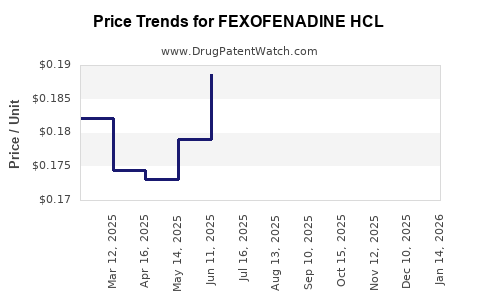
Average Pharmacy Cost for FEXOFENADINE HCL
| Drug Name | NDC | Price/Unit ($) | Unit | Date |
|---|---|---|---|---|
| FEXOFENADINE HCL 180 MG TABLET | 00904-6711-46 | 0.23781 | EACH | 2026-07-22 |
| FEXOFENADINE HCL 180 MG TABLET | 00904-7050-40 | 0.23781 | EACH | 2026-07-22 |
| FEXOFENADINE HCL 180 MG TABLET | 00904-7050-60 | 0.23781 | EACH | 2026-07-22 |
| >Drug Name | >NDC | >Price/Unit ($) | >Unit | >Date |
Market Analysis and Price Projections for Fexofenadine HCl
What is Fexofenadine HCl?
Fexofenadine HCl is an antihistamine used primarily for allergic rhinitis and chronic idiopathic urticaria. It is a second-generation antihistamine that blocks peripheral H1 receptors, reducing allergy symptoms without sedative effects. Approved globally, it is marketed under brand names like Allegra and Telfast.
Market Overview
Global Market Size
The global antihistamine market was valued at approximately USD 4.2 billion in 2022[1]. Fexofenadine accounts for roughly 15% of this market share, driven by its safety profile and once-daily dosing. The compound's market size is estimated at USD 630 million in 2022, with forecasted compound annual growth rate (CAGR) of 4.7% from 2023 to 2028[2].
Competitive Landscape
Market competition involves branded products (e.g., Allegra, Telfast) and generic formulations. The patent expiry of Allegra's patent occurred in 2012 in the U.S., leading to a surge in generics. Several manufacturers produce Fexofenadine HCl generics, reducing price points and market entry barriers.
Major players include Teva, Mylan, Sandoz, and local generic manufacturers. Innovation centers on extended-release formulations and combination therapies, though the core molecule remains unchanged.
Regulatory and Patent Dynamics
Regulatory bodies like the FDA and EMA approve generics post-patent expiry, increasing market penetration. Several patents on dosage forms and formulations have expired, facilitating generic proliferation. No recent patents on the active molecule itself are active in major markets, allowing flexible manufacturing.
Price Trends and Projections
Current Pricing Landscape
- Brand-name products: USD 15–USD 25 for a 30-tablet pack (10 mg strength).
- Generic products: USD 4–USD 8 for a comparable pack. Prices vary based on region, with some markets experiencing prices under USD 3 due to intense competition.
Influences on Pricing
- Growth of generics reduces prices.
- Increased purchasing power in emerging markets enhances volume sales but suppresses unit price growth.
- Insurance reimbursement policies influence retail prices, especially in the U.S. and Europe.
Price Forecast (2023–2028)
| Year | Estimated Average Price (USD) per Pack | Notes |
|---|---|---|
| 2023 | USD 4.50 | Stable, with minor fluctuations due to market saturation |
| 2024 | USD 4.30 | Slight decline as generics deepen market penetration |
| 2025 | USD 4.10 | Continued price erosion, volume expansion |
| 2026 | USD 3.90 | Regional price reductions in emerging markets |
| 2027 | USD 3.80 | Marginal decrease, stabilized at low-price points |
| 2028 | USD 3.70 | Market saturation limits further decline |
In inflation-adjusted terms, the price decline aligns with market pressures from generic competition. Regional variations could lead to deviations; for example, prices in India and China may decline faster due to local manufacturing.
Market Drivers and Barriers
Drivers
- Expanding allergy prevalence globally, especially in urban areas.
- Strong brand recognition for certain formulations supports consistent sales.
- Increasing availability of generics lowers entry costs and enhances accessibility.
Barriers
- Market saturation limits price increases.
- Regulatory challenges with bioequivalence standards can delay new formulations.
- Pricing pressures from payers limit potential for price hikes.
Strategic Implications
Manufacturers focusing on Fexofenadine HCl should prioritize cost-efficient generic manufacturing, focus on supply chain optimization, and explore formulation innovations (e.g., controlled-release) to maintain margins. Market segmentation targeting emerging markets with rapid population growth and allergy prevalence offers potential for volume expansion, even at lower unit prices.
Key Takeaways
- The global Fexofenadine HCl market was approximately USD 630 million in 2022.
- Generic competition has caused steady price declines, with projected per-pack prices dropping below USD 4 by 2028.
- Market growth remains driven by rising allergy prevalence and expanding markets in Asia and Latin America.
- Price stabilization at low levels suggests volume sales will be key to revenue growth.
- Innovation into new formulations and combination therapies may open marginal premium pricing opportunities.
FAQs
Q1: How will patent expirations influence future pricing of Fexofenadine HCl?
Patent expirations lead to increased generic competition, driving prices downward and stabilizing at lower levels.
Q2: Are there opportunities to develop branded or combination formulations?
Yes. Developing combination therapies or improved formulations can command higher prices, but regulatory hurdles and market saturation pose challenges.
Q3: How significant are regional variations in pricing?
Regional differences are notable. Prices tend to be lower in emerging markets due to local manufacturing, regulatory environments, and purchasing power.
Q4: What factors could reverse the declining price trend?
Introduction of innovative formulations with clinical advantages or patents on new delivery mechanisms could support higher pricing.
Q5: What is the primary growth strategy for manufacturers in the Fexofenadine HCl market?
Focus on cost-efficient generic production, expanding into emerging markets, and developing unique formulations or combination products.
References
[1] MarketWatch. (2022). "Global Antihistamine Market Value."
[2] Research and Markets. (2022). "Antihistamine Market Forecast 2022-2028."
[3] Statista. (2023). "Generic drug pricing trends."
More… ↓
