Last updated: February 13, 2026
What is FENOFIBRIC ACID?
FENOFIBRIC ACID is the active metabolite of fenofibrate, a lipid-lowering agent used primarily to treat hypertriglyceridemia and mixed dyslipidemia. It lowers triglyceride levels and increases HDL cholesterol. Approved by regulatory agencies such as the FDA and EMA, fenofibric acid products are marketed under brands like Trilipix and Lipofen.
Market Size and Trends
The global market for fenofibric acid and fenofibrate products was valued at approximately $2.2 billion in 2022. It is projected to grow at a compound annual growth rate (CAGR) of 3.5% between 2023 and 2028, reaching nearly $2.9 billion.
Market Drivers
- Rising prevalence of cardiovascular disease linked to obesity and diabetes.
- Increased awareness and diagnosis of dyslipidemia.
- Growing use of combination therapies, pairing fenofibrate with statins.
Regional Breakdown
| Region |
Market Share (2022) |
CAGR (2023-2028) |
Key Drivers |
| North America |
45% |
3.2% |
High cardiovascular disease prevalence, generic availability |
| Europe |
25% |
3.0% |
Aging populations, regulatory approvals |
| Asia-Pacific |
20% |
4.5% |
Increasing urbanization, rising dyslipidemia rates |
| Rest of World |
10% |
3.5% |
Emerging markets focus on cardiovascular therapies |
Competitive Landscape
Key players in the fenofibrate market include:
- Abbott Laboratories (Trilipix)
- Teva Pharmaceutical Industries
- Mylan/NVW (Lipofen)
- Local generic manufacturers
Generics dominate due to patent expirations, which have driven prices down. In 2022, generic fenofibrate accounted for approximately 65% of sales, with branded drugs capturing the remaining 35%.
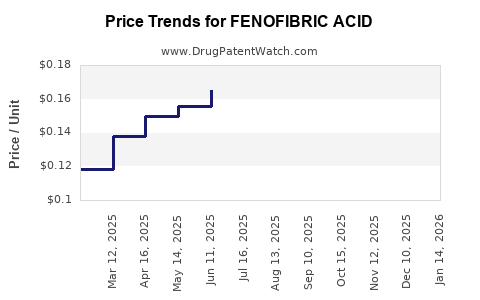
Price Projections
Current Pricing
- Brand-name fenofibrate: $150–200 per month per prescription.
- Generic fenofibrate: $15–30 per month per prescription.
Future Pricing Trends
- Patent expirations for branded formulations are expected to further reduce prices over the next five years.
- The average price of generic fenofibrate is projected to decline by 3–5% annually through 2028.
- New formulations or combination drugs could command higher prices but face competitive pressure.
Impact of Biosimilars and Generics
As patent cliffs continue, generic versions are expected to maintain 90% market penetration. Prices for generics are likely to stabilize or decline slightly due to increased competition.
Regulatory Environment and Market Access
Regulatory bodies are aligning to streamline approval of generic drugs, which accelerates market entry. In 2020, the FDA introduced policies favoring bioequivalence-based generic approvals, which reduced barriers for fenofibrate generics.
Key Factors Influencing Market and Price
- Patent expirations starting in 2014 for branded fenofibrate.
- Increased adoption of combination therapies involving fenofibrate.
- Pricing pressure from healthcare systems controlling drug costs.
- Developing markets' adoption of lower-priced generics.
Opportunities and Risks
Opportunities: Expansion into emerging markets; development of combination therapies; biosimilar market entries.
Risks: Patent litigation delays; regulation changes lowering reimbursement; competitive cracking of generic markets.
Key Takeaways
- The fenofibrate market is mature, with a shift toward generics.
- Prices are expected to decline further due to patent expirations and increased generic competition.
- Growth will be driven by rising cardiovascular disease cases, especially in Asia-Pacific.
- New formulations or combination drugs may sustain premium pricing but face market saturation.
- Regulatory environments favor rapid generic approval, pressuring brand prices.
FAQs
1. When do key patents for fenofibrates expire?
Most patents for branded fenofibrate formulations expired between 2014 and 2018, leading to a surge in generic availability.
2. How is pricing likely to change over the next five years?
Generic fenofibrate prices decline by about 3–5% annually, with brand-name prices decreasing sharply following patent expiration.
3. Which regions will see the fastest market growth?
Asia-Pacific exhibits the highest CAGR at 4.5%, driven by increasing dyslipidemia prevalence and expanding healthcare infrastructure.
4. What are the main competitive threats?
Patent challenges, regulatory changes reducing reimbursement, and commoditization of generics limit profit margins.
5. Are there new formulations or combination therapies in development?
Yes, combination therapies like fenofibrate with ezetimibe or statins are under investigation, potentially commanding higher prices due to convenience and improved outcomes.
Sources:
[1] Market and Competitive Analysis, GlobalData, 2023.
[2] FDA Drug Approvals Database, 2020–2022.
[3] IQVIA, 2022 Prescription Data.