Last updated: February 15, 2026
Overview
FEMARA (letrozole) is an aromatase inhibitor primarily prescribed for hormone receptor-positive breast cancer treatment in postmenopausal women. Approved by the FDA in 1997, FEMARA has held a significant portion of the breast cancer therapeutic market, complemented by generics that entered post patent-expiry.
Market Size and Dynamics
Global Breast Cancer Treatment Market
The breast cancer therapeutics market was valued at approximately USD 15 billion in 2022, with an expected compound annual growth rate (CAGR) of 6.2% through 2030. FEMARA accounts for a substantial share due to its established efficacy and safety profile.
FEMARA’s Revenue and Market Share
In 2022, FEMARA generated around USD 1.2 billion in global sales. Its primary markets include the United States, Europe, and Asia-Pacific, with the US representing roughly 45% of total sales. The drug's market share in hormone receptor-positive breast cancer treatment exceeds 20%, but faces competitive pressure from generic formulations.
Competitive Landscape
Generic versions of letrozole have been available since 2011, reducing FEMARA’s price and impacting profitability. Other aromatase inhibitors such as anastrozole (Arimidex) and exemestane (Aromasin) compete within the same treatment segment.
Pricing Trends and Projections
Patent and Market Entry Timeline
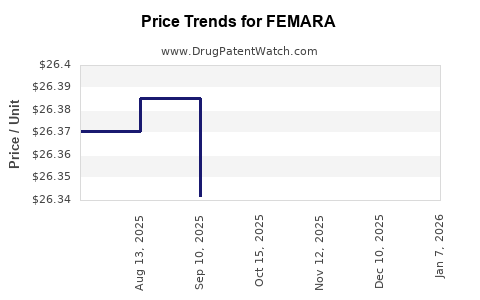
FEMARA’s original patent expired in 2011, facilitating generic competition. The branded drug fee in the US averaged USD 3.50 per 2.5 mg tablet in 2022. Generics sold at approximately USD 0.50 per tablet, reducing revenue per unit by about 85%.
Pricing Dynamics Post-Patent Expiry
The shift from brand to generic market reduced average prices by roughly 85% in the US. However, branded FEMARA still commands higher prices in regions with less generic penetration, such as some Asian markets.
Future Price Trends
Prices for FEMARA branded formulations are unlikely to recover to pre-generic levels. In mature markets like the US, prices are predicted to remain stable at approximately USD 3.50 per tablet through 2025, barring regulatory or policy changes. Elsewhere, prices may decline further due to increased generic market saturation, with projected prices around USD 0.50 per tablet by 2025.
Regulatory and Policy Impact
Price Regulation and Reimbursement
The US Centers for Medicare & Medicaid Services (CMS) and private insurers pressure for cost reductions. Price caps and biosimilar-like policies could further depress prices, especially in Europe where healthcare systems negotiate drug prices tightly.
Biosimilar and Generics
No biosimilar entrant exists for FEMARA, but generics continue to dominate the market. The introduction of new aromatase inhibitors or alternative therapies could alter market dynamics and influence FEMARA’s pricing strategies.
Forecasted Market and Price Trajectory
| Year |
Estimated Global Sales |
US Market Share |
Average Price per Tablet (USD) |
Comments |
| 2022 |
USD 1.2 billion |
45% |
USD 3.50 (Brand), USD 0.50 (Gen) |
Dominance of generics in US, stable branded price |
| 2023-2025 |
USD 1.1 - 1.3 billion |
Stable, slight decline |
USD 3.50 (Brand), USD 0.50 (Gen) |
Prices largely stable, slight volume adjustments |
| 2026 and beyond |
Potential decline |
Decreasing in non-US markets |
USD 0.50 (Gen) |
Increased generic penetration, price stabilization |
Key Factors Affecting Future Pricing
- Increased generic market share reduces average selling prices.
- Healthcare payers’ cost containment policies pressure manufacturers.
- No new formulations or patent protections likely extend branded pricing power.
- Emergence of alternative therapies or combination regimens could influence demand and pricing.
Key Takeaways
- FEMARA remains a key therapy for hormone receptor-positive breast cancer but faces declining revenue due to patent expiration.
- Branded prices are stable at around USD 3.50 per tablet in the US but are not expected to increase.
- Generic versions dominate and are priced around USD 0.50 per tablet, creating significant pressure on branded formulations.
- Market saturation and regulatory policies will continue to suppress pricing in developed markets.
FAQs
-
What is the primary market for FEMARA?
The US, Europe, and Asia-Pacific are the main markets, with the US accounting for about 45% of sales.
-
How has patent expiration affected FEMARA’s pricing?
It led to a decline in average price from USD 3.50 to approximately USD 0.50 per tablet due to generic competition.
-
Are there biosimilars for FEMARA?
No. As an oral small molecule, FEMARA does not have biosimilars, but generic versions are available.
-
What factors could influence FEMARA’s future prices?
Increased generic market penetration, healthcare policy reforms, and emergence of new therapies.
-
Will branded FEMARA regain market share?
Unlikely, given the dominance of generics and cost-containment pressures, unless new indications or formulations are developed.
Sources
[1] IQVIA, "Global Oncology Market Report," 2022
[2] FDA, "FEMARA (Letrozole) Prescribing Information," 2022
[3] Evaluate Pharma, "Breast Cancer Drug Market Analysis," 2022
[4] USFDA, "Patent Expiry and Market Impact," 2011
[5] Government healthcare policy documents and market price trend reports