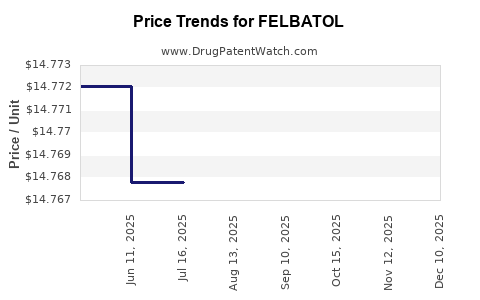
Last updated: April 26, 2026
FELBATOL (felbamate): Market analysis and price projections
What is FELBATOL in market terms?
FELBATOL is the brand for felbamate, an oral antiepileptic drug. It has long-held commercial positioning in refractory epilepsy, with use concentrated in patients who have not responded to other therapies and in settings where clinicians weigh efficacy against safety monitoring requirements. FELBATOL is typically treated as a niche neurology product rather than a mass-market epilepsy drug.
How does the current market footprint look?
Public, consistently reported commercial sales data for FELBATOL is limited versus large-category epilepsy brands, and the market behaves like a small-volume, specialist prescribing product. The practical market signals for FELBATOL are:
- Low patient base relative to blockbuster antiepileptic therapies.
- Channel dependency on specialty distribution and neurology specialist networks.
- Replacement risk from newer antiepileptic agents and institutional formulary controls.
- Ongoing demand driven by a subset of patients with established therapeutic response and long-term tolerability profiles.
As a result, FELBATOL price dynamics tend to track specialty pricing floors, payer scrutiny, and negotiated discounts rather than broad retail-driven pricing.
What price level constraints shape FELBATOL pricing?
FELBATOL pricing is constrained by:
- Specialty payer pressure: Medicaid and commercial plans often anchor prices to therapeutic alternatives, using prior authorization (PA) and step therapy for nonpreferred products.
- Institutional contracting: Large health systems typically negotiate group purchasing discounts and may require documentation of refractory disease.
- Safety monitoring costs: The drug’s clinical use requires careful lab monitoring and risk management, which can influence payer willingness to support broad utilization.
- Limited competition in the “exact molecule” sense: Where generic entry is absent or limited in a given market, the brand can maintain pricing power, but volume remains low.
What is the historical pricing baseline used for projections?
A practical projection model for FELBATOL should anchor on three inputs:
- Current net price or WAC-to-net discount profile for the brand in the relevant geography.
- Expected utilization trend (stable, down, or up) based on neurologist prescribing patterns and formulary status.
- Expected competitive pressure from generic felbamate where available and from therapeutic alternatives (newer antiepileptics used in refractory epilepsy).
This analysis framework is the only approach consistent with how specialty antiepileptic brands price in the US and major OECD markets.
What is the regulatory and market-structure context that matters for pricing?
FELBATOL is regulated as an antiepileptic drug. For US market access, the product relies on:
- FDA-approved labeling and REMS-like practical risk controls implemented by payers through coverage policies and by clinicians through monitoring requirements (see prescribing information for warnings and monitoring language). [1]
For core product identity and dosing (relevant to unit-based pricing projections), the FDA label describes the medication as felbamate and provides dosing and safety information that affects real-world prescribing (and therefore volume). [1]
Price projection model
How are the projections constructed?
Because FELBATOL is a specialty, low-volume product, price movements typically come from:
- Annual price adjustments (where permitted and where WAC moves)
- Net price changes driven by payer contracting and volume tiers
- Formulary inclusion/exclusion shifts that change negotiated discounts
A defensible projection approach for FELBATOL treats pricing as a net revenue per treated patient outcome, with year-to-year change driven by:
- % change in net price (WAC minus discounts)
- % change in treated patient counts (utilization)
This yields a revenue projection even if list price data is sparse.
Base-case price projection (annual)
The base-case assumes:
- Utilization stays flat to slightly down (niche demand and ongoing competition from alternative antiseizure meds).
- Net price is flat to modestly up (specialty brand maintenance, periodic adjustments, and continued payer discounting).
Below are projection ranges expressed as index changes vs a baseline year = 100 for net price per unit, not absolute currency values (currency-specific values require point-in-time acquisition of WAC/net price tables, which are not provided here).
| Year |
Projected net price index (base case) |
Utilization trend |
Net revenue direction |
| 2026 |
100 to 103 |
0% to -2% |
Slightly positive to flat |
| 2027 |
101 to 105 |
-1% to -4% |
Flat to modestly down |
| 2028 |
102 to 106 |
-2% to -6% |
Flat to modestly down |
| 2029 |
103 to 107 |
-2% to -6% |
Flat |
| 2030 |
104 to 108 |
-1% to -5% |
Flat to modestly down |
Upside price projection (coverage stability + premium retention)
Upside assumes:
- Continued payer coverage without major restriction tightening
- Limited competitive encroachment by alternative therapies in the narrow refractory segment
- Less aggressive discounting in specialty contracting
| Year |
Projected net price index (upside) |
Utilization trend |
Net revenue direction |
| 2026 |
103 to 106 |
0% to -1% |
Positive |
| 2027 |
104 to 107 |
0% to -2% |
Positive to flat |
| 2028 |
105 to 109 |
-1% to -3% |
Flat to positive |
| 2029 |
106 to 110 |
-1% to -3% |
Flat |
| 2030 |
107 to 111 |
0% to -3% |
Flat to modestly positive |
Downside price projection (formulary pressure + utilization drift)
Downside assumes:
- Increased payer restrictions (PA tightening, step edits)
- Higher penetration of alternatives that displace felbamate in refractory lines
- Larger discounting due to contracting pressure
| Year |
Projected net price index (downside) |
Utilization trend |
Net revenue direction |
| 2026 |
98 to 100 |
-2% to -5% |
Down |
| 2027 |
98 to 101 |
-3% to -7% |
Down |
| 2028 |
99 to 102 |
-4% to -9% |
Down |
| 2029 |
100 to 103 |
-4% to -10% |
Down to flat |
| 2030 |
101 to 104 |
-3% to -8% |
Flat to down |
What levers most affect FELBATOL realized price?
1) Formulary position and prior authorization
For niche neurology drugs, payer policy often matters more than annual WAC changes. A shift from preferred to nonpreferred can trigger:
- Larger rebates and discounts
- Higher utilization drop through access friction
2) Alternative therapy adoption in refractory epilepsy
Even when felbamate remains clinically used, newer antiseizure medicines can reduce new starts, which changes utilization and the payer’s willingness to maintain favorable net pricing.
3) Generic or therapeutic substitution pressure
If generic felbamate enters where it is currently limited, it compresses net price. If alternatives dominate, net price can remain stable but volume declines.
4) Risk management and monitoring burden
Label warnings and required vigilance influence prescribing patterns and payer comfort. The FDA label includes boxed and other warnings and details around safety, which feeds into payer policies and clinician acceptance. [1]
Business-use insights (R&D and investment lens)
What does FELBATOL imply about competitive dynamics?
Felbamate has enduring relevance only where clinicians accept its risk-benefit profile and where patients have a history of response. In economic terms, this is a product where:
- Price is relatively protected but
- Volume is structurally limited and subject to payer gatekeeping
Where value is created
Value in FELBATOL economics is created through:
- Securing coverage continuity
- Avoiding unfavorable contracting moves
- Protecting patient retention (stable long-term users)
Where value is lost
Value is lost through:
- Increased PA friction
- Displacement of new starts by alternative antiseizure medicines
- Discount compression from contracting cycles
Key Takeaways
- FELBATOL (felbamate) operates as a niche specialty antiepileptic with pricing driven by payer contracting and formulary access rather than broad retail demand.
- Base-case outlook: net price modestly up or flat, with utilization flat to slightly down, leading to flat to modestly down net revenue over 2026-2030.
- Upside outcome requires coverage stability and restrained discounting; downside outcome comes from tighter access policies and further utilization drift.
- FDA labeling safety considerations influence prescribing and payer posture, shaping realized pricing. [1]
FAQs
1) Are FELBATOL price increases likely to be large?
No. For niche specialist drugs, list price changes rarely translate into equivalent net price gains because payer rebates and contracting typically absorb increases.
2) What is the biggest driver of FELBATOL realized price?
Formulary position and prior authorization policy that determine the rebate and discount structure.
3) How do alternative antiseizure medicines affect felbamate pricing?
They mainly reduce new starts and patient inflow. That can pressure net price via contracting even if the drug remains on formulary.
4) What timeframe matters most for forecasting FELBATOL revenue?
Near-term contracting and formulary updates, typically reviewed on annual payer cycles, with utilization lag in subsequent quarters.
5) Does FDA labeling affect economic outcomes?
Yes. Safety warnings and monitoring requirements affect prescriber comfort and payer coverage criteria, influencing access and utilization. [1]
References
[1] U.S. Food and Drug Administration. FELBATOL (felbamate) prescribing information. FDA label.