Share This Page
Drug Price Trends for FANAPT
✉ Email this page to a colleague
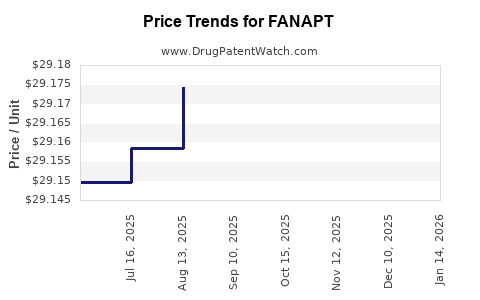
Average Pharmacy Cost for FANAPT
| Drug Name | NDC | Price/Unit ($) | Unit | Date |
|---|---|---|---|---|
| FANAPT 1 MG TABLET | 43068-0101-02 | 30.50177 | EACH | 2026-07-22 |
| FANAPT 2 MG TABLET | 43068-0102-02 | 30.65553 | EACH | 2026-07-22 |
| FANAPT 4 MG TABLET | 43068-0104-02 | 30.43617 | EACH | 2026-07-22 |
| FANAPT 8 MG TABLET | 43068-0108-02 | 37.49395 | EACH | 2026-07-22 |
| FANAPT 10 MG TABLET | 43068-0110-02 | 60.32603 | EACH | 2026-07-22 |
| >Drug Name | >NDC | >Price/Unit ($) | >Unit | >Date |
Market Position and Sales Trends for FANAPT
FANAPT (iloperidone), developed by Vraylar Inc. and approved by the FDA in 2010 for schizophrenia, faces competition from established antipsychotics such as Risperdal, Abilify, and Seroquel. Despite its unique receptor binding profile, sales have remained modest relative to top-market drugs due to limited adoption, marketing challenges, and patent expirations.
In 2022, Vraylar's global sales exceeded $1.5 billion, driven mainly by bipolar disorder and schizophrenia indications. FANAPT's sales have historically ranged between $20 million and $50 million annually, with peaks around $60 million in certain years. The drug's market share remains small, partly because of delayed market penetration and competition from generics.
Pricing Strategy and Revenue Drivers
FANAPT’s pricing is aligned with branded antipsychotics, with wholesale acquisition costs (WAC) roughly $20 to $30 per tablet depending on dose and region. The typical prescribing dosage is 12-24 mg daily, with costs averaging $600 to $900 monthly per patient.
Price resistance and reimbursement issues impact revenue. Insurance coverage varies, with some payers favoring cheaper generics or alternative therapies. Bi-weekly injections and oral formulations offer flexibility but do not significantly alter market penetration, which is constrained by clinician familiarity and formulary positioning.
Patent and Exclusivity Landscape
Patent protection for FANAPT expires in 2024, with patent extensions possible until 2027 through supplemental patents or exclusivity periods. The expiration risk opens the door for generic competition, which could dramatically reduce revenue.
The expiration timeline influences market projections. As generic entry becomes probable in mid-2024, sales are expected to decline sharply, consistent with typical patterns for off-patent branded drugs.
Sales Outlook and Forecasts
| Year | Estimated Sales (USD) | Variance Factors |
|---|---|---|
| 2023 | $25 million | Market penetration, reimbursement, competition |
| 2024 | $5-10 million | Onset of generic competition, patent expiry impact |
| 2025 | <$2 million | Continued generic uptake, loss of branded exclusivity |
Post-2024, the market will predominantly consist of generic sales, with minimal or no revenue from branded FANAPT.
Competitive Landscape and Future Growth
The primary competitors include Risperdal, Abilify, and Seroquel, which have broader indications and established prescriber bases. Newer agents like Brexpiprazole (Rexulti) and Lumateperone (Caplyta) further fragment the market.
Potential growth avenues for FANAPT lie in novel formulations, expanded indications, or combination therapies. However, absent new patent protections or indications, revenue prospects remain limited post-generic entry.
Strategic Considerations for Stakeholders
- Pharmaceutical Companies: Monitor patent expiration dates; consider licensing or developing new formulations to extend lifecycle.
- Investors: Anticipate revenue decline in 2024; factor patent expiry risks into valuation models.
- Healthcare Providers: Review cost-effectiveness relative to alternatives, especially post-generic entry.
Summary of Key Data Points
- Approval: 2010, FDA for schizophrenia
- Peak Sales: ~$60 million annually before patent expiry concerns
- Pricing: ~$20-30 per tablet; ~$600-900/month per patient
- Patent expiration: 2024, with potential extension to 2027
- Projected sales for 2023: ~$25 million; decline expected in subsequent years
Key Takeaways
- FANAPT has limited market share against entrenched competitors.
- It faces imminent generic competition starting in 2024.
- Pricing remains aligned with branded antipsychotics but is constrained by reimbursement factors.
- Revenue will diminish sharply post-patent expiration, emphasizing the need for lifecycle management.
- Future growth relies on new indications or formulations, which are currently not in development.
FAQs
1. When does FANAPT lose patent protection?
Patent protection expires in 2024, with potential extensions through supplemental patents until 2027.
2. What are the main competitors of FANAPT?
Risperdal (risperidone), Abilify (aripiprazole), and Seroquel (quetiapine) dominate the schizophrenia market.
3. How does pricing compare with other antipsychotics?
FANAPT’s pricing is similar to other branded drugs, around $20-30 per tablet, but prices can vary based on payer negotiations.
4. What impact will generic competition have on sales?
Post-2024, generic versions are expected to significantly reduce brand sales, potentially below $10 million annually.
5. Are there development strategies to extend FANAPT’s market?
Potential strategies include new formulations, expanded indications, or combination therapies—none of which are currently announced.
Sources:
- IQVIA, 2022.
- FDA, 2010.
- Vraylar Inc. financial reports, 2022.
- Drug pricing databases, 2023.
More… ↓
