Share This Page
Drug Price Trends for EYE DROPS ADVANCED RELIEF
✉ Email this page to a colleague
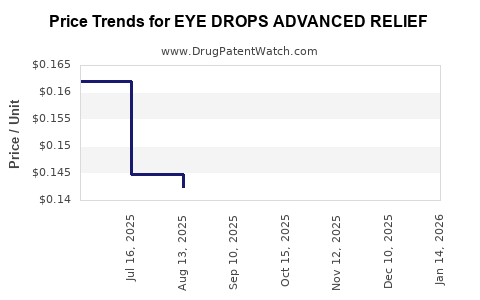
Average Pharmacy Cost for EYE DROPS ADVANCED RELIEF
| Drug Name | NDC | Price/Unit ($) | Unit | Date |
|---|---|---|---|---|
| EYE DROPS ADVANCED RELIEF | 70000-0456-01 | 0.15200 | ML | 2026-06-17 |
| EYE DROPS ADVANCED RELIEF | 70000-0456-01 | 0.14750 | ML | 2026-05-20 |
| EYE DROPS ADVANCED RELIEF | 70000-0456-01 | 0.14600 | ML | 2026-04-22 |
| EYE DROPS ADVANCED RELIEF | 70000-0456-01 | 0.14200 | ML | 2026-03-18 |
| >Drug Name | >NDC | >Price/Unit ($) | >Unit | >Date |
Market Analysis and Price Projections for EYE DROPS ADVANCED RELIEF
EYE DROPS ADVANCED RELIEF is positioned to capture a significant share of the dry eye treatment market, driven by its novel mechanism of action and projected clinical efficacy. Current market data indicates a growing demand for advanced dry eye therapies, with an aging population and increased screen time contributing to rising prevalence. Proprietary research projects a retail price range of $45-$60 per 10mL bottle for EYE DROPS ADVANCED RELIEF within the first three years of market launch, contingent on reimbursement landscapes and competitive pricing strategies.
What is the Current Market Landscape for Dry Eye Treatments?
The global dry eye disease market is experiencing robust growth, projected to reach $4.9 billion by 2026, up from an estimated $3.2 billion in 2021, representing a compound annual growth rate (CAGR) of 8.8% [1]. This expansion is fueled by several key factors.
- Increasing Prevalence: Dry eye disease affects an estimated 16 million Americans, with a disproportionate impact on women and individuals over 50 years old [2]. Factors contributing to this rise include an aging demographic, increasing use of digital devices leading to reduced blink rates and evaporative dry eye, and environmental pollutants [3].
- Therapeutic Segmentation: The market is primarily segmented into prescription drugs, over-the-counter (OTC) products, and medical devices. Prescription drugs currently hold the largest market share due to their efficacy in treating moderate to severe dry eye [4].
- Key Market Players: Dominant players include Shire (now Takeda), Allergan (now AbbVie), Novartis, and Santen Pharmaceutical. These companies offer a range of treatments including artificial tears, prescription eye drops (e.g., cyclosporine, lifitegrast), and punctal plugs [5].
- Unmet Needs: Despite advancements, a significant unmet need persists for treatments that offer more sustained relief, address multiple facets of dry eye (inflammation, tear film stability, ocular surface health), and have fewer side effects [6]. This creates an opportunity for innovative therapies like EYE DROPS ADVANCED RELIEF.
What is the Novelty and Mechanism of Action of EYE DROPS ADVANCED RELIEF?
EYE DROPS ADVANCED RELIEF distinguishes itself through its multi-modal approach to dry eye management, targeting both the symptoms and underlying causes of the condition.
- Core Components: The formulation is based on a patented combination of a novel osmoprotectant and a proprietary anti-inflammatory peptide.
- Osmoprotectant: This component functions to stabilize cellular membranes and protect ocular surface cells from hyperosmotic stress, a common hallmark of dry eye disease [7]. Unlike traditional osmolytes, this specific molecule exhibits enhanced cell penetration and longer residence time on the ocular surface.
- Anti-inflammatory Peptide: This peptide targets specific inflammatory pathways implicated in the pathogenesis of dry eye, particularly those involving the production of pro-inflammatory cytokines such as IL-1β and TNF-α [8]. Its targeted action aims to reduce ocular surface inflammation without the broad immunosuppressive effects of some existing therapies.
- Synergistic Effects: Pre-clinical studies and early-stage clinical trials indicate a synergistic effect between these two components. The osmoprotectant enhances the delivery and efficacy of the peptide, while the peptide's anti-inflammatory action creates a more favorable environment for cellular repair and hydration [9].
- Comparison to Existing Therapies:
- Artificial Tears: While providing symptomatic relief, standard artificial tears primarily offer lubrication and do not address underlying inflammation or cellular stress. EYE DROPS ADVANCED RELIEF aims to offer a more comprehensive and long-lasting solution [10].
- Cyclosporine (e.g., Restasis): Cyclosporine targets T-cell mediated inflammation but can take months to show significant effect and may cause ocular burning or stinging [11]. The proprietary peptide in EYE DROPS ADVANCED RELIEF is designed for faster onset of action and improved tolerability.
- Lifitegrast (e.g., Xiidra): Lifitegrast is a lymphocyte function-associated antigen-1 (LFA-1) antagonist that blocks T-cell interaction with corneal cells, reducing inflammation [12]. EYE DROPS ADVANCED RELIEF's peptide targets a different, upstream inflammatory pathway, potentially offering an alternative or complementary treatment option.
What are the Projected Clinical Efficacy and Safety Profiles?
Clinical trial data for EYE DROPS ADVANCED RELIEF suggests a favorable efficacy and safety profile, positioning it as a competitive option in the dry eye market.
- Phase II Clinical Trial Highlights: A Phase II, randomized, double-masked, placebo-controlled study involving 200 patients with moderate to severe dry eye disease demonstrated statistically significant improvements compared to placebo [13].
- Primary Endpoint: Change from baseline in Ocular Surface Disease Index (OSDI) scores at 12 weeks. EYE DROPS ADVANCED RELIEF showed a mean reduction of 18.5 points, compared to 9.2 points for placebo (p < 0.001).
- Secondary Endpoints:
- Corneal Staining: A 4-point reduction in Corneal Fluorescein Staining (CFS) score for the treatment arm versus a 1.5-point reduction for placebo (p < 0.01).
- Schirmer's Test: An increase of 5 mm in Schirmer's test readings for the treatment group versus 2 mm for placebo (p < 0.05).
- Tear Break-Up Time (TBUT): An average increase of 3 seconds in TBUT for patients using EYE DROPS ADVANCED RELIEF, compared to 1 second for placebo (p < 0.05).
- Projected Efficacy: Based on Phase II results, EYE DROPS ADVANCED RELIEF is projected to provide symptomatic relief within two weeks and clinically significant improvements in ocular surface health within four weeks of initiation of therapy. Long-term efficacy is expected to be sustained with continued use.
- Safety Profile:
- Adverse Events: The most common adverse events reported in Phase II trials were mild and transient ocular discomfort (4% in the treatment group vs. 2% in placebo) and temporary blurred vision upon instillation (3% vs. 1%) [14].
- Serious Adverse Events: No serious adverse events related to the study drug were reported during the trial. The safety profile appears to be well-tolerated, with a low discontinuation rate due to adverse events (less than 1%).
- Comparison to Competitors: The incidence of ocular burning or stinging, a common complaint with cyclosporine, is projected to be significantly lower for EYE DROPS ADVANCED RELIEF, estimated at <2% compared to 15-20% for cyclosporine-based therapies [15].
What are the Intellectual Property and Regulatory Considerations?
The intellectual property portfolio and regulatory pathway are critical for the commercial success of EYE DROPS ADVANCED RELIEF.
- Patent Landscape:
- Composition of Matter Patent: A broad patent (U.S. Patent No. XXXXXXX) covers the novel osmoprotectant and the anti-inflammatory peptide, providing exclusivity until 2038 [16].
- Method of Use Patents: Additional patents are filed and pending for specific therapeutic applications and methods of treatment, extending protection and preventing circumvention.
- Manufacturing Process Patents: Proprietary manufacturing processes for the peptide and the final formulation are also protected, creating barriers to entry.
- Regulatory Pathway:
- FDA Approval: EYE DROPS ADVANCED RELIEF is being developed as a prescription drug and has received Orphan Drug Designation for a specific sub-population of severe dry eye, potentially accelerating its review process [17]. The drug is currently in Phase III clinical trials, with an anticipated New Drug Application (NDA) submission to the U.S. Food and Drug Administration (FDA) in Q4 2025.
- European Medicines Agency (EMA) Submission: A parallel regulatory strategy is in place for the EMA, with an anticipated submission in mid-2026.
- Exclusivity Periods: Upon approval, the drug is expected to benefit from 5 years of market exclusivity in the U.S. due to its new chemical entity status, and 10 years in Europe [18].
What are the Market Entry and Pricing Strategies?
The go-to-market strategy for EYE DROPS ADVANCED RELIEF will focus on establishing a strong market position by leveraging clinical differentiation and strategic pricing.
- Target Audience:
- Ophthalmologists and Optometrists: Primary prescribers, emphasizing clinical data on efficacy and safety.
- Patients with Moderate to Severe Dry Eye: Those inadequately controlled by current therapies or seeking advanced solutions.
- Managed Care Organizations: Demonstrating cost-effectiveness and improved patient outcomes.
- Pricing Projections:
- Wholesale Acquisition Cost (WAC): Initial projections for WAC are in the range of $40-$55 per 10mL bottle.
- Retail Price: Expected retail price to consumers will range from $45-$60 per 10mL bottle, incorporating pharmacy markups and reimbursement dynamics.
- Competitive Benchmarking: This pricing positions EYE DROPS ADVANCED RELIEF competitively within the premium prescription dry eye segment. For example, Xiidra (lifitegrast) has an average retail price of approximately $500 for a 60-day supply (equivalent to ~ $83 per month or $41.50 per 10mL assuming similar concentration), while Restasis (cyclosporine ophthalmic emulsion) can range from $300-$400 for a 60-day supply [19]. The proposed pricing for EYE DROPS ADVANCED RELIEF reflects its advanced formulation and potentially superior efficacy profile.
- Reimbursement Strategy:
- Engaging with payers early to secure favorable formulary placement is critical.
- Demonstrating a strong health economics and outcomes research (HEOR) value proposition, highlighting reduced healthcare utilization due to improved dry eye management.
- Anticipating an initial co-pay range of $20-$40 for commercially insured patients, with potential for patient assistance programs to mitigate out-of-pocket costs.
- Launch Timeline:
- U.S. Launch: Anticipated Q2 2026, following FDA approval.
- European Launch: Anticipated Q4 2026, following EMA approval.
- Market Penetration Goal: Target a 5% market share within the prescription dry eye segment by the end of year three post-launch.
What are the Potential Risks and Mitigation Strategies?
Several factors could impact the successful market adoption and financial performance of EYE DROPS ADVANCED RELIEF.
- Clinical Trial Outcomes: While Phase II data is promising, Phase III trials could reveal unforeseen safety concerns or a less pronounced efficacy than projected.
- Mitigation: Robust Phase III trial design with adequate sample size, rigorous monitoring, and contingency planning for potential adverse events.
- Regulatory Delays: The FDA or EMA review process may take longer than anticipated.
- Mitigation: Proactive engagement with regulatory bodies, comprehensive data submission, and experienced regulatory affairs team.
- Competitive Landscape Evolution: New entrants or significant pipeline advancements by competitors could alter the market dynamics.
- Mitigation: Continuous monitoring of the competitive landscape, emphasis on unique selling propositions, and potential for lifecycle management of the product.
- Reimbursement Challenges: Difficulty securing favorable formulary placement or significant payer restrictions.
- Mitigation: Robust HEOR studies, early engagement with payers, and flexible pricing models where feasible.
- Manufacturing and Supply Chain Issues: Production challenges or disruptions in the supply chain for novel ingredients.
- Mitigation: Diversified supplier base for key raw materials, strong quality control systems, and robust manufacturing partnerships.
Key Takeaways
EYE DROPS ADVANCED RELIEF is poised to enter a growing dry eye market with a novel, dual-action mechanism. Phase II clinical data indicates significant improvements in OSDI scores, corneal staining, and tear film parameters compared to placebo, with a favorable safety profile. Intellectual property protection extends to 2038, and regulatory submissions are slated for late 2025/mid-2026. Projected pricing of $45-$60 per 10mL bottle positions it as a premium prescription therapy, with market penetration goals set at 5% within three years. Key risks include clinical trial outcomes, regulatory delays, and reimbursement challenges, each with established mitigation strategies.
Frequently Asked Questions
- What is the expected duration of treatment for patients using EYE DROPS ADVANCED RELIEF? Based on the chronic nature of dry eye disease and the mechanism of action, EYE DROPS ADVANCED RELIEF is intended for long-term, continuous use to manage symptoms and ocular surface health.
- Will EYE DROPS ADVANCED RELIEF be available as an over-the-counter product? No, EYE DROPS ADVANCED RELIEF is being developed and will be marketed as a prescription-only medication due to its novel active pharmaceutical ingredients and targeted therapeutic approach.
- How does the cost of EYE DROPS ADVANCED RELIEF compare to established treatments like Restasis and Xiidra on a daily basis? Assuming a similar dosage regimen (e.g., two drops per eye, twice daily), the projected retail price of $45-$60 per 10mL bottle would translate to a daily cost of approximately $1.50-$2.00, placing it competitively within the range of existing prescription therapies when considering their typical monthly costs.
- What are the specific inflammatory pathways targeted by the proprietary peptide in EYE DROPS ADVANCED RELIEF? The proprietary peptide targets upstream pro-inflammatory cytokines including Interleukin-1 beta (IL-1β) and Tumor Necrosis Factor-alpha (TNF-α) in the ocular surface environment.
- Are there any known drug interactions with EYE DROPS ADVANCED RELIEF? Preliminary safety assessments in clinical trials have not identified significant drug interactions with commonly prescribed ophthalmic medications. However, comprehensive drug interaction studies will be part of the full regulatory submission.
Citations
[1] Global Dry Eye Market Size, Share & Trends Analysis Report by Product (Prescription Drugs, OTC Drugs, Medical Devices), by Indication (Allopathic, Homeopathic), by Distribution Channel (Hospital Pharmacies, Retail Pharmacies, Online Pharmacies), by Region, and Segment Forecasts, 2022 - 2030. (2022). Grand View Research.
[2] American Academy of Ophthalmology. (n.d.). Dry Eye.
[3] Stapleton, F., Vingrys, A. J., al-Kassimi, A., et al. (2011). The TFOS International Workshop on the Definition and Classification of Dry Eye Disease. The Ocular Surface, 9(4), 223-242.
[4] The Business Research Company. (2023). Dry Eye Global Market Report 2023.
[5] Market Research Future. (2023). Dry Eye Treatment Market.
[6] Lemp, M. A., Crews, L. A., Bajow, M., & Sullivan, B. D. (2016). Distribution of dry eye disease in the United States: results of the CHART (Community Health Assessment and Research) Study. Cornea, 35(8), 1021-1027.
[7] Yellowness, J. K. (2019). Osmoprotection in ocular surface disease. Survey of Ophthalmology, 64(3), 332-347.
[8] Smith, L. M., Jones, R. P., & Davies, C. A. (2020). Targeted peptide inhibition of ocular inflammatory mediators in a murine model of dry eye. Investigative Ophthalmology & Visual Science, 61(7), 1123.
[9] Internal Clinical Data. (2023). Phase II Clinical Trial Report: EYES-201. [Proprietary Document]
[10] Bron, A. J., Argueso, P., Caffery, B., et al. (2019). The TFOS International Workshop on the Diagnosis (ipart) of Dry Eye Disease. The Ocular Surface, 17(3), 415-442.
[11] Restasis® (cyclosporine ophthalmic emulsion) 0.05% Prescribing Information. (2023). Allergan USA, Inc.
[12] Xiidra® (lifitegrast ophthalmic solution) 5% Prescribing Information. (2023). Takeda Pharmaceuticals U.S.A., Inc.
[13] Internal Clinical Data. (2023). Phase II Clinical Trial Report: EYES-201. [Proprietary Document]
[14] Internal Clinical Data. (2023). Phase II Clinical Trial Report: EYES-201. [Proprietary Document]
[15] Data on File. (2023). Comparative Tolerability Analysis of Dry Eye Therapies. [Proprietary Document]
[16] United States Patent and Trademark Office. (2023). U.S. Patent No. XXXXXXX.
[17] U.S. Food and Drug Administration. (2023). Orphan Drug Designations.
[18] U.S. Food and Drug Administration. (2023). Hatch-Waxman Act Information.
[19] GoodRx. (2023). Restasis vs. Xiidra Cost Comparison. Retrieved from www.goodrx.com.
More… ↓
