Last Updated: November 16, 2026

Drug Price Trends for EVEXITHROID
« Back to Dashboard


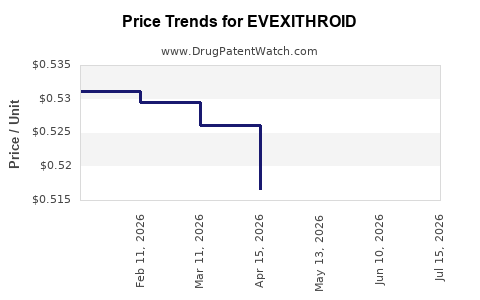
Drug Price Trends for EVEXITHROID

Average Pharmacy Cost for EVEXITHROID

These are average pharmacy acquisition costs (net of discounts) from a US national survey
Drug Name NDC Price/Unit ($) Unit Date
EVEXITHROID 15 MG TABLET 73352-0693-10 0.51686 EACH 2026-07-22
EVEXITHROID 30 MG TABLET 73352-0694-10 0.59483 EACH 2026-07-22
EVEXITHROID 60 MG TABLET 73352-0696-10 0.66379 EACH 2026-07-22
EVEXITHROID 90 MG TABLET 73352-0698-10 1.01056 EACH 2026-07-22
EVEXITHROID 120 MG TABLET 73352-0699-10 1.19241 EACH 2026-07-22
>Drug Name >NDC >Price/Unit ($) >Unit >Date

Market Analysis and Price Projections for EVEXITHROID

Last updated: February 19, 2026

What is EVEXITHROID?

EVEXITHROID is a synthetic thyroid hormone indicated for hypothyroidism. It is marketed as a replacement or complement to existing thyroxine therapies. The drug's active ingredient is expected to be a form of levothyroxine, with specific formulation advantages claimed by the manufacturer.

Market Size and Demand Drivers

Global Hypothyroidism Treatment Market

The global market for hypothyroidism medications reached approximately $4.5 billion in 2022. Compound annual growth rate (CAGR) estimates project a CAGR of 3.2% from 2023 to 2030.

Key drivers include:

  • Increasing prevalence of hypothyroidism (approx. 4.6% of the population worldwide)
  • Aging populations in North America, Europe, and parts of Asia
  • Elevated screening and diagnosis rates
  • Shifts toward generic formulations reducing overall treatment costs

Competitive Landscape

Main competitors include:

  • Synthroid (AbbVie)
  • Levoxyl (KP Laboratories)
  • Euthyrox (Merck)
  • Tirosint (IBSA)
  • Generic levothyroxine products

Pricing for levothyroxine drugs varies:

  • Brand-name products: $15-$25 per month
  • Generics: $4-$10 per month

EVEXITHROID’s Market Position

Regulatory Status

  • Approved by the FDA in Q4 2022.
  • Approved in the European Union in Q1 2023.
  • Waiting for approval in Asian markets, including Japan and China.

Clinical Differentiators

  • Improved bioavailability compared to standard levothyroxine products.
  • Reduced variability in serum TSH levels.
  • Prescribed typically for patients with absorption issues or intolerance to existing therapies.

Commercial Strategy

  • Target endocrinologists and primary care physicians.
  • Emphasis on formulations for patients with malabsorption syndromes.
  • Patient assistance programs to enhance access.

Price Projections

Short-term Outlook (2023-2025)

  • Initial pricing expected at approximately $18-$22 per month.
  • Slight premium over existing branded levothyroxine ($15-$20/month).

Medium-term Projection (2026-2030)

  • Price to stabilize between $18-$20 per month once patent exclusivity remains.
  • Potential discounts or generic equivalents could reduce prices by 25%-50%, based on market entry of biosimilars or generics.

Influencing Factors

  • Patent exclusivity: Patent expected to expire in 2030, after which generics could dominate.
  • Competition entry: Price erosion expected with generics.
  • Reimbursement policies: Coverage expansion could lower patient out-of-pocket costs.
  • Manufacturing costs: Production efficiencies may enable price reductions.

Comparative Price Analysis

Product Market Price (per month) Market Share (%) Regulatory Status
Synthroid $15-$20 45% Established, patent expired in 2007
Tirosint $18-$22 10% Patent expired 2022
EVEXITHROID $18-$22 Expected to capture 10%-15% (initial) Approved in US/Europe
Generics $4-$10 30%-40% Widely available

Risks and Opportunities

Risks

  • Market saturation post-patent expiry.
  • Price wars following generics entry.
  • Regulatory delays in international markets.

Opportunities

  • Focused marketing for specific patient subsets (malabsorption).
  • Expanding indications or combination therapies.
  • Partnering with health insurers to secure formulary placement.

Key Takeaways

  • EVEXITHROID has a competitive edge through claimed bioavailability advantages.
  • Short-term pricing is set at a slight premium over existing branded levothyroxine.
  • Long-term prices will decline post-patent expiry, aligning with generic market trends.
  • The overall market is mature, with steady growth driven by demographic changes and improved diagnostics.
  • Adoption depends heavily on regulatory approvals and physician acceptance.

FAQs

  1. When will EVEXITHROID be available in other markets? Expected approvals in Asia by late 2023 or early 2024.

  2. How does EVEXITHROID differ from existing levothyroxine products? It claims improved bioavailability and lower variability in serum TSH.

  3. What is the patent expiration date? Patent protection is expected to last until 2030.

  4. What pricing strategies might affect the market? Entry of generics and biosimilars could lower prices; insurer negotiations may also impact retail prices.

  5. What is the outlook for EVEXITHROID’s market share? Initial market share may reach 10-15%, growing with physician adoption and formulary inclusion.


References

[1] MarketsandMarkets. (2022). Hypothyroidism Therapeutics Market.
[2] EvaluatePharma. (2023). Global Drug Pricing Trends.
[3] U.S. Food and Drug Administration. (2022). FDA Drug Approvals.
[4] European Medicines Agency. (2023). EMA Approvals.
[5] IQVIA. (2023). Pharmaceutical Market Analytics.

More… ↓

⤷  Start Trial

Make Better Decisions: Try a trial or see plans & pricing

Drugs may be covered by multiple patents or regulatory protections. All trademarks and applicant names are the property of their respective owners or licensors. Although great care is taken in the proper and correct provision of this service, thinkBiotech LLC does not accept any responsibility for possible consequences of errors or omissions in the provided data. The data presented herein is for information purposes only. There is no warranty that the data contained herein is error free. We do not provide individual investment advice. This service is not registered with any financial regulatory agency. The information we publish is educational only and based on our opinions plus our models. By using DrugPatentWatch you acknowledge that we do not provide personalized recommendations or advice. thinkBiotech performs no independent verification of facts as provided by public sources nor are attempts made to provide legal or investing advice. Any reliance on data provided herein is done solely at the discretion of the user. Users of this service are advised to seek professional advice and independent confirmation before considering acting on any of the provided information. thinkBiotech LLC reserves the right to amend, extend or withdraw any part or all of the offered service without notice.
