Last updated: February 12, 2026
Ethosuximide is an antiepileptic drug primarily indicated for absence seizures. Market dynamics depend on its therapeutic efficacy, patent status, competition, and manufacturing costs. Current trends indicate moderate growth prospects as epilepsy management evolves.
Market Overview
Indication and Usage:
Primarily prescribed for absence seizures, a subtype of generalized epilepsy. It is usually first-line therapy, especially in pediatric populations. Off-label uses are limited.
Market Size:
The global epilepsy drug market was valued at approximately $4.5 billion in 2022. Ethosuximide accounts for roughly 10-15% of this segment, translating to an estimated market size between $450 million and $675 million.
Key Geographic Markets:
- North America: 40% of total epilepsy drug sales.
- Europe: 30%.
- Asia-Pacific: 20%.
- Rest of the world: 10%.
Market Drivers:
- Rising incidence of epilepsy worldwide (about 50 million patients globally).
- Preference for older, generic options due to cost considerations.
- Preference for drug monotherapy, supporting steady demand for ethosuximide as a first-line agent.
Market Constraints:
- Competition from valproic acid, lamotrigine, and newer antiepileptics.
- Side-effect profile, including gastrointestinal disturbances and potential hematologic effects, may limit use in some populations.
- Patent expirations of generics and availability of alternatives diminish pricing power.
Competitive Landscape
Producers and Suppliers:
- Mylan (now part of Viatris) and Teva remain leading generic manufacturers.
- Limited branded competitors due to patent expiration decades ago.
Generic Penetration:
- Ethosuximide is predominantly available as a generic product.
- Market prices are driven mainly by manufacturing costs and regional pricing regulations.
Emerging Competition:
- Development of newer antiepilepsy drugs with improved side effect profiles.
- Potential for biosimilars or novel formulations under clinical investigation.
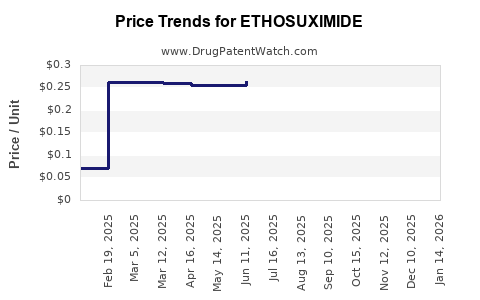
Price Trends and Projections
Current Pricing:
- Per 250 mg capsules: $0.10 – $0.20 in the U.S. (source: GoodRx).
- Monthly therapy cost for average adult dosage (~750 mg/day): approximately $3 – $6.
Factors Affecting Prices:
- Regional pricing regulations limit cost increases in many countries.
- Increased manufacturing efficiency could reduce costs further.
- Entry of biosimilars is unlikely due to the drug's small molecule and age.
Price Trends (2020-2022):
- Prices have remained largely stable with slight reductions in some markets due to increased generic competition.
- Higher prices persist in low- and middle-income countries because of supply chain and patent enforcement issues.
Future Price Projections (2023-2027):
- Prices are expected to remain stable with minimal fluctuations.
- Marginal declines (~2-3%) may occur as generic producers increase manufacturing efficiency.
- Regional regulatory changes could influence pricing, especially in Europe post-EU price control policies.
| Pricing Outlook: |
Year |
Estimated Price Range (per 250 mg capsule) |
Notes |
| 2023 |
$0.10 – $0.20 |
Stable, competition persists |
| 2024 |
$0.09 – $0.19 |
Slight decrease due to manufacturing efficiencies |
| 2025 |
$0.09 – $0.18 |
Market saturation, minimal price change |
| 2026 |
$0.08 – $0.17 |
Potential price reduction in strict markets |
| 2027 |
$0.08 – $0.16 |
Ongoing competition and cost factors |
Regulatory and Patent Considerations
- Patents on ethosuximide ended in the 1980s.
- Generic manufacturing is well-established globally.
- No current pipeline for novel formulations expected to disrupt pricing structure.
Conclusion
Ethosuximide remains a low-cost, first-line treatment for absence seizures, primarily distributed as a generic. The market is mature with limited growth prospects unless new indications or formulations emerge. Price projections suggest stability with slight declines as manufacturing efficiencies increase and competition intensifies.
Key Takeaways
- The global epilepsy drug market stands at approximately $4.5 billion, with ethosuximide representing a significant portion.
- The drug's market is primarily driven by generic availability, resulting in low and stable prices.
- Future pricing will likely experience marginal declines; substantial increases are unlikely barring new indications.
- Competition from newer drugs limits market expansion but sustains steady demand as a low-cost treatment.
- Regional regulatory policies influence regional pricing, particularly in Europe and Asia.
Frequently Asked Questions
1. What are the main competitors to ethosuximide in treating absence seizures?
Valproic acid, lamotrigine, and newer medications like ethosuximide are competitors. However, ethosuximide is often preferred due to tolerability and targeted efficacy.
2. Are there any new formulations or delivery methods for ethosuximide?
Currently, no significant novel formulations are under development or marketed; the drug remains available mainly in capsule form.
3. How does regional regulation affect ethosuximide pricing?
In many countries, price controls and reimbursement policies suppress prices. In low-income regions, prices are often lower due to generic competition and regulatory policies.
4. Is there potential for ethosuximide to regain patent protection?
Unlikely, as patents expired decades ago. No ongoing patent disputes or exclusive licenses exist.
5. What is the outlook for new entrants or biosimilars?
Biosimilars are not applicable as ethosuximide is a small-molecule drug. Barrier to new entrants remains high due to market maturity and manufacturing costs.
References
- Grand View Research, "Epilepsy Drugs Market Size, Share & Trends Analysis Report," 2022.
- GoodRx, "Ethosuximide Prices and Coupons," 2023.
- U.S. Food and Drug Administration (FDA), "Drug Approvals and Patent Data," 2022.
- IQVIA, "Global Epilepsy Market Data," 2022.
- European Medicines Agency (EMA), "Price Trends and Policies," 2022.