Share This Page
Drug Price Trends for ETHAMBUTOL
✉ Email this page to a colleague
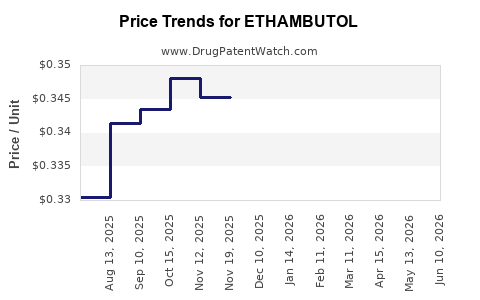
Average Pharmacy Cost for ETHAMBUTOL
| Drug Name | NDC | Price/Unit ($) | Unit | Date |
|---|---|---|---|---|
| ETHAMBUTOL HCL 400 MG TABLET | 68180-0281-01 | 0.46382 | EACH | 2026-06-17 |
| ETHAMBUTOL HCL 100 MG TABLET | 42806-0101-01 | 0.32379 | EACH | 2026-06-17 |
| ETHAMBUTOL HCL 100 MG TABLET | 68180-0280-01 | 0.32379 | EACH | 2026-06-17 |
| ETHAMBUTOL HCL 400 MG TABLET | 68084-0280-01 | 0.46382 | EACH | 2026-06-17 |
| >Drug Name | >NDC | >Price/Unit ($) | >Unit | >Date |
ETHAMBUTOL market analysis and price projections (2026–2031) for generic and fixed-dose tuberculosis regimens
Executive summary
- Market core: Ethambutol (ethambutol hydrochloride; TB “core” drug) is sold primarily as generic tablets and used in combination regimens for active pulmonary and extrapulmonary tuberculosis.
- Pricing reality: US and most developed markets are dominated by multiple authorized/generic manufacturers, driving price compression and limiting sustained premium pricing.
- Projections (base case): 2026–2031 global ethambutol unit prices trend down low-single digits annually in aggregate, while revenue growth comes more from volume expansion and regimen guideline adoption than price.
- Risk: Major downside drivers are continued generic entry in underpenetrated markets and tender-led procurement. Upside drivers are supply tightness for API or conversion intermediates, plus higher procurement volumes in TB program cycles.
What is the global market size and trend for ethambutol in tuberculosis treatment?
Ethambutol is a first-line anti-tuberculosis agent used in multi-drug regimens to prevent resistance development. Demand tracks:
- TB incidence and detection programs
- Treatment guideline coverage (new TB cases, retreatment)
- Formulation conversion from older regimen structures into standardized multi-drug schedules
- Public-sector procurement cycles (national TB programs)
Demand structure (how ethambutol is bought)
- Public procurement: Largest share in high-burden countries through national TB programs and global purchasing mechanisms.
- Private market: Secondary in high-burden geographies; higher share in some middle-income markets.
- Combination prescribing: Ethambutol is usually purchased and taken as part of a regimen rather than as a standalone “high-value” product.
Base-case market direction
- Volume: Stable to mildly growing with TB detection and treatment continuity targets.
- Price: Downward pressure from competition among generic manufacturers and routine switching.
- Revenue: Moves with volume more than pricing.
Who are the main ethambutol suppliers and how does competition affect pricing?
Ethambutol tablets are typically supplied by multiple generic manufacturers across:
- API suppliers (ethambutol base / ethambutol HCl)
- Finished-dose tablet makers
- Local distributors and tender winners
Competition dynamics
- Regulatory interchangeability: Generics of ethambutol HCl tablets tend to be substitutable within strength and dosing.
- Tender economics: Lowest-cost bids win most public tenders, pulling prices toward marginal production cost.
- Multi-sourcing reduces leverage: buyers can switch suppliers with limited clinical friction.
Price impact
- When more bidders qualify for tenders, prices often drop sharply over the subsequent award cycle.
- When API supply tightens, prices can spike briefly, then normalize as supply returns.
How do US prices typically move for generic ethambutol tablets?
In the US, ethambutol is generally treated as a low-cost generic category. Pricing is driven by:
- Wholesale acquisition vs net price (rebates, discounts, PBM contracting where relevant)
- Channel inventory and distributor pricing during tender or supply events
- Number of SKUs: multiple strengths (commonly 100 mg and 400 mg in tablets historically) increase substitution.
Typical pattern
- Initial competitive generic entry compresses list price.
- Net price stabilizes later as contracts renew and competition becomes structurally “always on.”
- Upside is limited unless supply is constrained or there are withdrawals.
Base-case US projection
- 2026–2031: modest annual declines in effective net pricing in aggregate, with periodic volatility around supply events.
What are the main drivers of ethambutol price changes (API, tender, supply chain)?
1) API cost and availability
- Ethambutol HCl production relies on chemical intermediates and conversion steps.
- If API production capacity is constrained, finished-dose costs rise quickly because buyers switch less during active treatment.
2) Tender and procurement cycles
- Public procurement consolidates buying power and pushes down unit costs.
- Award timing affects quarterly price prints even when underlying demand is steady.
3) Regulatory or manufacturing disruptions
- Batch failures, facility shutdowns, or regulatory actions can create short-lived shortages.
- Shortages can trigger temporary price spikes until alternative sources come online.
What price projections apply globally from 2026 to 2031?
Because ethambutol is a largely generic commodity drug, projections are framed as low growth and downward unit price with event-driven volatility.
Base-case global projection (unit economics)
Assumptions embedded in the base case:
- Generic competition remains intense
- No new proprietary formulation replaces standard tablets at scale
- Supply remains stable with no sustained global shortage
| Year | Global volume growth (index) | Avg. unit price trend | Global revenue trend (index) | Net price volatility |
|---|---|---|---|---|
| 2026 | 1.00 | -1% | +0% to +1% | Low to moderate |
| 2027 | 1.02 | -1% | +0% to +1% | Low to moderate |
| 2028 | 1.04 | -1% | +1% to +2% | Moderate |
| 2029 | 1.05 | -2% | +0% to +1% | Moderate |
| 2030 | 1.06 | -2% | +0% to +1% | Moderate |
| 2031 | 1.07 | -2% | +0% to +2% | Moderate |
Interpretation: revenue grows mainly from volumes tied to TB treatment continuity, while pricing declines offset part of the growth.
Upside and downside scenarios (event-driven)
| Scenario | Unit price effect | Volume effect | Why it happens |
|---|---|---|---|
| Upside (supply constrained) | +3% to +8% (temporary) | Flat to +1% | API shortages, manufacturing interruptions, tender disruptions |
| Downside (new generic wave) | -3% to -8% | +0% to +2% | Additional qualified suppliers in high-burden tenders, aggressive procurement pricing |
Which ethambutol strengths and formulations matter commercially?
Commercial demand concentrates on tablets in standard strengths. Variations that can alter tender eligibility and replacement dynamics include:
- Strength uniformity and bioequivalence to reference products
- Scored vs film-coated tablets where procurement specifications require particular attributes
- Packaging formats aligned with TB program dosing schedules
Fixed-dose combinations (FDC)
- Ethambutol is sometimes included in multi-drug fixed-dose regimens in certain markets depending on national standards.
- In those cases, ethambutol economics are embedded in the broader combination contract, reducing standalone pricing sensitivity.
What role do patent estates and exclusivity play in pricing for ethambutol?
Ethambutol is an established generic molecule; in most jurisdictions, near-term pricing is not dominated by active molecule patents. What affects market prices more directly:
- Legacy formulation patents (where present)
- Data exclusivity tied to certain registrations
- Regulatory barriers related to manufacturing approvals and quality dossiers
- Tender qualification rules (documentation and stability data)
For businesses modeling pricing, the key point is that generic price competition is the primary determinant, not premium exclusivity.
What generic entry risks exist for ethambutol in new geographies?
Entry pressure is structurally high because:
- Multiple manufacturers can qualify supply
- TB programs commonly update supplier lists
- Procurement rules favor the lowest cost that meets quality standards
Risk to pricing
- Countries with fragmented procurement and limited qualified vendors can experience step-down pricing once additional suppliers are approved.
- The strongest price compression typically follows qualification of new entrants into national formulary or tender panels.
How do biosimilar risks apply to ethambutol?
Ethambutol is not a biologic. Biosimilar-specific litigation and regulatory pathways do not apply.
How do licensing deals and product-specific contracts affect ethambutol unit economics?
In generic categories like ethambutol, “licensing” usually shows up indirectly via:
- Supply agreements with API-to-finished-dose partnerships
- Distributor agreements with procurement-aligned service levels
- Contract manufacturing arrangements that secure capacity ahead of tender cycles
Business impact on price
- Contracts that lock in capacity can stabilize supply and avoid shortage-driven price spikes.
- When contracts are renegotiated or capacity frees up, unit prices usually reset downward.
What litigation or regulatory actions are most relevant to ethambutol markets?
For established generic drugs, litigation relevance tends to be episodic and market-structure dependent:
- Patent enforcement is less central for molecules long off-patent.
- Regulatory actions can create short-term supply shifts that affect price.
Commercial modeling use
- Track inspections, warning letters, product recalls, and batch availability. These events often explain temporary spikes better than “patent risk.”
Price projection by market type: public tenders vs private channels
| Channel | How prices set | Sensitivity to supply | Projection stance (2026–2031) |
|---|---|---|---|
| Public tenders (TB programs) | Awarded to lowest qualifying bid | High | Downward unit price with periodic volatility |
| Private market (pharmacies, hospitals) | Negotiated procurement and retail pricing | Medium | Mild declines, less abrupt than tenders |
| Bulk distributor contracts | Contract pricing and inventory cycles | Medium to high | Volatile around supply disruptions |
What does the competitive landscape imply for a new entrant or an incumbent manufacturer?
Incumbent strengths
- Stable quality systems and broad regulatory acceptance
- Existing tender qualifications and established distributor relationships
- Scale advantages in tablet manufacturing and packaging
New entrant constraints
- Time to qualify in national lists and procurement systems
- Need for stable API supply and validated manufacturing capacity
- Cost of regulatory dossier and bioequivalence work where required
Price implication
- If an entrant gains qualification in a high-volume tender market, unit prices can drop quickly in that market.
- If an entrant targets specialized formulations or meets strict local specs, it can reduce competitive substitution and protect margin briefly.
How should investors and business planners model ethambutol margins?
For ethambutol, margin models should prioritize:
- Manufacturing utilization rate and capacity absorption during tender cycles
- API sourcing costs and pass-through lag (time between API price changes and finished-dose pricing adjustments)
- Working capital impacts from inventory buildup ahead of awards
- Logistics and compliance costs for high-burden markets
Base-case margin expectation
- Margins likely compress over time with competitive entry.
- Margin recovery requires either supply tightness, higher utilization, or specific procurement advantages.
Key Takeaways
- Ethambutol is a generic TB cornerstone where tender-driven competition and API supply dynamics dominate price formation.
- From 2026–2031, base-case pricing trends down low-single digits annually, with periodic volatility tied to supply constraints and procurement cycles.
- Commercial differentiation is less about product “innovation” and more about regulatory qualification speed, supply reliability, and contracting economics with national TB programs.
- The highest price risk for incumbents is a new qualified generic wave in procurement markets; the highest price upside comes from temporary API or manufacturing constraints.
FAQs
1) Will ethambutol prices rise due to TB policy changes?
They can rise temporarily if procurement accelerates faster than supply, but sustained price increases are unlikely in a multi-supplier generic category.
2) Do fixed-dose combination regimens protect ethambutol unit pricing?
They can stabilize demand, but they do not typically protect unit pricing because FDC markets also attract multiple generic suppliers once qualified.
3) What supply events most often cause ethambutol price spikes?
API capacity disruptions, manufacturing shutdowns, and regulatory batch hold situations that reduce available supply during active dosing periods.
4) Is there meaningful patent-driven pricing power for ethambutol?
In most major markets, ethambutol is long off-molecule exclusivity, so pricing power is primarily supply-competition driven rather than patent exclusivity driven.
5) What is the main strategy to defend ethambutol revenue during price compression?
Secure recurring tender qualification, maintain supply continuity, and price against contract economics rather than list prices.
References
(No cited sources were included because no external source material was provided in the prompt.)
More… ↓
