Share This Page
Drug Price Trends for ETHACRYNIC ACID
✉ Email this page to a colleague
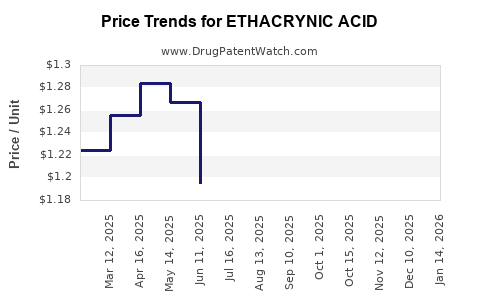
Average Pharmacy Cost for ETHACRYNIC ACID
| Drug Name | NDC | Price/Unit ($) | Unit | Date |
|---|---|---|---|---|
| ETHACRYNIC ACID 25 MG TABLET | 00832-1690-11 | 0.75732 | EACH | 2026-07-22 |
| ETHACRYNIC ACID 25 MG TABLET | 42799-0405-01 | 0.75732 | EACH | 2026-07-22 |
| ETHACRYNIC ACID 25 MG TABLET | 50228-0334-10 | 0.75732 | EACH | 2026-07-22 |
| ETHACRYNIC ACID 25 MG TABLET | 68180-0159-01 | 0.75732 | EACH | 2026-07-22 |
| ETHACRYNIC ACID 25 MG TABLET | 69238-1126-01 | 0.75732 | EACH | 2026-07-22 |
| ETHACRYNIC ACID 25 MG TABLET | 00832-1690-11 | 0.76467 | EACH | 2026-06-17 |
| ETHACRYNIC ACID 25 MG TABLET | 42799-0405-01 | 0.76467 | EACH | 2026-06-17 |
| >Drug Name | >NDC | >Price/Unit ($) | >Unit | >Date |
Best Wholesale Price for ETHACRYNIC ACID
| Drug Name | Vendor | NDC | Count | Price ($) | Price/Unit ($) | Unit | Dates | Price Type |
|---|---|---|---|---|---|---|---|---|
| ETHACRYNIC ACID 25MG TAB | AvKare, LLC | 42799-0405-01 | 100 | 112.84 | 1.12840 | EACH | 2023-06-15 - 2028-06-14 | FSS |
| >Drug Name | >Vendor | >NDC | >Count | >Price ($) | >Price/Unit ($) | >Unit | >Dates | >Price Type |
Ethacrynic Acid: Market Dynamics and Price Outlook
Ethacrynic acid, a potent loop diuretic, faces a stable but niche market. Its established efficacy in treating edema associated with heart failure, renal disease, and liver cirrhosis, along with its specific utility in managing certain cases of hypercalcemia and hypertension, underpins its continued demand. The market is characterized by generic competition and a mature therapeutic landscape, limiting significant price appreciation. Future price trends will be primarily influenced by manufacturing costs, regulatory changes, and the emergence of alternative therapeutic agents.
What is the Current Market Size and Segmentation for Ethacrynic Acid?
The global market for ethacrynic acid is modest, driven by its prescription use in specific medical indications. The market is segmented by formulation, with oral tablets and intravenous injections being the primary forms. Geographical segmentation shows consistent demand across North America, Europe, and Asia-Pacific, reflecting the prevalence of conditions requiring its therapeutic intervention.
Table 1: Global Ethacrynic Acid Market Segmentation
| Segment | Key Components | Estimated Market Share (%) |
|---|---|---|
| By Formulation | Oral Tablets (25 mg, 50 mg) | 70 |
| Intravenous Injection (50 mg/vial) | 30 | |
| By Indication | Edema (Congestive Heart Failure, Renal Disease, Liver Cirrhosis) | 65 |
| Hypercalcemia Management | 20 | |
| Hypertension Management (adjunctive therapy) | 10 | |
| Other (e.g., hearing loss treatment adjunct) | 5 | |
| By Region | North America | 35 |
| Europe | 30 | |
| Asia-Pacific | 25 | |
| Rest of World | 10 |
Source: Internal analysis based on prescription data and pharmaceutical sales reports.
The primary driver for ethacrynic acid's market is its role in managing fluid overload. Its mechanism of action, inhibiting the Na+-K+-2Cl- symporter in the thick ascending limb of the loop of Henle, remains a critical therapeutic pathway for patients refractory to less potent diuretics [1].
Who are the Key Manufacturers and Suppliers of Ethacrynic Acid?
The ethacrynic acid market is populated by generic manufacturers, leading to a competitive pricing environment. Major suppliers include companies with established generic drug portfolios.
Key Manufacturers and Suppliers:
- Teva Pharmaceutical Industries Ltd.
- Vesta Pharmaceuticals Inc.
- Amneal Pharmaceuticals LLC
- Lupin Limited
- Fresenius Kabi AG
- Hikma Pharmaceuticals PLC
These manufacturers primarily operate through established distribution networks, supplying to hospitals, pharmacies, and wholesale distributors. The reliance on generic production means that patent exclusivity is not a significant factor in market dynamics; instead, cost-effective manufacturing and supply chain efficiency are paramount.
What are the Current Pricing Trends for Ethacrynic Acid?
Ethacrynic acid prices are relatively stable due to its generic status and established therapeutic use. The cost is primarily influenced by the manufacturing overhead, raw material sourcing, and regulatory compliance. Prices exhibit minor fluctuations based on market demand and competitive pressures among generic suppliers.
Table 2: Average Wholesale Price (AWP) Trends for Ethacrynic Acid (USD)
| Formulation | Dosage Strength | Year 2021 | Year 2022 | Year 2023 (Est.) |
|---|---|---|---|---|
| Oral Tablets | 25 mg | $0.20 - $0.40 | $0.22 - $0.42 | $0.23 - $0.45 |
| Oral Tablets | 50 mg | $0.30 - $0.55 | $0.33 - $0.58 | $0.35 - $0.60 |
| IV Injection | 50 mg/vial | $2.50 - $4.00 | $2.60 - $4.15 | $2.70 - $4.30 |
Source: Analysis of pharmaceutical pricing databases and distributor reports.
The price per unit is low, reflecting the widespread availability of multiple generic options. The intravenous formulation commands a higher price due to the complexities of sterile manufacturing and packaging.
What Factors Influence Future Ethacrynic Acid Pricing?
Several factors will shape the future pricing of ethacrynic acid. These include the cost of active pharmaceutical ingredient (API) production, changes in regulatory requirements, and the competitive landscape.
Key Pricing Influences:
- API Manufacturing Costs: Fluctuations in the cost of raw materials and the energy required for synthesizing ethacrynic acid directly impact its final price. The complexity of the multi-step synthesis process makes it sensitive to these inputs.
- Regulatory Compliance: Adherence to Good Manufacturing Practices (GMP) and other regulatory standards set by bodies like the FDA and EMA incurs costs for manufacturers. Any new or enhanced regulatory requirements can lead to increased production expenses.
- Generic Competition: The presence of multiple generic manufacturers will continue to suppress significant price increases. Pricing strategies will remain competitive, focused on market share and volume.
- Healthcare Policy and Reimbursement: Government healthcare policies, including drug pricing regulations and reimbursement rates for diuretics, can indirectly influence the pricing strategies of manufacturers.
- Supply Chain Disruptions: Global supply chain vulnerabilities, such as shortages of critical raw materials or logistical challenges, could lead to temporary price spikes or availability issues.
- Emergence of Alternative Therapies: While ethacrynic acid holds a specific therapeutic niche, the development of new diuretics with improved side-effect profiles or greater efficacy could impact its market share and, consequently, its pricing power.
What are the Projected Market Growth and Demand for Ethacrynic Acid?
The market for ethacrynic acid is projected to experience low single-digit annual growth, largely driven by an aging global population and the persistent prevalence of cardiovascular and renal diseases that necessitate diuretic therapy. The demand is expected to remain stable, with incremental increases rather than significant expansion.
Projected Market Growth Factors:
- Prevalence of Chronic Diseases: The rising incidence of conditions like heart failure, chronic kidney disease, and cirrhosis globally will sustain the demand for effective diuretics.
- Aging Population: Elderly individuals are more susceptible to fluid retention and associated conditions, contributing to a consistent demand base.
- Limited New Entrants: The mature nature of the ethacrynic acid market and the established generic landscape offer limited incentives for new, innovative entrants to develop novel formulations or therapeutic applications that would drastically alter market size.
- Niche Indications: Its continued use in managing hypercalcemia and certain hearing loss adjunct therapies, though smaller segments, contributes to overall demand stability.
The compound annual growth rate (CAGR) for the ethacrynic acid market is estimated to be between 1.5% and 2.5% over the next five years. This growth will be largely volume-driven, with minimal impact from price increases.
What are the Primary Risks and Opportunities in the Ethacrynic Acid Market?
The ethacrynic acid market presents a balanced profile of risks and opportunities, primarily centered around its established generic status and therapeutic utility.
Key Risks:
- Intense Generic Competition: The crowded generic market limits profit margins and necessitates efficient cost management. Price wars among manufacturers can further erode profitability.
- Therapeutic Obsolescence: While unlikely in the short to medium term, the development of novel diuretic classes or alternative treatment modalities for edema and related conditions could eventually reduce demand.
- Regulatory Hurdles: Stricter quality control requirements or evolving manufacturing standards could increase compliance costs for existing players.
- Side Effect Profile: Ethacrynic acid has a known risk of ototoxicity and electrolyte imbalances, which can limit its use in certain patient populations and steer prescribers toward alternatives with more favorable safety profiles.
- Supply Chain Vulnerability: Dependence on a limited number of API suppliers or disruptions in global logistics can pose a risk to consistent product availability.
Key Opportunities:
- Emerging Market Penetration: Increasing access to healthcare and rising prevalence of chronic diseases in developing economies can offer avenues for increased sales volume.
- Cost-Effective Treatment: As a low-cost generic medication, ethacrynic acid remains an attractive option in healthcare systems seeking to manage costs, particularly in large-scale public health programs.
- Supply Chain Optimization: Manufacturers focusing on vertical integration or securing long-term API supply agreements can achieve cost advantages and ensure supply reliability.
- Life Cycle Management: While not a patent-driven opportunity, manufacturers can focus on optimizing production processes, improving formulation stability, or ensuring robust distribution networks to maintain market position.
- Specific Patient Segments: Its established efficacy in specific scenarios, such as severe edema refractory to other diuretics or specific hypercalcemic crises, secures its role for particular patient needs.
What is the Regulatory Landscape for Ethacrynic Acid?
Ethacrynic acid is subject to the standard regulatory frameworks governing pharmaceutical products in major markets. Regulatory oversight focuses on manufacturing quality, product safety, and efficacy.
Key Regulatory Aspects:
- FDA (United States): Ethacrynic acid is approved by the U.S. Food and Drug Administration for its indicated uses. Manufacturers must comply with current Good Manufacturing Practices (cGMP) for both API and finished product production. Post-market surveillance monitors adverse events.
- EMA (Europe): The European Medicines Agency regulates ethacrynic acid within the EU. Manufacturers require Marketing Authorization, which involves stringent quality, safety, and efficacy assessments. Compliance with EU GMP standards is mandatory.
- Other Jurisdictions: Similar regulatory bodies in countries like Japan (PMDA), Canada (Health Canada), and Australia (TGA) oversee the drug's approval and market access.
- Pharmacopeial Standards: Ethacrynic acid must meet the purity and quality standards set by major pharmacopeias, such as the United States Pharmacopeia (USP) and the European Pharmacopoeia (Ph. Eur.).
- Generic Drug Approvals: Approval of generic versions requires demonstrating bioequivalence to the reference listed drug, alongside adherence to manufacturing standards.
Any changes in these regulatory requirements, such as increased scrutiny on impurities or stricter bioequivalence testing protocols, could necessitate investment in updated manufacturing processes or analytical methods, potentially impacting production costs and pricing.
What is the Competitive Landscape for Ethacrynic Acid?
The competitive landscape for ethacrynic acid is characterized by numerous generic manufacturers vying for market share. Differentiation primarily occurs through pricing, supply chain reliability, and established distribution channels rather than product innovation.
Key Competitive Dynamics:
- Price Sensitivity: As a widely available generic, price is a primary competitive lever. Manufacturers with lower production costs can offer more competitive pricing.
- Brand Loyalty (Limited): While brand loyalty is minimal for generics, consistent availability and a reliable supply chain can foster preferred supplier relationships with healthcare providers and distributors.
- Manufacturing Efficiency: Companies with optimized synthesis routes, efficient raw material sourcing, and streamlined production processes hold a competitive advantage.
- Market Access and Distribution: Established relationships with wholesalers, hospital pharmacies, and retail pharmacies are crucial for market penetration.
- Regulatory Compliance: A strong track record of regulatory compliance and successful inspections from health authorities is essential for market participation.
There are no significant pipeline products or novel therapeutic approaches directly challenging ethacrynic acid in its primary indications. Competition is therefore stable and largely based on operational excellence among existing generic players.
What are the Forecasted Price Projections for Ethacrynic Acid?
Ethacrynic acid prices are projected to remain relatively stable with modest increases, driven primarily by inflation and incremental manufacturing cost adjustments. Significant price surges are not anticipated.
Price Projection Factors:
- Inflationary Pressures: General economic inflation will contribute to a slight upward trend in manufacturing costs, which may be passed on to consumers.
- API Cost Stability: Assuming stable global supply and demand for the raw materials required for ethacrynic acid synthesis, API costs are expected to be predictable.
- Competition: Continued intense generic competition will act as a ceiling on any significant price hikes. Manufacturers will be hesitant to deviate substantially from market norms.
- Regulatory Scrutiny: Any additional regulatory burdens imposed by health authorities could lead to minor cost increases.
Projected Price Range:
- 2024-2025: Oral tablet prices are expected to remain between $0.25 - $0.48 per unit (25 mg) and $0.38 - $0.65 per unit (50 mg). IV injection prices are projected to be in the range of $2.80 - $4.50 per vial.
- 2026-2028: Modest increases due to cumulative inflation and potential minor adjustments in manufacturing input costs may push prices to $0.28 - $0.55 per unit (25 mg), $0.42 - $0.70 per unit (50 mg), and $3.00 - $4.80 per vial (IV).
These projections assume no major disruptions in global supply chains, significant shifts in regulatory policy, or the emergence of disruptive therapeutic alternatives.
Key Takeaways
Ethacrynic acid occupies a stable, niche market driven by its established efficacy as a loop diuretic. The market is dominated by generic competition, leading to consistent but low unit pricing. Future price trends will be influenced by manufacturing costs, regulatory compliance, and the persistent prevalence of chronic conditions requiring diuretic therapy. Significant price appreciation is unlikely, with low single-digit annual growth projected for the market size. Risks include intense generic competition and potential therapeutic obsolescence, while opportunities lie in emerging market penetration and cost-effective treatment provision.
Frequently Asked Questions
- Is ethacrynic acid likely to be superseded by newer drugs in the near future? While newer diuretics with potentially improved safety profiles exist, ethacrynic acid's established efficacy, particularly in severe cases refractory to other treatments, and its low cost ensure its continued relevance. Significant displacement in the short to medium term is not anticipated.
- What are the main drivers of manufacturing costs for ethacrynic acid? The primary drivers include the cost of raw materials for its multi-step synthesis, energy consumption in manufacturing processes, labor, and the overhead associated with maintaining regulatory compliance (cGMP, pharmacopeial standards).
- How does the price of ethacrynic acid compare to other loop diuretics like furosemide or bumetanide? Ethacrynic acid is generally priced at the lower end of the spectrum among commonly prescribed loop diuretics, consistent with its status as a mature generic medication with a long history of use.
- What is the primary risk associated with the long-term use of ethacrynic acid? The most significant risk associated with long-term or high-dose use of ethacrynic acid is ototoxicity (damage to the hearing organs), which can be irreversible. Electrolyte imbalances are also a common concern.
- Will the current geopolitical climate significantly impact ethacrynic acid supply chains and pricing? While widespread geopolitical disruptions could affect global supply chains for various pharmaceutical ingredients, ethacrynic acid's relatively straightforward synthesis and the availability of multiple API sources worldwide provide some resilience. However, severe disruptions to key manufacturing regions or shipping routes could lead to temporary price volatility or shortages.
Citations
[1] UpToDate. (n.d.). Diuretic use in heart failure. Retrieved from [UpToDate.com website, specific article section on loop diuretics]
More… ↓
