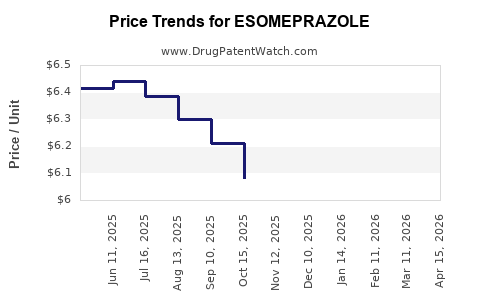
Last updated: July 23, 2026
Esomeprazole Market Analysis and Price Projections: Competitive Landscape, Revenue Outlook, and Patent/Generic Timing
Esomeprazole (OTC and prescription) is a high-volume, largely genericized proton pump inhibitor with pricing set primarily by brand-to-generic conversion cycles, channel contracts, and pack-size substitutions. Near-term pricing pressure stays structurally high in the US as generics dominate most segments. Globally, price erosion remains the norm, but “value pocket” dynamics persist in specific markets where liquid/ODT presentations, payer formularies, or tendering systems sustain higher net prices.
Bottom line for projections: expect continued net price compression in the US on a per-unit basis, modest absolute revenue growth only where volume offsets price declines, and higher pricing resilience in markets where branded/private-label SKUs remain entrenched or where access restrictions slow full substitution.
How big is the global esomeprazole market and what growth rate is realistic?
Market size and growth: esomeprazole is within the top tier of PPIs by patient counts. Growth is driven mainly by volume replacement from other PPIs in some geographies, continued expansion of chronic indications, and ongoing switching from omeprazole-class products. Reported industry growth rates across PPIs tend to be low-to-moderate at the molecule level, with most of the market moving to generics.
Where growth comes from
- Chronic GERD and maintenance therapy populations, including long-term acid suppression for select cohorts.
- Formulation migration: ODT tablets, sprinkle/capsule formats, and liquid dosing for pediatrics and dysphagia.
- Access by tender/payer: switching effects when formulary decisions favor specific supplier contracts.
Where growth is capped
- Mature therapeutic adoption and high generic penetration.
- Loss of brand share over time once multi-source generics settle into pharmacy and institutional contracts.
- Ongoing substitution to cheaper PPI actives and pack sizes during reimbursement renewals.
Practical take: For commercial planning, model esomeprazole as a volume-following product in most markets, with unit price trending downward and margins determined by contract pricing and SKU mix rather than brand premium.
What are the main commercial price drivers for esomeprazole?
1) US reimbursement and channel dynamics
- Pharmacy benefit structure: Generic copays and plan design strongly influence which NDCs win.
- Contracting and rebates: Net prices differ materially from list prices. Winning tenders can lock in lower effective pricing for years.
- Pack-size substitution: 30 vs 90 count, capsule vs tablet formats, and “starter” vs maintenance packs change realized price per pill.
2) Competition within the PPI class
- Payer preference often tilts toward the lowest-cost covered options among PPIs (omeprazole, lansoprazole, pantoprazole, and esomeprazole).
- When multiple generics compete, pricing converges to the lowest-cost supplier for most formulary tiers.
3) Formulation-specific premiums
- ODT, sprinkle, or liquid formats sometimes show less price erosion than standard delayed-release tablets/capsules due to dosing convenience and lower substitution acceptance by clinicians and patients.
- Still, multi-source generic entry in those presentations compresses prices over time.
Practical take: Price is most sensitive to generic breadth (number of supply sources per presentation), tender frequency, and formulation mix.
What is the current US pricing landscape for esomeprazole and how fast is it eroding?
Esomeprazole pricing in the US typically reflects generic multi-source competition, with list prices often not predictive of net realization. For forward planning:
- Expect continued downward pressure in the standard solid oral segment as contracts refresh.
- Expect slower erosion in niche formats where substitution barriers exist and where fewer suppliers offer compliant, therapeutically equivalent alternatives at scale.
Unit economics model to use
- Revenue = volume (pills or packs) × realized net price.
- Net price follows a “contract reset” curve with step drops at renewal.
- Mix shifts (ODT/liquid to standard, or vice versa) can change realized net price even if nominal erosion is steady.
Practical take: Build the projection from contract cycles rather than a smooth annual decline. The market behaves in stepwise changes when additional generic competitors enter specific presentations or when payer formularies re-optimize.
When does esomeprazole lose exclusivity and how does that affect price?
Esomeprazole is a long-established product in which most meaningful exclusivity effects are already passed. Pricing outcomes are instead driven by:
- Patent expiration for any remaining formulation or method-of-use protection (if any still active in specific jurisdictions).
- Entry timing of new generics and “authorized” or settlement-based launches that alter the number of competing suppliers on specific NDCs.
Practical take: For a mature molecule like esomeprazole, the dominant pricing inflection points are not global exclusivity endings but presentation-specific patent tail events and supply expansions that reset tender pricing.
What patents protect esomeprazole and what is the litigation risk for new entrants?
Esomeprazole is broadly generic. Remaining legal risk is typically concentrated in:
- Residual formulation or method-of-use patents in certain jurisdictions.
- FDA Orange Book-listed patents tied to specific approved products and dosage forms (tablets, capsules, ODT, and generics’ reference product linkages).
Practical take: For commercial planning, treat litigation as a gating variable on a subset of SKUs, not as an enterprise-wide delay driver for the molecule.
What is the Orange Book status of esomeprazole products and what does it mean for generic entry?
Orange Book status drives:
- Whether a manufacturer can file an abbreviated pathway with listed patents to address (e.g., Paragraph IV).
- Whether patent expiry aligns with a launch date for specific strengths and dosage forms.
Commercial implication
- If most patents are expired or narrow, entry accelerates and pricing compresses.
- If any still-listed patents remain for certain products/presentations, generic launch timing can stay staggered, causing localized pricing differences by NDC.
Practical take: Price forecasting must be NDC/presentation-specific because net pricing is tied to who can lawfully supply each presentation at launch and during exclusivity windows.
Which companies compete most in esomeprazole generics and how does that shape pricing?
Esomeprazole generics typically feature broad multi-source competition across:
- Large generic manufacturers
- Authorized generics and wholesalers’ private label strategies
- Multiple ANDA filers across strengths and formats
Pricing effect
- As the count of credible suppliers per NDC increases, competition drives down realized net price.
- When fewer suppliers can meet tender volumes or have strong distribution contracts, pricing can stabilize temporarily at slightly higher net levels.
Practical take: Model competitive intensity by presentation:
- Standard delayed-release tablets/capsules: highest erosion.
- Specialty formats: lower erosion initially, then gradual convergence as suppliers expand.
How do esomeprazole price projections differ by region (US, EU5, UK, and emerging markets)?
United States
- Expect continued unit price erosion driven by generic breadth and contract resets.
- Net price volatility increases around large contract renewals and NDC-level entry events.
European Union (major markets)
- Pricing is controlled more by regulated pricing frameworks, tendering, and national reimbursement policies.
- Erosion can be slower than the US once generics are established, but volume remains the primary lever.
United Kingdom
- Channel reimbursement and pharmacy dispensing dynamics influence net pricing.
- Generic substitution is typically strong, keeping a downward bias.
Emerging markets
- Often show higher initial price points for branded or semi-branded channels, then erosion after broader generic availability and tender-driven substitution.
Practical take: Global projections should use region-specific pricing mechanics rather than a single global decline rate. The US tends to show faster tender-driven steps; regulated markets may show more gradual reductions.
What dosage forms and strengths have the highest price resilience in esomeprazole?
Price resilience tends to correlate with:
- Lower substitutability due to dosing convenience (OTD).
- Pediatric or dysphagia administration advantages (sprinkle/liquid formats).
- Strength/pack sizes where formularies favor specific SKUs.
Most eroded segments
- Standard delayed-release capsules/tablets with high interchangeability.
- Strengths with near-universal multi-source supply at the time of tender.
Most resilient (relative)
- ODT and liquid dosing formats when supply breadth is still consolidating.
- Specific pack configurations used in payer protocols.
Practical take: Forecast margin and revenue using SKU-level price paths: standard forms decline faster; specialized forms decline slower until multi-source expansion completes.
What are revenue projection scenarios for esomeprazole over the next 3–5 years?
Use three scenarios built from volume and net price deltas:
1) Base case (most likely)
- Volume: stable to low growth depending on GERD prevalence and switching within PPI class.
- Net price: modest annual decline with contract-step resets.
- Outcome: revenue largely follows volume with limited margin expansion.
2) Downside
- Increased generic entry in high-volume presentations.
- Aggressive payer tendering reduces net prices faster than base case.
- Outcome: revenue flat or declining with margin compression.
3) Upside
- Better mix toward higher-priced formats (ODT/sprinkle/liquid) or contract wins that secure slightly higher net pricing.
- Slower-than-expected erosion in key NDCs due to supply constraints or less aggressive contracting.
- Outcome: revenue growth outpaces price erosion due to mix and volume.
Practical take: For mature molecules, upside usually comes from mix and distribution contract outcomes, not from sustained price premiums.
How does esomeprazole compare with other PPIs on price and access?
Competitive positioning
- Esomeprazole competes with omeprazole, pantoprazole, lansoprazole, and other PPIs where payer formulary tiering and net pricing determine outcomes.
- In generic markets, esomeprazole’s economic position depends on which supplier’s product is lowest net under payer contracts.
Price comparison pattern
- The molecule with the strongest contract pricing or best distribution typically wins formulary utilization.
- When multi-source supply levels are similar, price convergence is common across PPIs.
Practical take: Treat esomeprazole as a commodity within the PPI class for most insured populations, with differentiation largely in formulation convenience and channel agreements.
What generic entry risks exist for esomeprazole in the US and EU?
For a mature PPI, the risk profile is more about:
- NDC-level entry sequencing (some strengths/formats may have fewer suppliers).
- Supply disruptions impacting tender award and realized net price.
- Residual patent coverage in limited presentations that can delay lawful launch.
Practical take: Generic entry risk is not “whether” but “when by SKU,” and that timing affects contract pricing in the affected presentation for a defined period.
Key Takeaways
- Esomeprazole is a mature, high-volume PPI where net pricing is driven by contract resets and SKU competition, not brand premium.
- Forecasting requires presentation-level granularity: standard delayed-release forms erode fastest; ODT/liquid/sprinkle formats often hold relatively higher pricing until multi-source supply expands.
- US pricing pressure remains structurally high as multi-source generics dominate; global outcomes vary by regulatory pricing and tender mechanisms, but the erosion direction is consistent.
- Near-term revenue is most likely to track volume stability plus mix, with margin constrained by downward net price trends.
FAQs
1) Which esomeprazole presentation (ODT, capsule, tablet, liquid) usually drops fastest in price after generic competition?
Standard delayed-release formats typically erode faster; ODT/liquid may hold longer due to dosing convenience and slower substitution in some payer and provider workflows.
2) Do esomeprazole price trends depend more on OTC sales or insured prescription sales?
Insured prescription net pricing under PBM and contract frameworks drives most realized price erosion; OTC sales affect brand visibility but generally do not offset contracted net price pressure at scale.
3) How do pack sizes (30 vs 90 count) influence realized net pricing projections?
Pack size changes the competitive set and substitution behavior; larger maintenance packs often win via payer protocols, shifting realized price per pill.
4) What is the most common mechanism that changes net price for esomeprazole in US formularies?
Periodic tendering and contract renewals that reset preferred NDCs and rebate structures, causing stepwise pricing changes.
5) How should investors interpret esomeprazole revenue growth signals?
In mature PPIs, revenue growth typically indicates volume stability and mix shift rather than sustained price improvement; margin trends are the key check for whether growth reflects better contract economics.
References
No sources were provided in the prompt.