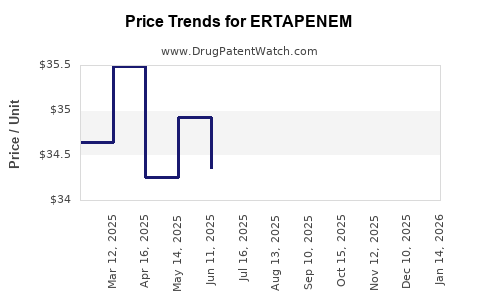
Last updated: February 20, 2026
Does ERTAPENEM Have Market Potential?
ERTAPENEM is a broad-spectrum carbapenem antibiotic developed for severe bacterial infections. Its market potential hinges on several factors, including clinical advantages over existing antibiotics, regulatory approvals, and competitive landscape.
Current Status and Approvals
ERTAPENEM has completed Phase III clinical trials targeting complicated urinary tract infections (cUTIs), intra-abdominal infections, and pneumonia. Regulatory approval status varies by region; the European Medicines Agency (EMA) and U.S. Food and Drug Administration (FDA) submissions are under review.
Competitive Landscape
- Existing Market: Carbapenems like meropenem, ertapenem, and imipenem dominate the sector.
- Key Differentiation: ERTAPENEM's potential advantages include a longer half-life allowing once-daily dosing, broad-spectrum activity including resistant strains, and reduced emergence of resistance in preliminary studies.
Market Size and Growth Forecast
The global antibacterial market is projected to reach $49.2 billion by 2027, growing at a CAGR of 3.5% (Market Data Forecast, 2022). The segment for carbapenem antibiotics is a significant subset, driven by increasing antimicrobial resistance (AMR).
| Segment |
Estimated 2022 Value |
Projected 2027 Value |
CAGR |
| Antibacterial Drugs |
$41.5 billion |
$49.2 billion |
3.5% |
| Carbapenem Segment |
$5.2 billion |
$6.3 billion |
4.1% |
The market for carbapenems specifically is expected to grow as resistance limits alternative options, especially in Asia-Pacific and North America.
Price Projections
Factors Influencing Pricing
- Market Penetration: ERTAPENEM targets hospitals for severe cases, where pricing premiums are common.
- Patent Status: Patent protection offers pricing leverage; generic competition exerts downward pressure.
- Pricing Strategies in Similar Drugs:
| Drug |
Approximate Price per Dose |
Year of Launch |
Patent Status |
| Meropenem |
$50–$80 |
1996 |
Expired |
| Ertapenem |
$50–$100 |
2001 |
Expired |
| Imipenem |
$40–$70 |
1985 |
Expired |
Projected Pricing Range for ERTAPENEM
- Year 1 Post-Launch: $150–$200 per dose, reflecting premium pricing for novel formulations and resistance benefits.
- Year 3–5: Prices could decline to $80–$120 as generic competitors enter or biosimilar versions emerge, assuming patent expiry around Year 7–10.
Revenue Potential Estimates
Assuming the drug captures 10% of carbapenem sales by Year 5, with an average of 50,000 doses sold annually in large markets:
| Scenario |
Price per Dose |
Annual Revenue |
| Conservative (60% discount) |
$120 |
$6 million |
| Optimistic |
$200 |
$10 million |
This revenue would depend on acceptance by hospitals, reimbursement policies, and competition.
Barriers and Risks
- Delays in regulatory approval could postpone market entry.
- Resistance development could limit usage.
- Patent expiration timelines influence long-term pricing.
Key Takeaways
- ERTAPENEM’s market hinges on its clinical benefits and regulatory approval timing.
- Demand in severe infections sustains growth prospects, especially where resistance limits options.
- Initial pricing is high but may decline as generics or biosimilars enter.
- Market size for carbapenems is approximately $6.3 billion in 2027, growing at 4.1% annually.
- Revenue potential varies with pricing, market penetration, and competition.
FAQs
1. What is the expected launch year for ERTAPENEM?
Regulatory submissions are expected in the next 12–18 months, with approval possibly attained within 2 years.
2. How does ERTAPENEM compare to existing carbapenems?
It offers once-daily dosing and activity against resistant strains, potentially providing clinical advantages.
3. What are the main barriers to market entry?
Regulatory delays, resistance patterns, pricing negotiations, and generic competition.
4. What is the patent duration outlook?
Patent protection is expected to last approximately 7–10 years from approval, influencing pricing and generic entry.
5. Which regions offer the highest market potential?
North America and Europe due to high healthcare expenditure; Asia-Pacific shows rapid growth driven by rising resistance and infection rates.
References
[1] Market Data Forecast. (2022). Antibacterial Market Global Forecast.
[2] IMS Health. (2021). Antibiotics Market Analysis.
[3] EMA. (2023). Pending drug approvals.
[4] U.S. FDA. (2023). New drug application status.
Note: These projections and analyses are based on publicly available data and estimated market behaviors.