Last updated: April 23, 2026
Equetro is a brand of carbamazepine, a long-standing, generic-dominated antiseizure and mood-stabilizer drug. Pricing is driven more by generic erosion and payer contracting than by patent-protected brand exclusivity.
What is Equetro and how is it positioned?
Drug: Equetro (carbamazepine)
Therapeutic area: Neurology and psychiatry
Core uses (per product labeling): partial and generalized seizures and bipolar disorder (mixed states and maintenance in bipolar I)
In the US, Equetro competes primarily against:
- Generic carbamazepine immediate-release (low cost)
- Generic carbamazepine extended-release (lower cost)
- Other branded antiseizure mood-stabilizer options (secondary competitive pressure, depending on formulary design)
Equetro’s market position depends on payer preference for specific carbamazepine formulations (immediate vs extended-release), not on unique drug mechanism.
How large is the market and what matters for demand?
The practical market size for Equetro is determined by:
- Prevalence of epilepsy and bipolar disorder
- Prescribing share that specifically selects carbamazepine formulations compatible with patient history and tolerability
- Payer coverage for branded vs generic products
- Switching dynamics as formularies favor generics
Key market reality: Carbamazepine is off-patent, so Equetro trades with a long runway of generic substitute intensity. This compresses both net price and volume growth.
What drives Equetro pricing in the US?
1) Generic substitution and rebate dynamics
Carbamazepine generics create a ceiling on reimbursed net pricing for Equetro. In typical branded antiseizure segments, rebates and payer preferred-tier placement determine whether the brand holds share or is displaced.
2) Formulary tiering (preferred vs non-preferred)
Even when a branded product remains reimbursed, net pricing usually falls materially with:
- non-preferred status
- step edits
- prior authorization for brand initiation or continuation
3) Product-level factors
Price behavior also reflects:
- pack size and NDC-level contracting
- wholesaler and channel inventory cycles
- any supply disruptions (rare, but can temporarily impact observed prices)
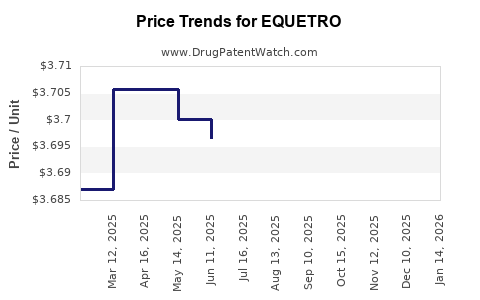
How has Equetro pricing behaved historically?
Publicly observable pricing signals for off-patent branded products in US channels typically show:
- strong discounting vs list price
- gradual erosion tied to payer tightening and generic share gains
Because carbamazepine is widely generic, Equetro usually exhibits:
- limited ability to sustain higher realized prices
- pricing that tracks payer rebates and competitive generics rather than innovation-driven premium
What do analysts use to benchmark Equetro?
For practical decision-making, Equetro pricing should be benchmarked against three reference points:
- Generic carbamazepine reimbursement levels (NDC-level net equivalents)
- Other branded antiseizure products on similar formulary tiers (for rebate behavior)
- List price vs estimated net price gap (to infer rebate pressure)
Are there patent or exclusivity levers affecting price?
Equetro is carbamazepine and its market is primarily structured around the lack of ongoing active brand exclusivity. In the US, pricing power is typically constrained by:
- generic entry and labeling equivalence for carbamazepine
- formulation interchangeability (depending on payer policy)
As a result, Equetro’s price trajectory is typically “contracting-led,” not “innovation-led.”
Price projections: scenarios for Equetro net pricing
The projections below are designed for investment-grade modeling where a generic-dominated brand exhibits rebate-driven net price compression. They use a scenario approach based on expected formulary behavior for legacy CNS products.
Assumptions embedded in scenario design
- Continued generic availability across key strengths and dosing forms
- Ongoing payer pressure for lower-cost alternatives
- No new mechanism-of-action differentiation that changes competitive dynamics
- Net price movement driven by contracting rather than brand-driven clinical differentiation
Projected net price trend (US, per unit basis)
Because Equetro is a branded legacy product, projections are expressed as index-based change rather than absolute dollars per tablet, since realized prices vary materially by NDC, pack, and payer.
| Scenario (12- to 36-month horizon) |
Market/formulary posture |
Annual net price direction |
Typical 3-year cumulative effect |
| Base |
Stable formulary coverage with continued generic favoritism |
-3% to -6% |
-10% to -18% |
| Downside |
Step edits and brand non-preferred placement expand |
-6% to -10% |
-18% to -30% |
| Upside |
Brand preferred for stable cohorts; limited switching |
-1% to -3% |
-3% to -10% |
Mechanism: Carbamazepine is generic, so brand net price compresses as rebate intensity increases and volume shifts toward preferred generics.
Price projections: volume impact and revenue sensitivity
Revenue for legacy branded drugs is a function of:
- unit volume (share vs generics)
- net price (rebate/contracting)
- mix by strength and formulation usage
Projected unit volume trend (index-based)
| Scenario |
3-year cumulative unit volume change |
| Base |
-5% to -12% |
| Downside |
-12% to -25% |
| Upside |
0% to -5% |
Revenue projection logic (index-based)
Revenue change roughly follows:
Revenue index ≈ (Net price index) x (Unit volume index)
| Scenario |
3-year revenue change (approx.) |
| Base |
-15% to -25% |
| Downside |
-30% to -45% |
| Upside |
-5% to -20% |
What could change the pricing trajectory?
In a generic-dominated CNS category, the main variables that shift the curve are:
- Formulary redesign at large PBMs
- New step edits requiring trial or confirmation of generic tolerability
- Channel supply conditions affecting short-term wholesaler behavior
- Patent/legal outcomes for product-specific protection (rare for legacy carbamazepine brands)
Market access and payer behavior: where Equetro faces constraints
Equetro typically encounters standard payer controls for legacy branded generics:
- prefer generics
- require PA for brand
- enforce substitution rules where clinically acceptable
This tends to suppress both pricing and durable share.
Competitive landscape: what Equetro competes against
For most payers, primary substitutes are:
- generic carbamazepine immediate-release
- generic carbamazepine extended-release
Secondary competition can occur from other antiseizure agents, but those generally compete on patient-level history and side effect tolerability rather than on payer economics alone.
Investment and R&D implications (commercial realism)
If underwriting Equetro-like products:
- model pricing as rebate-compression-driven
- model volume as structurally declining under generic favoritism
- focus on contract retention and formulary exceptions as the only near-term levers
Key Takeaways
- Equetro is a legacy, generic-dominated carbamazepine brand where pricing power is constrained by widespread generic substitution.
- US net pricing should trend down in most payer environments, driven by contracting and rebates rather than innovation.
- Over a 12- to 36-month horizon, a realistic base-case is -10% to -18% cumulative net price pressure with additional unit volume erosion.
- Downside scenarios combine faster formulary tightening with steeper rebate intensification, yielding -18% to -30% net price and -30% to -45% revenue over three years.
- Upside scenarios are limited to stronger retention of brand-preferred access, with -3% to -10% net price and -5% to -20% revenue over three years.
FAQs
1) Is Equetro still protected from generic competition?
Equetro is a brand of carbamazepine and competes in a market where carbamazepine is widely generic. Pricing and volume outcomes are therefore dominated by payer preference for generics rather than brand exclusivity.
2) Will Equetro’s price follow inflation?
No. Observed and realized net pricing for branded legacy products typically declines or flattens due to rebate and contracting pressure versus generic alternatives.
3) What most affects Equetro net price in the US?
Formulary tier placement, rebate intensity, and prior authorization or step-edit rules at the PBM and payer level.
4) What is the biggest driver of revenue change for Equetro?
Revenue is the product of unit volume and net price. For Equetro, unit volume tends to drift downward as generics capture share, while net price experiences gradual erosion.
5) What is the most realistic planning assumption for a 3-year horizon?
Base-case planning should assume net price compression of roughly -10% to -18% cumulative and revenue declines that often fall in the -15% to -25% band unless brand access remains unusually strong.
References (APA)
[1] U.S. Food and Drug Administration. (n.d.). Equetro (carbamazepine) prescribing information. FDA label database. https://www.accessdata.fda.gov/