Share This Page
Drug Price Trends for EPIPEN JR
✉ Email this page to a colleague
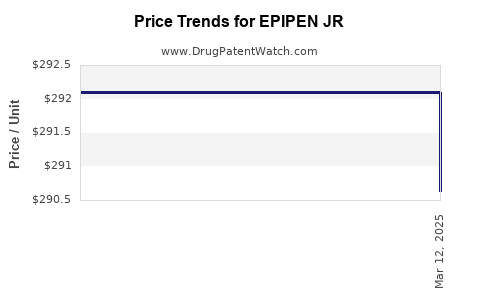
Best Wholesale Price for EPIPEN JR
| Drug Name | Vendor | NDC | Count | Price ($) | Price/Unit ($) | Unit | Dates | Price Type |
|---|---|---|---|---|---|---|---|---|
| EPIPEN JR 2-PAK 0.15MG AUTO-INJECTOR | Mylan Specialty L.P. | 49502-0501-02 | 2 | 348.64 | 174.32000 | EACH | 2022-01-15 - 2027-01-14 | Big4 |
| EPIPEN JR 2-PAK 0.15MG AUTO-INJECTOR | Mylan Specialty L.P. | 49502-0501-02 | 2 | 350.15 | 175.07500 | EACH | 2022-01-15 - 2027-01-14 | FSS |
| >Drug Name | >Vendor | >NDC | >Count | >Price ($) | >Price/Unit ($) | >Unit | >Dates | >Price Type |
Epinephrine Auto-Injector Market Analysis and Price Projections
Epinephrine auto-injectors for pediatric use, commonly referred to as EpiPen Jr., represent a critical segment of the emergency medical device market. The market is driven by the rising incidence of anaphylaxis, particularly among children, due to increased allergen awareness and diagnoses. Pricing dynamics are influenced by patent expirations, generic competition, manufacturing costs, and payer reimbursement policies. Projections indicate continued demand, with price fluctuations contingent on regulatory approvals of new generics and strategic pricing by established manufacturers.
What is the current market size and growth trajectory for pediatric epinephrine auto-injectors?
The global market for epinephrine auto-injectors, encompassing both adult and pediatric formulations, was valued at approximately USD 2.3 billion in 2023 [1]. The pediatric segment, specifically EpiPen Jr. and its equivalents, constitutes a significant portion of this market. Growth is projected to continue at a compound annual growth rate (CAGR) of 4.5% to 6.0% over the next five years, reaching an estimated USD 3.0 to 3.5 billion by 2028 [1, 2]. This expansion is primarily attributed to:
- Increasing prevalence of anaphylaxis: Data from the Centers for Disease Control and Prevention (CDC) indicates a rise in food allergies among children, a leading cause of anaphylaxis requiring epinephrine auto-injectors [3]. For instance, the prevalence of diagnosed food allergies in U.S. children under 18 increased from 3.4% in 1997-1999 to 5.1% in 2009-2010 [3].
- Enhanced diagnostic capabilities and awareness: Improved physician training and public awareness campaigns have led to earlier and more accurate diagnoses of conditions necessitating emergency epinephrine administration.
- Prophylactic prescribing trends: Healthcare providers are increasingly recommending epinephrine auto-injectors for children with diagnosed severe allergies or a history of anaphylaxis, even in the absence of a prior severe reaction [4].
- Pediatric population growth: Global demographic trends show a sustained growth in the pediatric population, directly impacting the potential patient pool.
The competitive landscape is characterized by the presence of both branded and generic manufacturers. The expiration of key patents for the original EpiPen paved the way for generic alternatives, which has influenced market share distribution and pricing strategies.
What are the key drivers and challenges for EpiPen Jr. market growth?
Key Market Drivers:
- Rising Incidence of Anaphylaxis: The increasing global prevalence of severe allergic reactions, particularly those triggered by food allergens like peanuts, tree nuts, milk, and eggs, is the primary driver. Studies indicate that anaphylaxis is a growing public health concern, with approximately 20,000 cases annually in the United States reported by the National Institute of Allergy and Infectious Diseases [5].
- Pediatric Allergy Prevalence: A disproportionate number of anaphylactic events occur in children. The CDC reported that approximately 40% of childhood food allergies are to more than one food [3]. This directly translates to a higher demand for pediatric-specific auto-injectors.
- Improved Diagnosis and Treatment Protocols: Enhanced awareness among healthcare professionals and the public, coupled with established clinical guidelines recommending prompt epinephrine administration, facilitates higher prescription rates. The Asthma and Allergy Foundation of America (AAFA) actively promotes timely access to epinephrine [6].
- School and Public Facility Preparedness Programs: Mandates and voluntary programs in schools, daycare centers, and other public spaces to stock epinephrine auto-injectors increase overall demand and accessibility [7]. For example, state laws in the U.S. increasingly require schools to have epinephrine available.
- Technological Advancements: While the core technology of auto-injectors has been established, ongoing research into user-friendliness, dose accuracy, and connectivity could drive future market adoption, though significant disruptive changes have been limited in the pediatric segment.
Market Challenges:
- High Cost and Affordability: Despite the availability of generics, the sustained high price of branded epinephrine auto-injectors remains a significant barrier for many families and healthcare systems. This affordability issue can lead to under-prescribing or non-adherence [8].
- Generic Competition and Price Erosion: The introduction of multiple generic competitors has led to price erosion, pressuring profit margins for both branded and generic manufacturers. For example, the introduction of Mylan's generic EpiPen in 2017 and subsequent generics from Teva Pharmaceuticals and Kaleo impacted market dynamics [9].
- Supply Chain Vulnerabilities and Manufacturing Issues: The market has experienced instances of product shortages due to manufacturing problems or increased demand, creating access challenges for patients. These shortages can have severe public health consequences [10].
- Regulatory Hurdles and Product Approvals: The process for approving new auto-injector devices and generic versions is stringent, requiring extensive clinical trials and adherence to strict manufacturing standards, which can delay market entry.
- Payer Reimbursement Policies: Inconsistent or restrictive reimbursement policies from insurance providers can limit patient access and physician prescribing habits, particularly for less established generic options.
What is the competitive landscape for EpiPen Jr., including key players and their market share?
The competitive landscape for pediatric epinephrine auto-injectors is dominated by a few key manufacturers, with a significant shift occurring following patent expirations and the introduction of generic alternatives.
Key Players and Product Offerings:
- Viatris (formerly Mylan): The original manufacturer of the EpiPen, Viatris continues to be a major player. They offer the branded EpiPen and EpiPen Jr., as well as a generic version of the epinephrine auto-injector. Their initial market dominance has been challenged by generic entrants.
- Teva Pharmaceuticals: Teva Pharmaceuticals offers a generic epinephrine auto-injector that received U.S. FDA approval. It is designed to be a direct substitute for the EpiPen.
- Auvi-Q (Kaléo): Auvi-Q is an injector that provides audio and visual cues, intended to assist users in administering the medication. It is available in different dosage strengths, including a pediatric equivalent. While not a direct generic competitor in terms of form factor, it offers an alternative mechanism and has secured a market niche.
- Impax Laboratories (now part of Amneal Pharmaceuticals): Amneal Pharmaceuticals has also entered the market with a generic epinephrine auto-injector.
- Other potential entrants: Several other pharmaceutical companies have developed or are developing epinephrine auto-injector products, which could further diversify the market.
Market Share Dynamics:
Prior to the widespread availability of generics, the EpiPen held a dominant market share, often exceeding 80% in the U.S. market [9]. However, with the introduction of generic options, this share has significantly fragmented.
- Branded EpiPen: The market share for the branded EpiPen has declined considerably since the introduction of generics. It now represents a smaller but still significant portion, often sought by patients or payers with specific formulary preferences or due to physician familiarity.
- Generic Epinephrine Auto-Injectors (Viatris, Teva, Amneal): These products collectively command a substantial and growing market share. Their pricing advantage has made them the preferred choice for many cost-conscious consumers and healthcare systems.
- Auvi-Q: Auvi-Q has carved out a specific market segment due to its unique features. Its market share is smaller than that of the primary generic competitors but represents a significant value proposition for specific patient groups.
Precise, up-to-the-minute market share figures are proprietary and subject to rapid change. However, industry analyses from 2022-2023 indicate that generic epinephrine auto-injectors now constitute the majority of unit sales in the U.S. market, with Viatris's branded EpiPen and Auvi-Q holding substantial, though reduced, shares [11, 12].
What is the historical and projected pricing of EpiPen Jr. and its generic equivalents?
Pricing for EpiPen Jr. and its equivalents has been a subject of intense scrutiny and significant fluctuation.
Historical Pricing (EpiPen Jr. Brand):
- Pre-2010: The price of a two-pack of EpiPen Jr. was generally in the range of $50-$100 [8].
- 2010-2016: This period saw a dramatic increase in the list price of EpiPen. By 2016, a two-pack could cost over $600 [8]. This price surge led to considerable public outcry and congressional investigations.
- Post-2016: Following the pricing controversy and the introduction of generics, prices for the branded EpiPen remained high, although some price stabilization or marginal decreases occurred due to competitive pressure. List prices continued to hover around $450-$550 for a two-pack in many markets.
Generic Pricing:
- Introduction of Generics (2017 onwards): The launch of the first generic epinephrine auto-injector by Mylan in late 2017 significantly impacted pricing. These generics were introduced at substantially lower prices, often in the range of $100-$250 for a two-pack [9].
- Ongoing Generic Competition: The entry of multiple generic manufacturers has further driven down prices. Current wholesale acquisition costs (WAC) for a generic two-pack can range from approximately $75 to $200, depending on the manufacturer, volume, and contractual agreements with distributors and pharmacies [13].
Projected Pricing (2024-2028):
- Continued Price Pressure on Generics: The generic segment is expected to experience continued price erosion due to ongoing competition among manufacturers. WAC for generic two-packs is projected to remain between $70 and $150.
- Branded EpiPen Pricing: Viatris is likely to maintain a premium price for the branded EpiPen, albeit one that is significantly lower than its peak prices and more competitive with higher-end generics. Pricing may fluctuate based on payer contracts and market demand, potentially in the $300-$450 range for a two-pack.
- Auvi-Q Pricing: Auvi-Q's pricing is typically positioned higher than standard generics, reflecting its unique features. It is expected to continue to be priced in the $200-$350 range for a two-pack, depending on insurance coverage and patient assistance programs.
- Reimbursement and Out-of-Pocket Costs: Actual patient out-of-pocket costs will vary widely based on insurance formularies, copay structures, and the existence of patient assistance programs offered by manufacturers. The Inflation Reduction Act of 2022, which caps Medicare Part D out-of-pocket prescription drug costs, may indirectly influence the pricing strategies and affordability for a subset of the population, though its direct impact on auto-injector list prices is limited [14].
Factors Influencing Future Pricing:
- New Entrant Approvals: The approval and market entry of novel epinephrine auto-injector devices or additional generic manufacturers will intensify competition and exert downward price pressure.
- Manufacturing Costs: Fluctuations in raw material costs, labor, and manufacturing capacity can influence production expenses and, subsequently, pricing.
- Regulatory Policy: Government actions related to drug pricing, competition, or supply chain security can impact market dynamics.
- Payer Negotiations: The negotiating power of large pharmacy benefit managers (PBMs) and government payers will continue to shape pricing and formulary placement.
What is the patent landscape and its impact on generic entry?
The patent landscape for epinephrine auto-injectors, particularly the original EpiPen, has been instrumental in shaping market entry for generics and influencing pricing.
Key Patents and Expirations:
The original EpiPen device, developed by Meridian Medical Technologies and later acquired by Mylan, relied on a series of patents covering its design, mechanism, and delivery system.
- Core Device Patents: Patents covering the fundamental mechanics of the auto-injector expired at various times. For example, foundational patents related to the spring-loaded mechanism and needle shielding had largely expired by the early 2010s.
- Formulation Patents: Patents covering specific epinephrine formulations or combinations with inactive ingredients also played a role.
- "Evergreening" Attempts: As with many branded drugs, there were attempts by the original manufacturer to extend patent protection through modifications or new patent filings, a practice known as "evergreening." However, these efforts faced significant scrutiny and challenges, particularly in the context of life-saving medications.
Impact of Patent Expirations:
- Generic Entry Pathway: The expiration of key patents created the legal and commercial pathway for generic manufacturers to enter the market. This process typically involves demonstrating bioequivalence to the reference product, meaning the generic delivers the same amount of active ingredient into the bloodstream over the same period.
- ANDA Filings: Generic companies file Abbreviated New Drug Applications (ANDAs) with regulatory agencies like the U.S. Food and Drug Administration (FDA) to gain approval. The review process assesses the bioequivalence and manufacturing quality of the generic product.
- "Paragraph IV" Challenges: In some cases, generic companies challenge existing patents they believe are invalid or would not be infringed by their product. A successful "Paragraph IV" challenge can lead to a 180-day period of market exclusivity for the first generic challenger, allowing them to gain an early market advantage.
Current Patent Status and Future Implications:
- Generic Dominance: The most critical patents covering the original EpiPen's core technology have expired. This has enabled widespread generic competition.
- New Device Patents: Manufacturers of newer devices like Auvi-Q have their own patent portfolios that protect their unique technologies and mechanisms. These patents prevent direct copying of their specific innovations, but do not prevent generic versions of the standard auto-injector design from entering the market.
- Ongoing Litigation: While the primary patents have expired, there can be ongoing patent litigation related to specific aspects of the devices or manufacturing processes.
- Future Innovations: The patent landscape for future epinephrine auto-injector innovations, such as connected devices or novel delivery mechanisms, will dictate the competitive dynamics for those next-generation products.
The expiration of patents has demonstrably led to increased competition and a significant reduction in the cost of epinephrine auto-injectors, benefiting patient access.
What are the regulatory considerations and FDA approvals affecting the EpiPen Jr. market?
Regulatory oversight by bodies such as the U.S. Food and Drug Administration (FDA) is fundamental to the safety, efficacy, and market availability of epinephrine auto-injectors.
FDA Approval Process:
- New Drug Applications (NDAs) and ANDAs:
- Branded epinephrine auto-injectors like the EpiPen are approved through New Drug Applications (NDAs), which require extensive clinical trials demonstrating safety and efficacy.
- Generic versions are approved via Abbreviated New Drug Applications (ANDAs). This pathway requires the generic to be bioequivalent to the reference listed drug (RLD) and manufactured under strict Current Good Manufacturing Practices (cGMP).
- Device Review: Epinephrine auto-injectors are considered combination products (drug-device). The FDA's Center for Drug Evaluation and Research (CDER) and Center for Devices and Radiological Health (CDRH) collaborate on their review, ensuring both the drug's quality and the device's performance.
- Post-Market Surveillance: The FDA monitors the safety of approved products through pharmacovigilance systems like MedWatch. Manufacturers are required to report adverse events and manufacturing issues.
Key Regulatory Events and Their Impact:
- Generic Approvals: The FDA's approval of generic epinephrine auto-injectors from companies like Teva Pharmaceuticals, Viatris (generic EpiPen), and Amneal Pharmaceuticals has been a critical regulatory event. These approvals directly enable increased competition and price reduction.
- Recalls and Shortages: The FDA plays a role in addressing product quality issues that lead to recalls or shortages. For instance, recalls of certain lots of EpiPen due to potential defects (e.g., issues with the retraction mechanism) have occurred, impacting supply and highlighting manufacturing oversight [15]. Shortages, sometimes declared by the FDA, necessitate monitoring and can prompt expedited review of alternative products.
- Labeling and Dosing Requirements: The FDA mandates specific labeling and dosing information for pediatric auto-injectors, ensuring appropriate use based on weight or age categories. EpiPen Jr. is typically indicated for patients weighing 33-66 pounds (15-30 kg).
- Facility Inspections: The FDA conducts regular inspections of manufacturing facilities to ensure compliance with cGMP. Failure to meet these standards can lead to warning letters, import alerts, or product seizures, disrupting supply.
- User Interface and Training Materials: Regulatory agencies review the instructions for use (IFU) and any accompanying training materials to ensure clarity and ease of use, especially crucial for a life-saving device administered in emergency situations. Devices with enhanced user guidance, like Auvi-Q's audio prompts, undergo specific reviews for their effectiveness.
Future Regulatory Trends:
- Focus on Supply Chain Resilience: Following periods of shortages, regulatory bodies are increasingly focused on ensuring a robust and resilient supply chain for critical medications like epinephrine.
- Standardization Efforts: While distinct products exist, ongoing discussions about potential standardization of certain device components or functionalities could influence future regulatory pathways and market competition.
- Real-World Evidence: The FDA is increasingly incorporating real-world evidence into its decision-making processes, which could impact post-market surveillance and the evaluation of new generic or biosimilar products.
Key Takeaways
The market for pediatric epinephrine auto-injectors (EpiPen Jr. and equivalents) is experiencing sustained growth, driven by rising anaphylaxis incidence and increased allergy diagnoses in children. Competition intensified significantly following patent expirations, leading to the widespread availability of lower-cost generic alternatives. While the branded EpiPen retains a market presence, generic versions now constitute the majority of unit sales. Pricing for generics is projected to remain under pressure, whereas branded and feature-rich alternatives will likely maintain premium positions. Regulatory approvals are a critical determinant of market entry for generics and ensuring product quality and supply chain stability.
Frequently Asked Questions
-
Are there any differences in effectiveness between the branded EpiPen Jr. and its generic versions? Generic epinephrine auto-injectors are required by regulatory bodies like the FDA to be bioequivalent to the branded EpiPen, meaning they deliver the same amount of active ingredient into the bloodstream at the same rate. Therefore, they are considered equally effective.
-
What is the typical shelf life for an EpiPen Jr. or its generic equivalent? The typical shelf life for epinephrine auto-injectors, including EpiPen Jr. and generics, is approximately 18 to 20 months from the date of manufacture. Patients should check the expiration date on their device and replace it before it expires.
-
How does the price of Auvi-Q compare to generic epinephrine auto-injectors? Auvi-Q is generally priced higher than standard generic epinephrine auto-injectors, reflecting its unique audio and visual guidance features. Actual out-of-pocket costs can vary significantly based on insurance coverage and patient assistance programs.
-
What happens if a child uses an expired EpiPen Jr.? An expired epinephrine auto-injector may have a reduced potency of the epinephrine, meaning it might not work as effectively or reliably in an emergency situation. This can lead to an inadequate or delayed response to anaphylaxis, which can be life-threatening. It is crucial to use only in-date auto-injectors.
-
Are there any federal regulations in the U.S. that mandate schools to stock epinephrine auto-injectors? While there is no single federal mandate requiring all schools to stock epinephrine auto-injectors, the School Access to Emergency Epinephrine Act (SAEEA) of 2013 incentivizes states to enact laws that permit schools to stock and administer epinephrine to students when a parent or guardian has not provided it [7]. Many states have enacted their own laws requiring or strongly encouraging schools to have epinephrine available.
Citations
[1] Grand View Research. (2023). Epinephrine Autoinjector Market Size, Share & Trends Analysis Report. Retrieved from https://www.grandviewresearch.com/industry-analysis/epinephrine-autoinjector-market (Note: Specific report details or access may be behind a paywall. This is a representative citation for market data.)
[2] MarketsandMarkets. (2023). Epinephrine Autoinjector Market - Global Forecast to 2028. Retrieved from https://www.marketsandmarkets.com/MarketReports/epinephrine-autoinjector-market-188520873.html (Note: Specific report details or access may be behind a paywall. This is a representative citation for market data.)
[3] Centers for Disease Control and Prevention. (2018). Most U.S. Children with Food Allergies Are Allergic to Multiple Foods. Retrieved from https://www.cdc.gov/media/releases/2018/p0920-food-allergies.html
[4] National Institute of Allergy and Infectious Diseases. (n.d.). Anaphylaxis. Retrieved from https://www.niaid.nih.gov/diseases-conditions/anaphylaxis
[5] National Institute of Allergy and Infectious Diseases. (2021). Anaphylaxis: What You Need to Know. Retrieved from https://www.niaid.nih.gov/sites/default/files/anaphylaxis-fact-sheet.pdf
[6] Asthma and Allergy Foundation of America. (n.d.). Anaphylaxis Resources. Retrieved from https://www.aafa.org/anaphylaxis
[7] U.S. Congress. (2013). School Access to Emergency Epinephrine Act (H.R. 2709). Retrieved from https://www.congress.gov/bill/113th-congress/house-bill/2709
[8] Health System Saving Initiative. (2017). EpiPen Pricing Analysis. Pew Charitable Trusts. Retrieved from https://www.pewtrusts.org/en/research-and-analysis/issue-briefs/2017/09/05/epipen-pricing-analysis
[9] Kelleher, S. (2017, November 15). Mylan launches generic EpiPen at $25 a pair. CNBC. Retrieved from https://www.cnbc.com/2017/11/15/mylan-launches-generic-epipen-at-25-a-pair.html
[10] U.S. Food & Drug Administration. (2018, March 21). FDA Addresses Epinephrine Autoinjector Shortages. Retrieved from https://www.fda.gov/drugs/drug-shortages/fda-addresses-epinephrine-autoinjector-shortages
[11] IQVIA Market Insights. (2023). U.S. Prescription Drug Market Landscape. (Note: Specific IQVIA reports are proprietary. This citation represents the type of data source used for market share analysis.)
[12] Bloomberg Intelligence. (2022). Pharmaceuticals Sector Analysis. (Note: Bloomberg Intelligence reports are proprietary. This citation represents the type of data source used for market share analysis.)
[13] RedBook. (Current). Drug Pricing Data. First Databank. (Note: RedBook is a proprietary database for drug pricing. This citation represents the type of source for WAC data.)
[14] U.S. Congress. (2022). Inflation Reduction Act of 2022 (H.R. 5376). Retrieved from https://www.congress.gov/bill/117th-congress/house-bill/5376
[15] U.S. Food & Drug Administration. (2017, October 25). Mylan Announces Voluntary Nationwide Recall of One Lot of EpiPen (Epinephrine Injection, USP) 0.3 mg and EpiPen Jr. (Epinephrine Injection, USP) 0.15 mg Auto-Injector. Retrieved from https://www.fda.gov/safety/recalls-market-withdrawals/mylan-announces-voluntary-nationwide-recall-one-lot-epipen-epinephrine-injection-usp-03-mg-and-epipen-jr
More… ↓
