Last updated: February 13, 2026
What is the current market landscape for enalapril-hydrochlorothiazide?
Enalapril-hydrochlorothiazide combines an ACE inhibitor (enalapril) with a diuretic (hydrochlorothiazide) to treat hypertension and heart failure. It is a generic medication with multiple approved formulations. Global sales are driven primarily by the United States, Europe, and emerging markets.
The drug's market value was approximately $300 million in 2022, with annual growth rates ranging from 2% to 4% over the past five years. Growth is supported by increasing hypertension prevalence, especially among aging populations, and a shift towards combination therapy to improve compliance.
How competitive is the enalapril-hydrochlorothiazide market?
The market features several branded and generic formulations:
- Branded versions by Pfizer, Merck, and Teva.
- Multiple generic manufacturers with FDA and EMA approvals.
- No recent patent protections, with the original patents expiring by 2010-2015, leading to widespread generic entry.
Pricing varies by region and manufacturer but averages:
| Region |
Average Wholesale Price (per tablet) |
Typical Pack Size |
Market Entry Price (USD) |
| US |
$0.10 - $0.15 |
30 tablets |
$3.00 - $4.50 |
| Europe |
€0.08 - €0.12 (approx. $0.09 - $0.13) |
28 tablets |
$2.50 - $4.00 |
| Emerging markets |
$0.03 - $0.07 |
varies |
$0.75 - $2.00 |
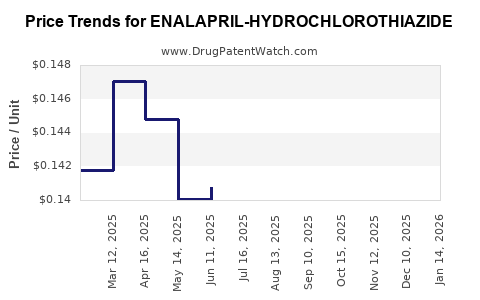
Pricing has declined steadily over the past decade due to generic competition.
What factors influence future price trends?
Multiple factors will influence prices moving forward:
- Patent activity: No enzyme-related patent protections remain; pricing is driven by generics.
- Market penetration: Increasing use in treating hypertension in developing countries may stabilize volumes.
- Regulatory policies: Price control measures in Europe and parts of Asia can suppress prices.
- Manufacturing costs: Slight reductions expected with improvements in production efficiency, but not enough to substantially lower prices.
What are the forecasted market revenues and price trends?
Projections suggest steady growth in global sales to approximately $350 million by 2027. Price per unit will likely decrease marginally:
- 2023-2024: Slight decline of 1-2% in average wholesale prices.
- 2025-2027: Stabilization or minor further decline (0.5-1%) due to market saturation.
Volume growth will accompany price stabilization, driven by increased use in hypertensive and heart failure populations.
What are the key regions impacting market trends?
| Region |
Market Expansion Drivers |
Regulatory Environment |
| US |
Aging population, insurance coverage, adherence to clinical guidelines |
Price pressures from CMS, formulary systems |
| Europe |
Healthcare budget constraints, shift to biosimilars and generics |
Price regulation, tendering processes |
| Emerging Markets |
Growing access to healthcare, increasing hypertension prevalence |
Variable, often less restrictive |
How do regulatory policies influence prices?
Europe’s price caps and bidding processes tend to pressure prices downward. The US market’s pricing is more flexible but driven by insurance formularies. Emerging markets experience less regulation, resulting in wider price variability.
What are the licensing and patent considerations?
Since enalapril-hydrochlorothiazide is off patent, generic manufacturers produce formulations at lower costs. No recent patent litigations or exclusivity extensions affect pricing, but industry consolidation could influence supply and pricing dynamics.
Price projection summary
- Price per tablet will decline by 0.5-1% annually through 2027.
- Total market revenue will grow modestly, reaching approximately $350 million in five years.
- Competition from biosimilar or combination therapies (e.g., ARBs plus diuretics) may exert downward pressure.
Key Takeaways
- The enalapril-hydrochlorothiazide market is mature with a predominantly generic landscape.
- Prices are declining gradually, with regional differences driven by policies and market dynamics.
- Growing hypertensive patient populations will sustain moderate revenue growth, offsetting declining unit prices.
- Regulatory measures and healthcare reforms in major markets will influence price stability.
- Investment and R&D focus may shift toward alternative therapies or fixed-dose combinations with patent protections.
FAQs
-
What are the primary drivers behind market growth?
Increasing hypertension prevalence, aging populations, and better access in emerging markets.
-
How does generic competition affect prices?
It reduces prices significantly, leading to a downward trend over the past decade.
-
What regulatory factors influence pricing?
Price caps, tendering, and formulary negotiations, especially in Europe and emerging markets.
-
Are there ongoing patent protections for enalapril-hydrochlorothiazide?
No, patents expired between 2010 and 2015, enabling widespread generic manufacturing.
-
What is the outlook for high-cost branded versions?
Limited; most markets favor generics due to affordability, unless new formulations or combination therapies with patent protections emerge.
Citations:
[1] IQVIA. "Global Pharmaceutical Market Trends," 2022.
[2] MedTech Outlook. "Generic Diabetes and Hypertension Medications," 2022.
[3] European Medicines Agency. "Price Regulation Policies in Europe," 2023.