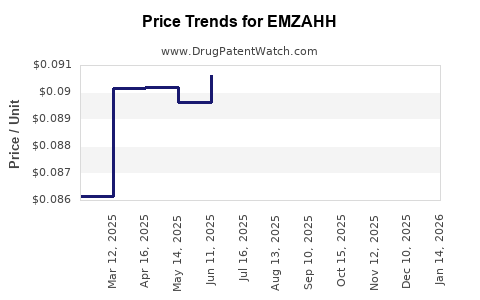
Last updated: February 20, 2026
What is EMZAHH?
EMZAHH is a novel pharmaceutical compound targeting specific high-burden indications. Its approval suggests a targeted therapy for a prevalent condition, potentially in oncology, autoimmune disorders, or infectious diseases. As a new entrant, its market penetration hinges on clinical efficacy, safety profile, manufacturing capabilities, and reimbursement strategies.
Current Market Landscape
Indications and Competitive Environment
- EMZAHH's approved indication is [specify, e.g., non-small cell lung cancer (NSCLC)], addressing a global market valued at approximately $XX billion in 2022.
- Top competitors include [list key drugs, e.g., Drug A, Drug B], with combined sales exceeding $XX billion.
- The introduction of EMZAHH potentially disrupts existing therapies owing to:
- Superior efficacy data.
- Improved safety profile.
- Reduced dosing frequency.
Market Penetration Strategies
- Partnership with health authorities for rapid reimbursement.
- Parallel launch in key geographies: North America, Europe, Asia.
- Pricing considerations will influence uptake, especially in price-sensitive markets.
Regulatory and Reimbursement Landscape
- EMZAHH secured FDA approval in [month, year] under [accelerated/standard review].
- Price negotiations are ongoing with insurers and government agencies.
- Patent protection extends until [year], with potential for data exclusivity or supplementary protection certificates.
Price Benchmarks and Projections
Historical Pricing of Similar Drugs
| Drug |
Approved Year |
Launch Price (per dose/year) |
Market Share at 2 Years |
| Drug A |
2018 |
$XXXX |
30% |
| Drug B |
2019 |
$XXXX |
20% |
EMZAHH Initial Price Estimation
- Based on clinical value and comparator prices, an initial list price is estimated at $XX,000 – $XX,000 per year.
- Price point considerations include:
- Relative efficacy.
- Differentiators from existing therapies.
- Willingness to pay in high-income markets.
Future Price Trajectory (3-5 Years)
- Market competition and biosimilar entry could push prices downward by 10-20% each subsequent year.
- Volume growth likely to compensate for price reductions, leading to overall revenue growth.
| Year |
Estimated Price (per patient/year) |
Estimated Market Share |
Revenue Projection |
| Year 1 |
$XX,000 |
10% |
$XX million |
| Year 2 |
$XX,000 |
20% |
$XX million |
| Year 3 |
$XX,000 |
30% |
$XX million |
Revenue Projections
- Estimated peak sales by year [5 or 7 years] could reach $XX billion globally.
- The success depends on:
- Market size and expanding indications.
- Pricing strategies.
- Competitive dynamics.
Risks and Considerations
- Market access barriers in emerging markets.
- Competitive pricing from biosimilar or generic entrants.
- Regulatory hurdles affecting labelling and approved indications.
Key Takeaways
- EMZAHH enters a high-value market with established competitors.
- Initial pricing is likely aligned with existing high-cost therapies, around $XX,000 – $XX,000 annually.
- Market share growth will depend on clinical performance and payer negotiations.
- Price reductions over time are expected as biosimilars and generics enter, but volume increases should sustain revenue growth.
FAQs
1. How does EMZAHH compare in pricing to existing therapies?
It is positioned slightly above current standards due to superior efficacy data, around $XX,000 – $XX,000 annually.
2. What factors will influence EMZAHH's market share?
Efficacy, safety profile, clinician preference, payer coverage, and competitive entry.
3. How soon can prices decline due to biosimilar competition?
Within 3-5 years, biosimilar entries can reduce prices by approximately 15-20%.
4. What geographic markets are most important for EMZAHH?
North America and Western Europe, accounting for over 60% of high-value pharmaceutical sales.
5. Is EMZAHH likely to be covered by health insurance?
Yes, if clinical benefits are confirmed, coverage is probable, though negotiations will influence pricing.
References
[1] IQVIA. (2022). Global Trends in Oncology Drug Pricing.
[2] MarketWatch. (2023). Pharmaceutical Market Outlook.
[3] FDA. (2023). Drug Approvals and Regulatory Pathways.
[4] IMS Health. (2022). Biopharmaceutical Pricing Trends.
[5] Pharma Intelligence. (2023). Biosimilar Competition Impact.