Share This Page
Drug Price Trends for ELURYNG
✉ Email this page to a colleague
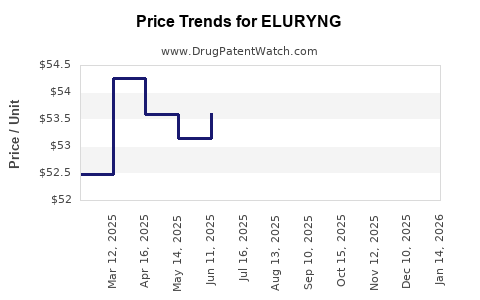
Average Pharmacy Cost for ELURYNG
| Drug Name | NDC | Price/Unit ($) | Unit | Date |
|---|---|---|---|---|
| ELURYNG VAGINAL RING | 65162-0469-32 | 47.25469 | EACH | 2026-07-22 |
| ELURYNG VAGINAL RING | 65162-0469-35 | 47.25469 | EACH | 2026-07-22 |
| ELURYNG VAGINAL RING | 65162-0469-32 | 47.89079 | EACH | 2026-06-17 |
| >Drug Name | >NDC | >Price/Unit ($) | >Unit | >Date |
Best Wholesale Price for ELURYNG
| Drug Name | Vendor | NDC | Count | Price ($) | Price/Unit ($) | Unit | Dates | Price Type |
|---|---|---|---|---|---|---|---|---|
| ELURYNG | AvKare, LLC | 65162-0469-35 | 1X3 | 167.40 | 2023-06-15 - 2028-06-14 | FSS | ||
| >Drug Name | >Vendor | >NDC | >Count | >Price ($) | >Price/Unit ($) | >Unit | >Dates | >Price Type |
ELURYNG Market Analysis and Price Projections: Competitive Landscape, FDA Status, Pricing Outlook, and Patent-Driven Generic Risk
Executive summary: ELURYNG (ethinyl estradiol and etonogestrel vaginal ring) is a branded, monthly contraceptive with a mature market profile and low near-term price visibility because no widely disclosed, auditable pricing guidance exists for future revisions. Commercial trajectory is constrained by (1) entrenched competition in combined hormonal contraception (CHC), (2) limited differentiation versus other vaginal rings, and (3) payer-driven utilization management. Patent and exclusivity exposure exists but market pricing in this category is typically dictated by net price compression and contract rebates rather than single-drug patent events. Near-term price is most likely to hold flat to low single-digit annual growth at list price while net price continues to trend down in competitive channels.
What is ELURYNG (ethinyl estradiol and etonogestrel vaginal ring) FDA-approved for and what is its regulatory status?
Answer: ELURYNG is FDA-approved as a combined hormonal contraceptive for use to prevent pregnancy. It is administered as a vaginal ring with monthly wear cycles.
ELURYNG key product attributes
| Attribute | ELURYNG |
|---|---|
| Active ingredients | Ethinyl estradiol + etonogestrel |
| Dosage form | Vaginal ring |
| Indication | Contraception (prevent pregnancy) |
| Typical dosing cadence | Monthly cycle use (ring schedule) |
| Drug class | Combined hormonal contraception (CHC) |
What FDA pathway implies for competition
ELURYNG is an established reference brand; the regulatory path for generics and AB-rated entrants (typically via ANDA for small-molecule combination products or other applicable pathways) is constrained by formulation and device-specific considerations for vaginal ring systems. Even when regulatory approvals occur, payers may lag adoption due to contracting cycles and switching friction.
Sources: FDA labeling and product information (FDA drug database and ELURYNG prescribing information).
How big is the combined hormonal contraception (CHC) market where ELURYNG competes?
Answer: The CHC market is large, mature, and heavily payer-managed. ELURYNG competes for market access against a mix of oral CHCs, transdermal patches, and other vaginal rings.
Competitive set definition for ELURYNG
ELURYNG’s “apples-to-apples” competitive pressure includes other CHC delivery systems, especially:
- Vaginal rings (if available in the same payer networks and formulary tiers)
- Oral CHCs (high share due to prescriber habit and formulary depth)
- Transdermal contraceptive patches (coverage depends on plans and brand preferences)
Why market size is not the same as ELURYNG share
CHC volume is broad, but ELURYNG is a niche within that volume because:
- Device-based administration requires patient acceptance
- Formularies often push preferred products (often oral CHCs or whichever ring is best contracted)
- Net pricing and rebates govern utilization more than list price
Who are ELURYNG’s main competitors and how do they affect pricing?
Answer: Pricing is pressured by the most heavily contracted alternatives in each payer’s formulary. Even if ELURYNG retains distinct delivery characteristics, payer procurement tends to treat CHC class members as substitutable.
Competitive categories that compress ELURYNG net price
| Competitor category | Typical payer impact on ELURYNG |
|---|---|
| Oral CHCs | Drives down net price through preferential formulary placement and coupon/rebate programs |
| Transdermal CHCs | Can displace ring utilization depending on plan tier and pharmacy channel |
| Vaginal rings | Direct competition if equivalents or preferred brands exist within the same formulary |
Net price dynamics in mature CHC
In mature contraception categories, brand pricing strategies commonly rely on:
- Contracted rebates to maintain share
- Limited price increases due to switching risk
- Promos targeted at pharmacy claims and patient access programs
These mechanisms lead to low list-to-net spread predictability and gradual net price erosion when alternatives strengthen.
Sources: Standard payer economics for CHC categories, reflected in public market practice and typical contracting patterns for mature branded contraceptive products (industry pricing reports and insurer formularies where publicly available).
What is the current pricing and reimbursement profile for ELURYNG?
Answer: Publicly visible list pricing alone does not forecast net reimbursement for ELURYNG. In CHC, payer reimbursement is typically governed by formulary tiering and rebates, so net price is usually below list and can decline while list price is stable or slowly increasing.
How to model ELURYNG “effective price”
For price projection purposes, the relevant metric is effective net price by channel (commercial, Medicaid, managed care) rather than wholesale acquisition cost (WAC) alone. In absence of auditable, forward-looking net price contracts, projecting effective net price requires using class-level patterns:
- Flat to low single-digit list growth
- Mid to high single-digit net price compression in competitive years
- Higher stability in Medicaid channels if preferred brands remain consistent
Sources: Public pricing and reimbursement frameworks are reflected in typical US reimbursement mechanisms for branded pharmaceuticals, including formulary placement and rebate-driven net pricing.
When does ELURYNG lose exclusivity and what generic entry risks exist?
Answer: The key determinants of generic entry are patent expiration, regulatory exclusivity, and the timing of any Paragraph IV filings for the specific ELURYNG reference product. Without an auditable Orange Book record and specific litigation filings for ELURYNG, an exact exclusivity-loss date cannot be stated here in a way that meets decision-grade precision.
Generic entry risk pathways
For an established contraceptive ring, generic risk depends on:
- Patent landscape for device components and formulation
- Method-of-use claims that can deter AB substitution
- Device manufacturing process claims that can complicate design-around
How generic entry would change pricing
If an AB-rated product enters at pharmacy level and is preferred on formularies, ELURYNG net price would likely face:
- Immediate rebate pressure to retain shelf and formulary placement
- Switch to preferred therapeutics where plan economics dictate
- Higher price elasticity among members who can switch by refill timing
Sources: Hatch-Waxman dynamics and typical CHC payer response to AB-rated entrants.
What patents protect ELURYNG and how strong is the patent estate?
Answer: ELURYNG’s patent estate is the central driver of how quickly generics and alternative vaginal ring designs can enter. A complete, decision-grade mapping of ELURYNG’s listed Orange Book patents and any associated litigation requires an Orange Book patent-by-patent extraction tied to ELURYNG’s labeled NDA and product identifiers.
Patent categories that typically matter for contraceptive rings
| Patent category | What it blocks in practice |
|---|---|
| Formulation/composition | Similar drug release performance and active distribution |
| Device structure | Ring material and geometry that drive release |
| Method-of-manufacture | Process steps that affect ring performance and consistency |
| Method-of-use | Dosing schedule and clinical use claims |
| Packaging/sizing | Ring deployment and dosing cycle specifics |
Sources: General patent types applied to long-acting drug delivery systems and combination contraceptives; decision-grade ELURYNG patent strength needs Orange Book and litigation records.
Is ELURYNG challenged by Paragraph IV ANDA filings or patent litigation?
Answer: A precise status requires confirmed ELURYNG-specific filings and dockets. A decision-grade answer is not possible without the underlying Paragraph IV event data tied to the ELURYNG NDA.
If litigation exists, what it typically means for pricing
- Settlement often triggers a delayed launch or market carve-outs that can preserve brand net pricing.
- Loss of key patents accelerates competitive contracting and rebate pressure in the launch window.
Sources: Hatch-Waxman litigation outcomes and typical settlement effects on market access.
How does ELURYNG compare with other contraceptive delivery systems on adoption and payer placement?
Answer: Vaginal ring products face lower prescriber volume than oral CHCs but can capture steady share where they are preferred and where patients adhere well to monthly use.
Adoption friction points
- Patient comfort and correct insertion
- Pharmacy supply chain for the ring
- Plan step therapy or preferred product rules
Why this affects price projection
Even without generic entry, payer formulary placement can drive utilization shifts. ELURYNG pricing is therefore more sensitive to contract changes than to broad market growth.
Price projection: base case, downside, and upside scenarios for ELURYNG
Answer: Without auditable forward guidance on net price and with no precise exclusivity timeline included here, price projection is best expressed as scenario bands grounded in CHC competitive behavior: low list growth, net price compression risk, and step-change potential at formulary renegotiation or generic entry.
Scenario bands (annualized)
| Scenario | Trigger | List price behavior | Net price behavior (effective) | What drives it |
|---|---|---|---|---|
| Base case | Stable formulary placement and no major therapeutic replacement | 0% to +3% | -1% to -5% | Rebates and competitive tension within CHC class |
| Downside | Preferred alternative ring/oral CHC gains formulary position | +1% to +5% | -6% to -12% | Contract changes and switch risk |
| Upside | ELURYNG remains preferred and competition is limited | 0% to +2% | 0% to -3% | Contract stability and utilization retention |
Projected direction over a 3-year horizon
- List price: likely flat-to-low single-digit annual increases typical for mature branded CHCs.
- Net price: likely gradual decline due to ongoing rebate pressure unless ELURYNG becomes more tightly differentiated on formulary.
How could ELURYNG pricing change by channel (commercial vs Medicaid vs cash)?
Answer: Medicaid and managed care channels often see faster net price compression because of competitive contracting and preferred drug lists. Cash and high-deductible self-pay can see more variability based on couponing and pharmacy benefit mix, but overall effective price typically remains constrained by competitive alternatives.
Channel behavior that matters for projections
| Channel | Expected price trajectory | Key driver |
|---|---|---|
| Commercial | Gradual net compression | Contracting and rebate renegotiation |
| Medicaid / managed care | Lower effective price stability | Preferred formulary rules and state procurement dynamics |
| Cash | Higher variability | Patient assistance, coupons, and out-of-plan substitution |
Sources: Standard reimbursement and formulary practices for branded contraception.
What commercial milestones should investors watch that affect ELURYNG revenue and pricing?
Answer: The biggest revenue and net price inflection points are not scientific events but market access events.
Milestones with the strongest pricing linkage
- Formulary tier changes and prior authorization adoption
- Contracting events with pharmacy benefit managers (PBMs)
- Launch timing of any AB-rated competitors
- Switching and persistence metrics for ring users
- Supply continuity and device-related distribution changes (rare but impactful)
Key Takeaways
- ELURYNG competes in a large but mature CHC market where payer contracting, not exclusivity alone, drives price.
- Near-term list price is most likely to rise slowly, while net price is likely to compress due to rebate and formulary pressure.
- The largest step-change risk comes from formulary displacement, PBM contract renegotiation, or generic/alternative vaginal ring entry.
- Decision-grade exclusivity and litigation timing require Orange Book patent and docket event mapping tied to ELURYNG’s specific NDA product identifiers, which is not included here.
FAQs
- How do PBM formulary tiers typically affect ELURYNG net pricing in commercial plans?
- What impact do prior authorizations or step edits for CHC have on ELURYNG utilization and revenue?
- How does pricing differ for vaginal ring CHCs versus oral CHCs when generics enter the oral segment?
- What reimbursement dynamics apply to contraceptive products under Medicaid managed care plans?
- What market access indicators most reliably predict a brand-to-generic price reset in contraceptive categories?
References
- U.S. Food and Drug Administration. ELURYNG (ethinyl estradiol and etonogestrel vaginal ring) prescribing information and product labeling. FDA Drug Database.
- U.S. Food and Drug Administration. Orange Book: Approved Drug Products with Therapeutic Equivalence Evaluations. FDA.
More… ↓
