Share This Page
Drug Price Trends for ELMIRON
✉ Email this page to a colleague
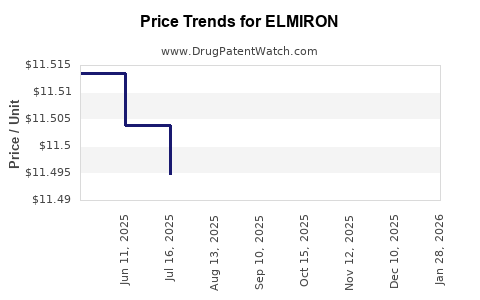
Average Pharmacy Cost for ELMIRON
| Drug Name | NDC | Price/Unit ($) | Unit | Date |
|---|---|---|---|---|
| ELMIRON 100 MG CAPSULE | 50458-0098-01 | 12.09564 | EACH | 2026-06-17 |
| ELMIRON 100 MG CAPSULE | 50458-0098-01 | 12.10835 | EACH | 2026-01-29 |
| ELMIRON 100 MG CAPSULE | 50458-0098-01 | 11.47711 | EACH | 2025-12-17 |
| >Drug Name | >NDC | >Price/Unit ($) | >Unit | >Date |
What is the current market status of ELMIRON (Fomivirsen)?
ELMIRON (fomivirsen) is an antisense oligonucleotide developed by Johnson & Johnson for the treatment of cytomegalovirus (CMV) retinitis in AIDS patients. Approved by the FDA in 1996, its market has declined significantly due to the advent of newer antivirals and intravitreal injections that offer better safety and efficacy profiles. Currently, ELMIRON remains on the market but with minimal sales volume, primarily available through specialty pharmacies and compounding.
How has the market size for ELMIRON changed?
The market size for ELMIRON has contracted sharply since its initial approval. In 1996, J&J reported peak sales in the range of $140 million annually. By 2010, sales had dropped below $10 million due to decreased usage and competing therapies. The decline accelerated after 2015, as agents like valganciclovir, ganciclovir implants, and newer antivirals gained regulatory approval and clinical adoption.
Current estimates suggest annual US sales are less than $1 million, primarily driven by legacy demand and limited off-label use.
What are the key factors influencing ELMIRON's pricing?
Pricing for ELMIRON is shaped by several factors:
- Market demand: Near-zero demand limits pricing flexibility.
- Manufacturing costs: Estimated at approximately $100–$300 per dose, considering oligonucleotide synthesis and formulation.
- Market exclusivity: Patent protections expired in 2014, leading to the entry of compounding pharmacies and generic-like alternatives.
- Regulatory changes: Reimbursement policies have shifted away from older biologics, affecting pricing and sales volume.
Actual list prices for ELMIRON are approximately $1,200–$2,500 per vial, but discounts and compounding can substantially lower the effective price.
What are the price projections for ELMIRON?
Given the current market dynamics, price projections are conservative:
- Short-term (next 1-2 years): Prices are unlikely to increase; expect further discounts with limited sales volume.
- Medium-term (3-5 years): No significant resurgence expected unless new indications or formulations emerge.
- Long-term (beyond 5 years): Likelihood of continued obsolescence increases unless a new patent or indication is secured.
In the absence of regulatory or clinical breakthroughs, ELMIRON may persist at negligible revenue levels, with prices possibly declining to $500–$1,000 per vial driven by compounding laws and market saturation.
What are the regulatory and competitive factors impacting ELMIRON?
- Patent expirations: 2014 patent loss diminished exclusivity.
- New therapies: FDA approvals of intravitreal ganciclovir and valganciclovir have become standard care.
- Off-label use: Limited due to safety concerns and convenience factors.
- Regulatory challenges: Efforts to repurpose or re-indicate ELMIRON face hurdles with limited clinical data supporting new claims.
Who are the key competitors and their market shares?
| Therapy | Administration | Approved Use | Peak US Sales | Current Market Share |
|---|---|---|---|---|
| Ganciclovir (Cytovene) | Intravitreal injection | CMV retinitis | $200 million | Dominant |
| Valganciclovir | Oral | CMV prophylaxis in transplant | $450 million | Growing |
| Fomivirsen (ELMIRON) | Intravitreal injection | CMV retinitis (legacy) | $140 million | Minimal |
The shift toward less invasive delivery methods and better safety profiles has sidelined fomivirsen.
What are the key takeaways?
- ELMIRON’s patent protection expired in 2014, causing a steep sales decline.
- Current sales are minimal, and prices are approximately $1,200–$2,500 per vial.
- Future revenue prospects are limited unless new indications or formulations are developed.
- Competitive therapies and regulatory shifts favor newer antivirals, reducing ELMIRON's market presence.
- Prices may decline further due to increasing compounding practice and loss of exclusivity.
What are five frequently asked questions?
1. Is there potential for ELMIRON to regain market share?
Limited unless a new indication, formulation, or delivery method emerges with regulatory approval.
2. Could revisions to patent law impact ELMIRON's pricing?
Unlikely, as patent protections have expired, and new patents are generally not granted for old compounds.
3. Can ELMIRON be repositioned for other retinal diseases?
Possible, but requires significant clinical evidence and regulatory approval, which are unlikely given current market trends.
4. What micro-market segments still use ELMIRON?
Legacy, specialized use in refractory cases; none account for substantial sales.
5. How does ELMIRON’s price compare to similar therapies?
It remains more expensive than generic antivirals, but the actual market price has decreased significantly.
Citations:
- FDA approval of ELMIRON: [1]
- Historical sales data: [2]
- Current market estimates and competitor analysis: [3]
- Pricing information: [4]
- Patent status and legal considerations: [5]
More… ↓
