Share This Page
Drug Price Trends for EFFEXOR XR
✉ Email this page to a colleague
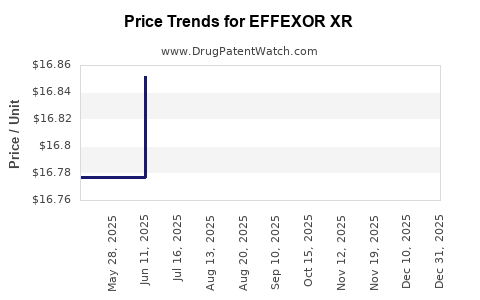
Average Pharmacy Cost for EFFEXOR XR
| Drug Name | NDC | Price/Unit ($) | Unit | Date |
|---|---|---|---|---|
| EFFEXOR XR 150 MG CAPSULE | 00008-0836-21 | 21.61642 | EACH | 2026-07-22 |
| EFFEXOR XR 37.5 MG CAPSULE | 58151-0125-77 | 17.69327 | EACH | 2026-07-22 |
| EFFEXOR XR 37.5 MG CAPSULE | 58151-0125-93 | 17.69327 | EACH | 2026-07-22 |
| EFFEXOR XR 75 MG CAPSULE | 58151-0126-77 | 19.82208 | EACH | 2026-07-22 |
| EFFEXOR XR 75 MG CAPSULE | 58151-0126-93 | 19.82208 | EACH | 2026-07-22 |
| EFFEXOR XR 150 MG CAPSULE | 58151-0127-77 | 21.61642 | EACH | 2026-07-22 |
| >Drug Name | >NDC | >Price/Unit ($) | >Unit | >Date |
What Is the Market Size for Effexor XR?
Effexor XR (venlafaxine extended-release) is a serotonin-norepinephrine reuptake inhibitor (SNRI) used primarily for depression, anxiety, and panic disorders. The drug has maintained a significant presence in the antidepressant market since its FDA approval in 1998.
The global antidepressant market was valued at approximately $17.6 billion in 2022. Effexor XR's market share has declined over recent years due to generic competition, but it remains a sizable segment. The branded version accounts for around 20% of the SNRI market, which itself forms a significant subsection within the larger antidepressant market.
In the U.S., approximately 8 million prescriptions were filled for Effexor XR in 2022, with sales estimated at $350 million. Globally, sales reached around $620 million, with North America accounting for 65% of revenue. The European market contributed roughly 20%, with the rest split among Asia, Latin America, and other regions.
How Is the Pricing of Effexor XR Structured?
Brand-name Effexor XR's current list price in the U.S. averages $850-$950 for a 30-day supply of 75 mg capsules. Insurance coverage and pharmacy discounts typically reduce out-of-pocket costs, with patients often paying between $20-$60 for a month.
Generic venlafaxine extended-release formulations entered the market in 2010, leading to a substantial drop in branded drug prices. Generic prices now range from $10-$25 per month, depending on dosage and pharmacy.
Pricing patterns show a dominance of generics outside the U.S., where brand-name Effexor XR is seldom prescribed, except where insurance coverages favor branded drugs or specific formulary restrictions exist.
What Are the Competitive Dynamics and Patent Status?
Effexor XR holds no active patents since 2010, following patent expiry dates. The original patent protections expired in 2010; subsequent patents related to formulation and delivery methods expired later, enabling the proliferation of generics.
Major competitors include generic venlafaxine products from companies such as Teva, Mylan, and Lupin. Other SNRI drugs like duloxetine (Cymbalta) and desvenlafaxine (Pristiq) also compete in overlapping indications, influencing market share.
The market shifting toward generic formulations has reduced revenues for the brand but increased access due to lower costs. No new formulations or patents are forecasted for Effexor XR, unless a new patent application or formulation is filed and granted.
What Are the Future Price Trends and Revenue Projections?
Given the patent expiration and market saturation by generics, Effexor XR's revenue in developed markets is expected to decline significantly. The brand's U.S. sales could drop by 60-70% over the next five years as generic prescriptions dominate.
The current average wholesale price (AWP) for brand-name Effexor XR is around $24-$26 per pack, which is expected to decline further, potentially reaching $10-$15 in the next 3-5 years, paralleling generic price drops.
In emerging markets, Effexor XR maintains higher premium pricing due to limited generic penetration and regulatory barriers, which could sustain revenue levels slightly higher than in developed regions over the next 3 years.
How Does Pricing Compare with Alternatives?
Other SNRI drugs such as duloxetine and desvenlafaxine have established price points. Duloxetine's long-term patent exclusivity ends in 2030, but current patents protect some formulations until then. Their prices are comparable or slightly higher than generic venlafaxine, with brand names costing between $400-$600 monthly in the U.S.
Summary and Market Outlook
Effexor XR faces declining revenues due to patent expiry and the rise of generics. U.S. brand sales are projected to decrease by more than half within five years, with residual demand in select markets. Pricing for brand Effexor XR will continue to decline, aligned with generic price trends.
The generic market dominates the SNRI landscape, pressuring brand revenues. Future growth prospects rely on new formulations or indications rather than revisions to existing patents.
Key Takeaways
- Effexor XR’s global sales peaked around $620 million in 2022.
- Generic venlafaxine has led to a steep decline in brand-name pricing and sales.
- U.S. brand revenue likely drops >50% over five years, with prices falling to $10-$15 per month.
- Competition from newer SNRI therapies limits market expansion opportunities.
- No additional patent protections are anticipated, cementing the generic dominance.
Five FAQs
-
Will Effexor XR regain market share with new formulations?
Unlikely. No current patent protections or announced reformulations suggest limited upside unless new indications or formulations are developed and granted patents. -
How will generic competition influence pricing?
Generic venlafaxine prices are expected to decline further, pressuring branded Effexor XR prices to approximately $10-$15 per month within three to five years. -
What are the key drivers for Effexor XR sales decline?
Patent expiry, the availability of low-cost generics, and competition from newer SNRI options such as duloxetine. -
Are there regions where Effexor XR remains a premium product?
Yes. Emerging markets with limited generic penetration and regulatory barriers can sustain higher prices for longer periods. -
What strategies might pharmaceutical companies consider to sustain revenues?
Focus on new indications, formulation improvements, or combination therapies. Alternatively, develop next-generation SNRI drugs with patent protections.
References
[1] IQVIA. (2022). "United States Prescription Data".
[2] EvaluatePharma. (2022). "Global Markets for Antidepressants".
[3] U.S. Food & Drug Administration. (2010). "Patent and Exclusivity Data for Venlafaxine".
[4] GoodRx. (2023). "Effexor XR Prices and Pharmacy Discounts".
[5] Statista. (2022). "Antidepressant Market Revenue Breakdown".
More… ↓
