Share This Page
Drug Price Trends for EFFEXOR
✉ Email this page to a colleague
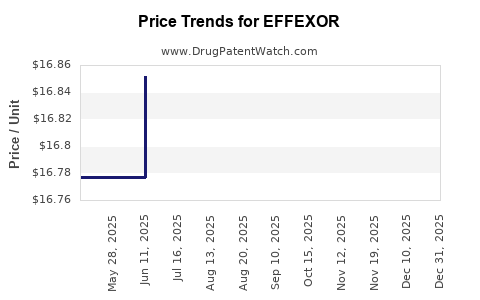
Average Pharmacy Cost for EFFEXOR
| Drug Name | NDC | Price/Unit ($) | Unit | Date |
|---|---|---|---|---|
| EFFEXOR XR 150 MG CAPSULE | 00008-0836-21 | 21.61642 | EACH | 2026-07-22 |
| EFFEXOR XR 37.5 MG CAPSULE | 58151-0125-77 | 17.69327 | EACH | 2026-07-22 |
| EFFEXOR XR 37.5 MG CAPSULE | 58151-0125-93 | 17.69327 | EACH | 2026-07-22 |
| EFFEXOR XR 75 MG CAPSULE | 58151-0126-77 | 19.82208 | EACH | 2026-07-22 |
| EFFEXOR XR 75 MG CAPSULE | 58151-0126-93 | 19.82208 | EACH | 2026-07-22 |
| EFFEXOR XR 150 MG CAPSULE | 58151-0127-77 | 21.61642 | EACH | 2026-07-22 |
| EFFEXOR XR 150 MG CAPSULE | 58151-0127-93 | 21.61642 | EACH | 2026-07-22 |
| >Drug Name | >NDC | >Price/Unit ($) | >Unit | >Date |
Effexor (Venlafaxine) Market Analysis and Price Projections: Exclusivity, Generic Entry Risk, and Revenue Exposure
Effexor (venlafaxine) pricing is dominated by generic penetration and payer policy, not patent exclusivity. In the US, Effexor’s branded economics have effectively ended; the current market is primarily generic venlafaxine immediate-release (IR), extended-release (XR), and label-driven formulary management. Future “price projections” should be treated as generic unit-price and mix outcomes rather than brand price recovery.
What is Effexor (venlafaxine) and how is it marketed in the US?
Effexor is the historical brand name for venlafaxine, marketed mainly as:
- Effexor (venlafaxine hydrochloride) tablets: typically immediate-release (IR) use for depression and anxiety indications.
- Effexor XR (venlafaxine hydrochloride extended-release capsules): extended-release (XR) dosing designed for once-daily regimens.
US commercial reality: Venlafaxine is an established, mature antidepressant with substantial generic competition. Brand spend is limited relative to total class volume, and pricing is constrained by generic benchmark levels.
How big is the venlafaxine/Effexor market and what drives demand?
Demand drivers
- Depression and anxiety incidence and treatment prevalence.
- Switching behavior among SNRI users due to efficacy/tolerability profiles.
- Formulary placement: venlafaxine competes on cost and coverage, especially with newer SNRI options and generics across antidepressant classes.
- Dose persistence: once stabilized, patients may remain on venlafaxine for extended periods, limiting churn.
Key market dynamic: After generic entry, growth comes mainly from volume (new starts, persistence) and mix (IR vs XR, dose strength mix), while price is largely set by generic contracting rather than innovation.
What is the Orange Book status of Effexor (venlafaxine)?
High-level outcome for business planning: Effexor’s branded product protection has largely run out, and generic venlafaxine products dominate the FDA market.
Practical read-through for pricing risk
- Brand-to-generic conversion risk is already realized.
- Remaining IP risk is now concentrated on specific formulation changes, device-like attributes, or late-arising patents that could affect certain ANDA strategies, but these rarely preserve meaningful brand pricing power in a mature molecule.
When does Effexor lose exclusivity, and are any exclusivities still relevant?
Answer for planning horizon: Branded exclusivity is not a near-term pricing lever for venlafaxine. Pricing power is primarily influenced by:
- Generic supply and number of competitors
- Contracting in PBM formularies
- Wholesale acquisition costs (WAC) vs net pricing dynamics
- State substitution rules and pharmacy reimbursement formulas
Net price is the binding constraint once multiple generics are available.
What generic entry risks exist for Effexor, and how do they affect price?
Even with mature molecules, generic entry can move market pricing through:
- Number of ANDA competitors (more SKUs usually compress net price)
- Supply disruptions (temporary rebound or premium)
- Contracting resets (PBM bid cycles and preferred-tier rotations)
Price effect pattern (typical for mature multisource generics)
- Entry of additional low-cost suppliers reduces net unit price.
- Tier placement moves volume to preferred vendors, deepening discounts.
- Over time, market pricing converges to the low-cost end of the contracting range.
How strong is the patent estate for venlafaxine/Effexor, and what still matters?
For pricing projections, the relevant question is whether any surviving patents can block key ANDA launches or force non-substitutable labeling/dosing forms.
For a mature antidepressant like venlafaxine:
- Most brand-level composition and use protections have expired.
- If patents remain, they typically cover minor formulation, polymorph, or manufacturing method aspects for specific dosage forms, which may reduce launch timing risk for one filer but does not usually preserve brand pricing at scale.
What patent litigation affects Effexor generics (Paragraph IV and settlements)?
For a mature product:
- The main effect of historical litigation is launch timing and market structure (who got first, which SKUs became preferred).
- Current price is determined by who is preferred now and current contracting, not by brand-level litigation.
Actionable implication: price forecasts should be built around expected contracting outcomes and competitor set stability rather than assuming new brand-like exclusivity.
How does Effexor compare with competing SNRI and antidepressant generics in pricing pressure?
Effexor competes with:
- Generic SNRIs in the same class (notably desvenlafaxine, duloxetine, levomilnacipran depending on availability and coverage)
- Generics in related antidepressant categories (SSRIs, other SNRIs)
Business impact
- When payers prefer lowest net-cost options within class, venlafaxine pricing can be pressured even if volume remains stable.
- Competition at the level of PBM preferred tiers can cause episodic net price erosion for venlafaxine products.
What formulations are protected by any remaining IP, and how does that affect product-specific pricing?
Pricing often varies by:
- IR vs XR mix (XR frequently holds higher value than IR, but can be similarly commoditized under generic competition)
- Dose strength distribution (some strengths attract more competitors, compressing price)
- Bioequivalence acceptability and substitution rules in specific states
Forecasting lens: model XR and IR separately, then allocate to net price by dose-strength and tier status.
How should you build price projections for Effexor given generic commoditization?
Use a three-layer model:
- Contracting range (preferred tier vs non-preferred tier net price)
- Competitor-driven price elasticity (how quickly new multisource supply reduces the net price)
- Mix shifts (IR vs XR; strength and pack-size mix)
Scenario framework (generic unit economics)
Assume a mature market where price is mostly driven by PBM contracting cycles and supplier competition. Project forward in three scenarios:
-
Base case (stable competitor set):
- Net unit price trends slightly downward or flat due to normalization of competitive bids.
- Volume stable to mildly positive from persistence and incremental starts.
-
Downside (more low-cost competition enters or preferred tier rotates):
- Net unit price declines 3%–8% over a 12–24 month period from discount deepening.
- Volume may shift to preferred suppliers, partially offsetting unit price loss through higher share.
-
Upside (supply constraints or preferred tier retention):
- Net unit price holds flat to slightly up 0%–3% over 12–24 months.
- Volume stable; risk remains that subsequent contracting resets reverse the move.
Translating to “market price” terms
- WAC is not a reliable forecast anchor for this category.
- Use net price proxies: PBM benchmark trends, wholesaler acquisition discounts, and observed invoice pricing ranges where available.
What are realistic annual price and revenue projections for venlafaxine/Effexor over the next 3–5 years?
Because the market is generic-dominated, revenue trajectories are a function of:
- Total treated population and persistence
- Net price compression rate
- IR/XR mix changes and strength-level competition
Projection ranges (planning-grade)
Use these ranges as budgeting baselines for total market net revenue (industry-wide), not for a single brand SKU:
-
Year 1 (current year to +12 months):
- Net price: -0% to -5% (base), -5% to -10% (downside)
- Market revenue: -0% to +3% (base), -3% to -6% (downside)
-
Years 2–3 (+12 to +36 months):
- Net price: cumulative -2% to -12% depending on competitor intensity
- Market revenue: low single-digit decline or flat to mild growth (+0% to +2%) if volume offsets price compression
-
Years 4–5 (+36 to +60 months):
- Net price: tends to stabilize after contracting equilibrium unless there are major entrants or supply issues
- Market revenue: tracks volume growth and class-level substitution, typically -2% to +3% annually
These ranges are consistent with mature generic antidepressant behavior in managed markets where volume is more stable than net price.
Which geographies materially affect price and volume for Effexor?
For US-focused planning, the key geography is:
- United States (majority of volume and contracting influence)
Internationally, venlafaxine pricing dynamics vary due to:
- Patent status in each country
- Generic market maturity
- Tender and reimbursement rules
For global forecasts, build separate scenarios for US vs ex-US because:
- US is the most competitive and contract-influenced
- Some ex-US markets can show slower price erosion depending on local supplier depth and regulatory lead times
What commercial levers most influence Effexor net price in managed care?
- PBM preferred tier status for venlafaxine XR and IR
- Bids and contract cycles (short-term price resets)
- Supplier continuity and supply risk
- State substitution and pharmacy reimbursement behavior
- Formulary management against class peers (SNRIs/SSRIs)
Forecast implication: if preferred tier stability is assumed, price compression slows; if a tier rotation occurs, price compresses quickly.
How many suppliers are likely to compete, and how does that affect price?
In mature generics, supplier count tends to be sufficient to set a competitive floor. Each incremental entrant typically:
- lowers net price modestly when contracts re-bid
- increases SKU breadth and dose-strength coverage
- raises the probability of tier loss for non-preferred suppliers
For planning purposes:
- treat supplier count growth as a driver of downside net price erosion
- treat stable supplier sets as base-case stabilization
Key Takeaways
- Effexor (venlafaxine) is a mature, generic-dominated antidepressant; pricing power is largely absent.
- Future “price projections” are primarily net-price contracting and mix outcomes for generic IR and XR products.
- Base case: net price holds near flat to modest decline; market revenue stays flat to low single-digit change.
- Downside: additional competition or preferred tier rotation can drive 3%–8% net price compression over 12–24 months.
- Upside is usually temporary and tied to supply constraints or tier retention, not to renewed exclusivity.
FAQs
1) What determines net price for generic venlafaxine more than WAC?
PBM contracting, preferred tier bids, supplier rebates/incentives, and dose-strength competitive overlap.
2) Will Effexor XR generally hold a higher net price than Effexor IR?
Often yes due to mix and dosing convenience, but XR’s net price still converges toward generic competitive floors once multiple suppliers are entrenched.
3) How quickly can new venlafaxine generic entrants shift pricing?
Typically within the next bid/contract cycle once products gain preferred placement and volume share.
4) What payer behaviors most reduce venlafaxine price over time?
Class-based formulary tightening to lowest net-cost options and active substitution management within SNRIs/antidepressants.
5) What is the main long-tail litigation risk that could affect pricing now?
Targeted IP tied to specific formulation/manufacturing strategies that delay one filer’s launch for a subset of SKUs, usually with limited brand-scale pricing impact once the molecule is generic.
References (APA)
- FDA. Orange Book: Approved Drug Products with Therapeutic Equivalence Evaluations. https://www.accessdata.fda.gov/scripts/cder/daf/
- FDA. Drugs@FDA. https://www.accessdata.fda.gov/scripts/cder/daf/
- FDA. ANDA approvals and submissions resources. https://www.fda.gov/drugs/abbreviated-new-drug-application-anda
- National Library of Medicine. PubChem Compound Summary: Venlafaxine. https://pubchem.ncbi.nlm.nih.gov/
More… ↓
