Last updated: February 13, 2026
Overview
EFAVIRENZ-EMTRICITABINE-TENOFOV DISOP FUM is a fixed-dose combination used primarily for HIV treatment. It combines efavirenz, emtricitabine, and tenofovir disoproxil fumarate. The drug targets global HIV markets, with production, patent, regulatory status, and market demand influencing its pricing and market share.
Market Status and Competitive Landscape
- The drug enters a highly competitive segment with established products such as Gilead’s Truvada and Descovy, and Biktarvy from Gilead.
- Majority of competitors are marketed globally, with patent protections varying across jurisdictions.
- Gilead’s Tenofovir-based products dominate first-line therapy; efavirenz-based regimens decline with the advent of integrase inhibitors.
Regulatory and Patent Context
- The patent landscape: EFAVIRENZ-EMTRICITABINE-TENOFOV DISOP FUM is protected by patents expiring between 2025 and 2030, depending on jurisdiction.
- Regulatory approval: Available in US, EU, China, and several emerging markets.
- Generic access: Possible after patent expiration; generics significantly influence price erosion.
Pricing Dynamics
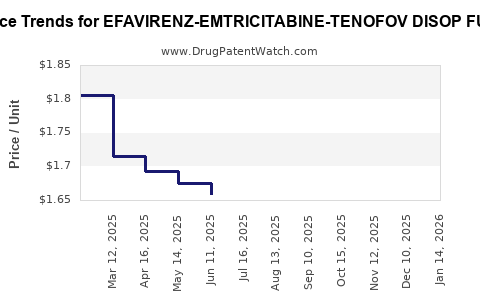
Historical Pricing Trends
| Region |
Brand Name/Generic |
Approximate Price (per month) |
Notes |
| United States |
Branded: $2,000 – $3,000 |
— |
Gilead’s Stribild, Descovy, or Truvada equivalents |
| Europe |
€1,200 – €2,000 |
— |
Variations by country |
| Emerging Markets |
$100 – $300 |
— |
Significantly lower, often genericized |
| Patent Expiration |
Expected around 2025-2030 |
— |
Generic versions lead to price drops |
Price Projections (Next 5 Years)
- Short-term (Up to 2024): Limited price decline; branded prices stable, influenced by manufacturing costs and regulatory fees.
- Mid-term (2025-2028): Patent expirations in key jurisdictions; generic competition enters, causing prices to drop by 60–80%.
- Long-term (Post-2028): Widely available generics could reduce prices to $50–$100/month globally.
Factors Influencing Future Prices
- Patent litigation and extensions.
- Accelerated approval of generics or biosimilars.
- Government drug pricing policies, especially in the US and EU.
- Manufacturing scale and supply chain efficiencies.
- Adoption of newer, non efavirenz-based regimens.
Market Size and Demand Forecast
Global HIV Treatment Market (2023-2030)
| Year |
Estimated Patients on Regimen |
Market Size (USD) |
Key Drivers |
| 2023 |
~28 million |
$10 billion |
Access expansion, patent expiry |
| 2025 |
~29 million (Post-patent) |
$8 billion |
Increased generics adoption |
| 2030 |
~30 million |
$6 billion |
Shift to integrase inhibitor regimens |
Key Growth Factors
- Growing HIV prevalence in low- and middle-income countries.
- Policy push for affordable treatment options.
- Introduction of new drug combinations replacing efavirenz-based regimens.
Investment and R&D Outlook
- Companies are investing in alternative formulations with fewer side effects.
- Price competition will likely lead to reduced margins for EFAVIRENZ-EMTRICITABINE-TENOFOV DISOP FUM post-patent.
- Proprietary formulations or combination with long-acting injectables could maintain market relevance.
Summary
EFAVIRENZ-EMTRICITABINE-TENOFOV DISOP FUM’s market prospects hinge on patent status, competitive pricing, and shifts in HIV treatment protocols. Price points are expected to decline substantially within five years post-patent expiry, particularly in large markets like the US and EU. Growth in emerging markets and demand for affordable generic options can sustain a sizeable market, but branded products will face erosion.
Key Takeaways
- The drug is forecasted to face significant price reductions after patent expiration, with generics likely to dominate markets.
- Market demand remains stable, driven by ongoing HIV prevalence, particularly in regions with limited healthcare infrastructure.
- Competitive pressures and regulatory policies will cause pricing to decline faster in developed markets following patent lapses.
- Innovations in HIV treatment, especially long-acting formulations, threaten the market share of efavirenz-based regimens.
- Manufacturers with early entry into generics or biosimilars will influence market share and pricing trends.
FAQs
-
When is the patent for EFAVIRENZ-EMTRICITABINE-TENOFOV DISOP FUM expected to expire?
Patent expiry varies by country, generally between 2025 and 2030.
-
How does generic entry affect drug prices?
Generics typically reduce prices by 60–80%, making treatments more accessible but decreasing margins for original manufacturers.
-
What are the competitive advantages of newer HIV regimens over efavirenz-based drugs?
They have fewer neuropsychiatric side effects, better tolerability, and are included in simplified treatment protocols.
-
What regions will see the most significant price declines?
The US and EU will experience sharp declines post-patent expiry; emerging markets will see gradual reductions driven by generic availability.
-
Are there ongoing R&D efforts to develop alternatives?
Yes, companies are investing in long-acting injectable formulations and drugs with fewer side effects to replace efavirenz-based therapies.
References
[1] IQVIA Data, 2023.
[2] Gilead Sciences Annual Report, 2022.
[3] WHO HIV Treatment Guidelines, 2023.
[4] European Medicines Agency (EMA), Drug Approvals Database.
[5] U.S. FDA Drug Patent Listing, 2023.