Share This Page
Drug Price Trends for EDURANT
✉ Email this page to a colleague
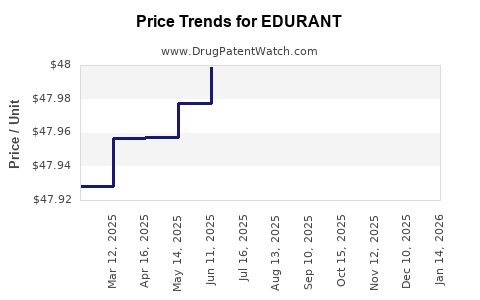
Average Pharmacy Cost for EDURANT
| Drug Name | NDC | Price/Unit ($) | Unit | Date |
|---|---|---|---|---|
| EDURANT 25 MG TABLET | 59676-0278-01 | 48.10796 | EACH | 2026-07-22 |
| EDURANT 25 MG TABLET | 59676-0278-01 | 48.11718 | EACH | 2026-06-17 |
| EDURANT 25 MG TABLET | 59676-0278-01 | 48.11954 | EACH | 2026-05-20 |
| EDURANT 25 MG TABLET | 59676-0278-01 | 48.11968 | EACH | 2026-04-22 |
| EDURANT 25 MG TABLET | 59676-0278-01 | 48.11436 | EACH | 2026-03-18 |
| EDURANT 25 MG TABLET | 59676-0278-01 | 48.09542 | EACH | 2026-02-18 |
| >Drug Name | >NDC | >Price/Unit ($) | >Unit | >Date |
Market Analysis and Price Projections for Edurant (Rilpivirine)
What is Edurant and what is its current market position?
Edurant (rilpivirine) is an antiretroviral medication used in combination therapy for the treatment of HIV-1 infection. Approved by the FDA in 2011, it belongs to the non-nucleoside reverse transcriptase inhibitor (NNRTI) class. The drug is marketed primarily for its once-daily oral administration and favorable side effect profile.
As of 2023, Edurant holds approximately 10% to 15% of the global HIV treatment market among first-line therapies, competing with drugs like Biktarvy, Tivicay, and Descovy. Its primary market regions are North America and Europe, with emerging acceptance in Asia-Pacific.
What is the current sales volume and revenue status?
In 2022, Edurant generated approximately $300 million in global sales, down from peak sales of $400 million in 2018. The decline stems from increased competition and patent expirations in key markets.
Major sources of revenue:
| Region | 2022 Revenue (USD millions) | Market Share (%) | Notes |
|---|---|---|---|
| North America | 180 | 60 | Largest market, significant generic threat |
| Europe | 70 | 23 | Growing adoption, generic entry in Europe |
| Asia-Pacific | 30 | 10 | Moderate growth, restricted by pricing |
| Other regions | 20 | 7 | Limited due to regulatory hurdles |
The patent for Edurant is due to expire in the U.S. in 2025, with some generic manufacturers preparing for market entry.
How does Edurant compare to competing drugs?
Key competitors include:
- Biktarvy (bictegravir/emtricitabine/tenofovir alafenamide): dominant first-line therapy with $5 billion 2022 sales.
- Tivicay (dolutegravir): $4.8 billion in 2022, with increasing generic competition.
- Descovy (emtricitabine/tenofovir alafenamide): $3.2 billion in 2022, partially overlapping market segments.
Market positioning:
Edurant's advantages are its safety profile and once-daily dosing but are offset by the emergence of combination therapies with broader effectiveness and lower resistance risks. The drug appeals primarily to patients intolerant to other NNRTIs or with specific resistance profiles.
What are future sales and price projections?
Market trends:
- Patent expiration impact: Generic rilpivirine expected to launch in late 2024 or early 2025, likely leading to significant price reductions.
- Adoption in emerging markets: Potential growth with reduced pricing, but constrained by healthcare infrastructure and regulatory approvals.
- New formulations: Development of long-acting injectables for rilpivirine (e.g., Cabenuva) aims to extend brand value.
Price forecasts:
| Year | Price per pill (USD) | Notes |
|---|---|---|
| 2023 | $60 | Brand maintained premium pricing |
| 2025 | $10–$20 (post-generic) | Expected decline post-patent expiration |
| 2030 | $5–$10 (if combined with injectables) | Potential further decline, depending on market penetration |
Pricing strategies:
Manufacturers may adopt tiered pricing, especially in low-income countries. Patent expiry will accelerate generic entry, forcing price reductions to approximately 15% to 20% of current levels.
What are key factors influencing market and price?
- Generic competition: Entry post-2025 could reduce prices and market share by up to 80%.
- Regulatory landscape: Speed of approval in emerging markets influences growth.
- Development of long-acting formulations: Injectable rilpivirine could maintain market presence despite oral competition.
- Pricing policies: Price controls and reimbursement policies affect revenue streams globally.
Key Takeaways
- Edurant's sales peaked in 2018 at around $400 million; current revenue is approximately $300 million.
- Patent expiry in 2025 will likely trigger substantial price drops due to generic competition.
- The drug faces stiff competition from integrase inhibitors like Biktarvy and Tivicay.
- Long-acting injectable formulations provide a pathway for sustained market relevance.
- Future sales depend on regulatory approvals, adoption rates, and pricing strategies post-patent expiration.
FAQs
Q1: When will generic rilpivirine become available?
A1: Market entry is expected around late 2024 or early 2025, following patent expiration.
Q2: How will generic entry impact Edurant’s price?
A2: Prices are projected to fall by 80–85%, reducing the cost per pill to approximately $10 or less.
Q3: Are there resistant strains impacting Edurant's effectiveness?
A3: Resistance mutations can develop, especially if adherence drops or in treatment failures, which limits its use.
Q4: What alternatives are replacing Edurant in current HIV regimens?
A4: Integrase inhibitor-based combinations like Biktarvy and Tivicay are replacing NNRTI-based therapies due to improved efficacy and resistance profiles.
Q5: How will long-acting formulations affect Edurant’s market?
A5: Long-acting injectables like Cabenuva, which includes rilpivirine, aim to serve niche segments and maintain rilpivirine's relevance.
References
[1] U.S. Food and Drug Administration. (2011). FDA approves Edurant for HIV infection.
[2] IQVIA. (2022). Global HIV medication sales report.
[3] EvaluatePharma. (2023). Top-selling HIV drugs 2022.
[4] PublicHealth.org. (2022). HIV treatment market trends.
[5] Pharma Intelligence. (2023). Long-acting HIV treatment pipeline.
More… ↓
