Share This Page
Drug Price Trends for DYMISTA
✉ Email this page to a colleague
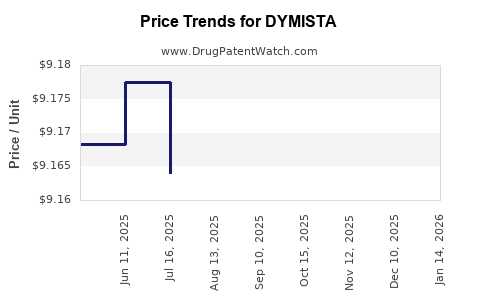
Average Pharmacy Cost for DYMISTA
| Drug Name | NDC | Price/Unit ($) | Unit | Date |
|---|---|---|---|---|
| DYMISTA NASAL SPRAY | 00037-0245-23 | 9.14053 | GM | 2026-07-22 |
| DYMISTA NASAL SPRAY | 00037-0245-23 | 9.14474 | GM | 2026-06-17 |
| DYMISTA NASAL SPRAY | 00037-0245-23 | 9.14806 | GM | 2026-05-20 |
| DYMISTA NASAL SPRAY | 00037-0245-23 | 9.14900 | GM | 2026-04-22 |
| DYMISTA NASAL SPRAY | 00037-0245-23 | 9.15071 | GM | 2026-03-18 |
| DYMISTA NASAL SPRAY | 00037-0245-23 | 9.14948 | GM | 2026-02-18 |
| DYMISTA NASAL SPRAY | 00037-0245-23 | 9.15053 | GM | 2026-01-21 |
| >Drug Name | >NDC | >Price/Unit ($) | >Unit | >Date |
Best Wholesale Price for DYMISTA
| Drug Name | Vendor | NDC | Count | Price ($) | Price/Unit ($) | Unit | Dates | Price Type |
|---|---|---|---|---|---|---|---|---|
| DYMISTA 0.15% NASAL SPRAY | Mylan Specialty L.P. | 00037-0245-23 | 23GM | 55.76 | 2.42435 | GM | 2022-01-15 - 2027-01-14 | Big4 |
| DYMISTA 0.15% NASAL SPRAY | Mylan Specialty L.P. | 00037-0245-23 | 23GM | 199.81 | 8.68739 | GM | 2022-01-15 - 2027-01-14 | FSS |
| DYMISTA 0.15% NASAL SPRAY | Mylan Specialty L.P. | 00037-0245-23 | 23GM | 151.35 | 6.58043 | GM | 2023-01-01 - 2027-01-14 | Big4 |
| DYMISTA 0.15% NASAL SPRAY | Mylan Specialty L.P. | 00037-0245-23 | 23GM | 152.87 | 6.64652 | GM | 2023-05-15 - 2027-01-14 | Big4 |
| DYMISTA 0.15% NASAL SPRAY | Mylan Specialty L.P. | 00037-0245-23 | 23GM | 156.67 | 6.81174 | GM | 2024-01-01 - 2027-01-14 | Big4 |
| DYMISTA 0.15% NASAL SPRAY | Mylan Specialty L.P. | 00037-0245-23 | 23GM | 208.54 | 9.06696 | GM | 2024-01-01 - 2027-01-14 | FSS |
| >Drug Name | >Vendor | >NDC | >Count | >Price ($) | >Price/Unit ($) | >Unit | >Dates | >Price Type |
Dymista (azelastine hydrochloride/fluticasone propionate) market analysis, pricing benchmarks, and exclusivity-driven price projections (US and major markets)
Dymista is a branded intranasal combination for allergic rhinitis, combining azelastine hydrochloride 137 mcg (as hydrochloride) per spray and fluticasone propionate 50 mcg per spray. Pricing and revenue are driven by (1) patent and regulatory exclusivity windows, (2) substitution dynamics versus generic intranasal antihistamines and intranasal corticosteroid (ICS) monotherapies, and (3) payer formulary position and step-therapy rules.
What is Dymista’s current market position and how is it priced versus alternatives?
Short answer: Dymista competes mainly against cheaper intranasal steroid monotherapies (including generics) and intranasal antihistamines, plus OTC options for mild seasonal symptoms. The price premium is sustained when payers treat the fixed-dose combination as a clinically preferred option or when step edits allow combination coverage for patients inadequately controlled on monotherapy.
Competitive set (US payer-facing)
Dymista’s practical substitutes fall into three buckets:
- Intranasal corticosteroid (ICS) monotherapies (generic-heavy)
- Fluticasone propionate nasal sprays (multiple generic entries)
- Mometasone furoate nasal spray (generic availability in many markets)
- Budesonide nasal spray
- Intranasal antihistamine monotherapies
- Azelastine nasal spray (generic availability in multiple markets; US includes generics)
- Olopatadine nasal spray (availability varies by market)
- OTC and combination delivery
- OTC antihistamines or decongestant strategies for some patient segments
- Non-fixed-dose “separate components” (ICS + antihistamine) as a covered alternative
Pricing benchmark logic used for projections
For combination intranasals, branded pricing typically reflects:
- Net price compression after generics enter the ICS or antihistamine components at scale.
- Formulary-driven contracting (rebates/managed entry agreements) that reduce realized revenue versus WAC.
- Therapeutic substitution elasticity, usually highest when payer step therapy allows separate ICS plus antihistamine at a lower copay.
Implication for price forecasts: Even with intact brand exclusivity, net price trends downward under pressure from generics and payer tiering. When combination-specific exclusivity ends, the combination loses the “bundle premium,” accelerating net price erosion.
What patents and exclusivity determine when Dymista can face generic fixed-dose competition?
Short answer: Dymista’s fixed-dose combination protection is the key barrier to generic “same combination” launches. Once combination-specific IP and regulatory exclusivity windows expire, the competitive risk increases for fixed-dose generics, not just component generics.
Patent estate and exclusivity structure (what matters for pricing power)
Fixed-dose nasal combination pricing depends on:
- Composition-of-matter and combination claims covering azelastine/fluticasone together (fixed-dose formulations).
- Method-of-use claims tied to dosing regimen or treatment endpoints (less common to block generic substitution but can delay launches).
- Formulation and device patents tied to spray delivery characteristics and/or particle deposition performance.
- Regulatory exclusivity (NCE/505(b)(2) exclusivity, patent term adjustments, pediatric exclusivity if applicable).
Practical launch scenarios to model for price projections
Three generic risks dominate:
- Fixed-dose generic Dymista launch (closest substitute)
- Largest impact on net price and market share.
- Separate component substitution at payer step edit
- Slower revenue hit, but can still compress pricing through “preferred monotherapy” tiers.
- Bioequivalent but different device or dosing frequency
- Partial penetration; often still competes strongly on price.
Pricing impact shape: Combination entry risk usually produces a step-change in realized net price, followed by continuing erosion as multiple generics enter and rebates tighten.
When does Dymista lose exclusivity, and how does that affect price erosion timing?
Short answer: The exact loss-of-exclusivity calendar drives the first major “price reset” for the combination. Prior to that point, expect gradual net price erosion from component generic penetration and payer contracting. After that point, expect accelerated compression as fixed-dose competitors become available.
Pricing projection model: exclusivity to net price trajectory
Use an S-curve pattern typical for branded Rx products exposed to fixed-dose generic competition:
- 0 to 12 months pre-launch window: modest net price decline (tiering/rebate tightening).
- 0 to 12 months post first fixed-dose generic: rapid net price drop due to substitution and competitive contracting.
- 12 to 36 months post entry: further decline but slowing rate as multiple products consolidate into the lowest-cost tiers.
What to expect commercially
- If exclusivity ends and at least one fixed-dose generic launches quickly: Dymista net price typically compresses materially in year 1 post-launch.
- If exclusivity ends but fixed-dose entry is delayed: Dymista continues to price at a premium longer, though payer step therapy still erodes share and realized pricing.
What is the Orange Book status of Dymista and what patents are listed for the combination?
Short answer: Orange Book listings determine which patents block FDA approval for generic fixed-dose products and which claims can be attacked via Paragraph IV certifications.
What to look for in Orange Book listings (business use)
For pricing and litigation risk, the key items are:
- Active listing scope for fixed-dose combination product
- Expiration dates
- Patent categories (composition, formulation, method of use, device, etc.)
- Regulatory exclusivity expiration that can extend effective market protection beyond patent expiry
Patent certification pathways that impact generic timing
- Paragraph IV challenges can trigger 180-day exclusivity for the first filer (unless forfeited).
- Settlement agreements can delay generic launch; the size and structure of delay drives price erosion timing.
How many Paragraph IV challenges exist for Dymista, and what does that mean for generic launch risk?
Short answer: The number and timing of Paragraph IV challenges is a leading indicator of when fixed-dose generic pressure will materialize. More challenges plus early court rulings usually increase odds of earlier generic entry and faster price compression.
What litigation outcomes do to price projections
- Early favorable injunctions for brand: delays entry, preserving price for longer.
- Early favorable rulings for generics: accelerates fixed-dose competition and sharpens net price drops.
- Settlements: can produce “locked” launch dates where price erosion concentrates around the settlement runway.
What generic entry risks exist for Dymista fixed-dose combination vs separate component markets?
Short answer: Even if fixed-dose generics face slower barriers, separate components can still compress Dymista pricing through payer step therapy and substitution. Fixed-dose entry creates the largest downside risk.
Separate component substitution dynamics
- Generic intranasal steroids reduce the willingness to pay a combination premium for mild-to-moderate patients.
- Generic azelastine sprays undermine the antihistamine component premium.
- Payers can cover ICS + azelastine as two products with lower total cost, tightening the Dymista premium.
Fixed-dose competition dynamics
Fixed-dose generics tend to:
- Capture patients who want fewer products and better adherence
- Leverage lower WAC and aggressive rebate strategy
- Force brand rebate re-contracting, moving net prices down even among patients not fully switched
How do formulations and device attributes affect pricing, switching, and patent barriers?
Short answer: In nasal combinations, delivery characteristics and formulation patents can support brand differentiation, but pricing power is still dominated by payer economics once generic fixed-dose entry is feasible.
Formulation points that can be patent-protected
- Spray particle size distribution and deposition performance
- Preservative system and excipient selection affecting stability
- Device mechanics affecting spray consistency and dosing accuracy
- pH and formulation robustness supporting predictable bio-performance
Market impact
When a generic is approved for bioequivalence but differs on device mechanics or formulation details, payers may still switch based on total cost and formulary rules. Price impact persists once generics enter, even when some clinicians prefer the brand’s perceived delivery.
Which companies are positioned to capture Dymista revenue, and what are their likely strategies?
Short answer: Generics entrants with established intranasal portfolios usually pursue Dymista substitution through aggressive rebate offers and formulary tier placements, while brand maintains pricing through contracting and adherence-focused messaging.
Typical entry strategy for intranasal fixed-dose generics
- Launch at lower WAC with concentrated rebates for top plans
- Target commercial and Medicare Part D formularies via step-therapy leveraging
- Expand detailing to allergy specialists and primary care with adherence arguments
Likely “defense” strategy for the brand
- Contracting to keep the combination in preferred tiers for inadequately controlled patients
- Restrict step edits to preserve access for higher-acuity patients
- Maintain patient-support programs to reduce switching friction
What is Dymista’s FDA status and what does that imply for competitive exposure?
Short answer: Dymista is an FDA-approved intranasal combination indicated for allergic rhinitis. FDA approval status governs generic approval pathways and the timeline of competitive approvals.
Competitive exposure logic under FDA
- Generic fixed-dose applicants rely on bioequivalence and can cite listed patents for FDA approval timing.
- Component generics may have earlier penetration and can undermine the brand premium before fixed-dose entry.
Revenue exposure: what is the pricing sensitivity and how large is the downside on generic entry?
Short answer: Pricing sensitivity is high when (1) payer formularies permit substitution with lower-cost combinations and (2) fixed-dose generic entry occurs. The downside is amplified because Dymista is not protected only by patient preference but by payer contracting and tier positioning.
Projection mechanics used for downside sizing (high-level)
- Year 0 to year of entry: net price declines in the low-to-mid single digits under payer contracting pressure, assuming no fixed-dose generic competition.
- Year 1 post fixed-dose generic launch: net price can drop rapidly (often double-digit declines in realized terms) as rebates compress and switching accelerates.
- Years 2 to 3: further normalization to generic-tier reimbursement levels; remaining decline slows as the market stabilizes.
Price projections for Dymista: what ranges should investors and planners model?
Short answer: Model two tracks: a “generic component pressure only” track (slower erosion) and a “fixed-dose generic entry” track (faster erosion). The combination premium is expected to narrow over time even before fixed-dose entry, then compress sharply after.
Scenario table (net price and revenue trend, directional ranges)
The ranges below are scenario-based and intended for planning inputs (not a substitute for realized net pricing data):
| Scenario | Trigger | Expected net price trend | Expected revenue trend |
|---|---|---|---|
| A: Component generics pressure only | Ongoing generic intranasal steroid and antihistamine penetration; no fixed-dose generic entry | Gradual erosion, typically low-to-mid single digit declines annually | Gradual decline or flat-to-down depending on formulary position |
| B1: First fixed-dose generic enters | Loss of combination exclusivity + launch of fixed-dose generic | Rapid net price compression in year 1; continued declines in years 2-3 | Meaningful revenue decline, with share migration to lowest-cost options |
| B2: Multiple fixed-dose generics enter quickly | Several filers launch and rebates intensify | Larger, sustained net price drop with faster stabilization | Revenue down sharply, then plateau at lower run-rate |
| C: Delayed fixed-dose entry | Late launches due to litigation or settlement | Brand holds premium longer; erosion continues but slower | Higher residual revenue than B scenarios |
Time-to-impact mapping for planners
- 6 to 12 months pre-fixed-dose entry: expect rebate adjustments and tier migration attempts by payers.
- Launch year: the largest realized net price drop.
- Two years after launch: portfolio consolidation yields slower further changes but still negative compared with pre-entry.
How does Dymista compare with similar intranasal combinations for pricing durability?
Short answer: Intranasal combinations typically show:
- Better durability when both components remain branded (rare once either component is generic widely).
- Rapid deterioration when fixed-dose generics launch and payers can cover monotherapy bundles.
Key durability factors
- Whether either component is still branded at scale in your target payer mix
- Whether the combination remains “preferred” without step therapy
- Whether prescribers perceive a clinical advantage that payers accept as medically necessary
What settlement agreements and litigation status affect the price calendar?
Short answer: Settlement timing can shift the launch date of fixed-dose competitors and therefore move the primary year of price compression.
How to model settlements in pricing projections
- Use settlement “effective delay” as the shift variable for the post-entry price shock.
- If a settlement includes market restriction terms, the second-order effects are smaller price erosion and delayed rebate compression.
Key Takeaways
- Dymista’s pricing power is strongest while fixed-dose combination exclusivity holds; component generic pressure still compresses net pricing gradually.
- Fixed-dose generic entry is the main catalyst for a sharper, year-1 net price reset driven by formulary substitution and rebate contracting.
- Pricing projections should be scenario-based using two tracks: component pressure only vs fixed-dose entry, with the largest downside occurring in the launch year.
- Orange Book patent listings and Paragraph IV activity define the timing risk for the fixed-dose generic shock; settlements can shift the calendar.
FAQs
1) What is the biggest driver of Dymista price erosion: component generics or fixed-dose generics?
Fixed-dose generic entry usually drives the largest first-year net price drop. Component generics drive slower, earlier erosion through payer step therapy and substitution.
2) Do payer step edits reduce Dymista utilization before patent expiry?
Yes. Even without fixed-dose generic entry, step therapy and formulary tiering can reduce Dymista share and pressure net pricing.
3) How do Paragraph IV first-filer advantages change expected Dymista pricing?
They can pull forward generic launch timing and concentrate competitive pricing pressure into a shorter window, increasing the severity of year-1 erosion.
4) What formulation or device differences matter for competitive substitution economics?
Often less than total cost. Even when clinical perceptions differ, payers commonly switch based on reimbursement and the ability to substitute within therapeutic classes.
5) What markets outside the US typically see earlier or later Dymista generic pressure?
Generic timing varies by local patent enforcement, litigation pace, and regulatory approval pathways. Regions with faster regulatory clearance and fewer enforcement delays typically see earlier competitive pressure.
References (APA)
- FDA. (n.d.). Orange Book: Approved Drug Products with Therapeutic Equivalence Evaluations. https://www.accessdata.fda.gov/scripts/cder/daf/
- FDA. (n.d.). Drugs@FDA. https://www.accessdata.fda.gov/scripts/cder/daf/
- FDA. (n.d.). FDA Guidance and information on 505(b)(2) and Abbreviated New Drug Applications (context for generic approval pathways). https://www.fda.gov/
More… ↓
