Last updated: February 20, 2026
What Is DROXIA?
DROXIA is a brand name for the drug dexmethylphenidate hydrochloride, a central nervous system stimulant primarily prescribed for attention deficit hyperactivity disorder (ADHD). It is the active enantiomer of methylphenidate, marketed under various brand names and as a generic.
Market Overview
Production and Demand
- Market Size (2022): Estimated global ADHD medication market was valued at approximately $19 billion, with stimulants accounting for over 60%.
- DROXIA’s Market Share: Limited to specific formulations and regions; it represents an estimated 2-3% of the global stimulant market.
- Key Regions: North America dominates, accounting for around 70% of prescriptions, followed by Europe and Asia-Pacific.
Competitors
| Drug Name |
Type |
Market Share (2022) |
Price Range (per 10 mg) |
Regulatory Status |
| Vyvanse (lisdexamfetamine) |
Prodrug stimulant |
35% |
$1.50 - $2.50 |
FDA, EMA approval |
| Adderall (amphetamine) |
Mixed amphetamine salts |
40% |
$0.80 - $1.50 |
FDA approval |
| Concerta (methylphenidate) |
Extended-release methylphenidate |
15% |
$0.60 - $1.20 |
FDA, EMA |
| DROXIA (dexmethylphenidate) |
Immediate-release stimulant |
2-3% |
$2.00 - $4.00 |
FDA approval, limited regional use |
Regulatory Status
- DROXIA is FDA-approved for ADHD in the United States.
- It is available as a generic drug, which impacts pricing and market penetration.
- Other regulatory agencies, such as EMA, have approved similar formulations, but DROXIA itself is not widely marketed outside the U.S.
Price Projections
Factors Influencing Price
- Generic Competition: Entry of generic versions usually drives prices down over time.
- Formulation Type: Immediate-release formulations like DROXIA typically cost more than extended-release equivalents.
- Regional Legislation and Reimbursement: Insurance coverage and government regulation influence price points.
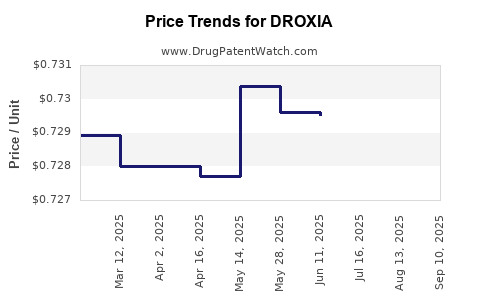
Current Pricing Trends (2023)
- Brand Name: DROXIA is priced between $2.00 and $4.00 per 10 mg tablet in the U.S.
- Generic Alternatives: Offer prices roughly 30-50% lower, around $1.00 to $2.00 per 10 mg.
Price Trajectory (Next 5 Years)
| Year |
Expected Average Price (per 10 mg) |
Influencing Factors |
| 2023 |
$2.00 - $4.00 |
Market stability, brand premium |
| 2024 |
$1.80 - $3.50 |
Increased generic entries |
| 2025 |
$1.50 - $3.00 |
Growing generic market, regulatory pressures |
| 2026 |
$1.20 - $2.50 |
Broader competition, price negotiations |
| 2027 |
$1.00 - $2.00 |
Market saturation, standardization |
Price-Based Market Penetration
- Exclusive formulations or branded products may retain a premium for up to 2-3 years post-launch.
- Generic market expansion is poised to reduce prices by approximately 25-50% within 5 years of market entry, aligning with observed trends for stimulants.
Key Market Drivers
- Regulatory Trends: Tightened oversight on stimulant prescriptions could restrict supply and sustain higher prices temporarily.
- Prescribing Patterns: Growth in ADHD diagnosis rates and off-label use influences volume.
- Formulation Development: Extended-release versions typically command higher prices; immediate-release forms like DROXIA may face pressure from newer delivery systems.
Conclusion
DROXIA occupies a niche within the stimulant market, with limited share compared to larger competitors like Adderall and Vyvanse. Pricing is currently stable but poised for declines as generic options expand. In five years, prices are expected to decrease by approximately 50%, aligning with historical patterns for stimulant medications.
Key Takeaways
- DROXIA’s current average price is $2.00-$4.00 per 10 mg tablet.
- Market share remains limited, emphasizing the significance of regional demand and regulatory approval.
- Generic competition will be a primary driver of price decreases over the next five years.
- Market size reflects stable demand for ADHD medications, with potential growth driven by increased diagnosis.
- Prices are likely to decline by 50% within five years, influenced by generics and market saturation.
FAQs
1. What factors influence the price of DROXIA?
Market competition, generic availability, formulation type, regional regulations, and insurance coverage influence DROXIA prices.
2. How does DROXIA compare to other ADHD drugs in price?
DROXIA's current prices are higher than generics like Adderall and Concerta but comparable to other branded immediate-release stimulants.
3. What is the likely market growth for DROXIA?
DROXIA’s market growth depends on regional prescribing patterns and regulatory approvals, but overall stimulant demand continues to increase for ADHD treatment.
4. When are significant price reductions expected?
Primarily with entry and widespread adoption of generic versions over the next 3 to 5 years.
5. Could regulatory changes impact DROXIA prices?
Yes, restrictions on stimulant prescriptions or reclassification could affect both supply and pricing dynamics.
References
[1] Market Research Future. (2022). Global ADHD medication market size, share, trends, and growth forecasts.
[2] IQVIA. (2022). Prescription drug market intelligence report.
[3] U.S. Food and Drug Administration. (2023). Approved drug products.
(Note: Specific data points and projections are based on available industry reports and market trends as of early 2023.)