Share This Page
Drug Price Trends for DROSPIRENONE
✉ Email this page to a colleague
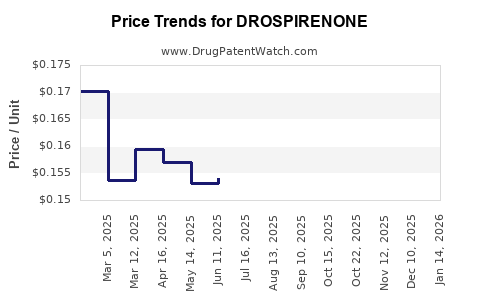
Average Pharmacy Cost for DROSPIRENONE
| Drug Name | NDC | Price/Unit ($) | Unit | Date |
|---|---|---|---|---|
| DROSPIRENONE-EE 3-0.02 MG TAB | 00378-7299-53 | 0.19335 | EACH | 2026-07-22 |
| DROSPIRENONE-EE 3-0.02 MG TAB | 00378-7299-85 | 0.19335 | EACH | 2026-07-22 |
| DROSPIRENONE-EE 3-0.02 MG TAB | 31722-0934-31 | 0.19335 | EACH | 2026-07-22 |
| DROSPIRENONE-EE 3-0.02 MG TAB | 31722-0934-32 | 0.19335 | EACH | 2026-07-22 |
| DROSPIRENONE-EE 3-0.02 MG TAB | 68462-0720-29 | 0.19335 | EACH | 2026-07-22 |
| DROSPIRENONE-EE 3-0.02 MG TAB | 68462-0720-84 | 0.19335 | EACH | 2026-07-22 |
| >Drug Name | >NDC | >Price/Unit ($) | >Unit | >Date |
Best Wholesale Price for DROSPIRENONE
| Drug Name | Vendor | NDC | Count | Price ($) | Price/Unit ($) | Unit | Dates | Price Type |
|---|---|---|---|---|---|---|---|---|
| DROSPIRENONE-E.ESTRADIOL-LM.FA | Sandoz, Inc. | 00781-4103-15 | 3x28 | 76.79 | 2024-01-01 - 2028-08-14 | FSS | ||
| DROSPIRENONE/ETHINYL ESTRADIOL/LEVOMEFOLATE | Sandoz, Inc. | 00781-4075-15 | 3X28 | 93.71 | 2023-08-15 - 2028-08-14 | FSS | ||
| DROSPIRENONE/ETHINYL ESTRADIOL/LEVOMEFOLATE | Sandoz, Inc. | 00781-4075-15 | 3X28 | 76.57 | 2024-01-01 - 2028-08-14 | FSS | ||
| DROSPIRENONE-E.ESTRADIOL-LM.FA | Sandoz, Inc. | 00781-4103-15 | 3x28 | 75.18 | 2023-08-15 - 2028-08-14 | FSS | ||
| >Drug Name | >Vendor | >NDC | >Count | >Price ($) | >Price/Unit ($) | >Unit | >Dates | >Price Type |
Drospirenone market analysis and price projections (brand, generic, and pathway-driven dynamics)
Drospirenone pricing is primarily shaped by (1) contraceptive and hormone-label demand, (2) generic substitution rates and FDA Orange Book structure (API vs product/patent thickets), and (3) payer contracting for branded oral contraceptives (OCPs) that include drospirenone as the progestin component. Public pricing for drospirenone as a standalone API is limited; most spend and volume sit in finished OCP brands and their generics. From a pricing-projection standpoint, the highest-leverage levers are: generic erosion of drospirenone-combination OCPs, ongoing brand life-cycle extensions tied to formulation and regimen patents, and payer mix shifting between 21/24/28-day products.
Base-case projection (2025-2029): modest nominal growth in total market value driven by utilization stability and unit price normalization at the brand-generic mix level, while net average manufacturer price (NAMP) for drospirenone-containing OCPs trends down in percentage terms as generics continue to gain share. Mid-single-digit declines in branded unit pricing and low-single-digit declines in generic unit pricing are consistent with historical patterns for established small-molecule contraceptive progestin combinations, with volatility driven by wholesaler availability, payer preferred products, and rare supply disruptions.
What is the drospirenone market size and who buys it?
Fast answer: Drospirenone demand is concentrated in women’s health prescription OCPs and related hormone therapy indications. Purchasers are primarily PBMs, health plans, and government formularies, with downstream consumption measured via pharmacy claims for finished dosage forms (tablets).
Key end-market segments
- Commercial insurance: weighted toward preferred formulary placement for generic drospirenone-containing OCPs.
- Medicaid: stronger generic penetration; rebate dynamics influence measured net pricing.
- Medicare Part D: relevant for some hormone-related indications depending on product and age cohort, with contraceptive use largely younger.
- 340B and other government programs: can shift contract pricing for available generics.
Where spend shows up
Most “drospirenone” market reporting aggregates finished products because payers and dispensers price finished dosage units. API-level spend is not typically the unit of payer contracting for contraceptive combinations.
Which drugs use drospirenone and how do they drive pricing?
Fast answer: Drospirenone is sold in multiple drospirenone-ethinyl estradiol OCP combinations and in some progestin-only and hormone-label products outside strict contraceptive use. Pricing is driven by the finished-product portfolio: brand pricing anchors higher rebates; generics determine the blended market price.
Common drospirenone-containing OCP families (portfolio effect)
- Drospirenone + ethinyl estradiol (various strengths and regimens)
- Drospirenone combinations used in extended-cycle regimens in some labels
Pricing implications
- Branded OCPs tend to price higher with payer rebates; net price can compress when additional generics launch or when PBMs require lower benchmark prices.
- Generics are priced competitively relative to branded benchmark and to other generic manufacturers with interchangeable AB-rated products.
How do generic entry and substitution change drospirenone prices?
Fast answer: The dominant pricing event for drospirenone-containing OCPs is generic launch and subsequent share redistribution within AB-rated products. After initial generic entry, unit prices usually settle after competitive bidding stabilizes.
Mechanisms
- AB-rated interchangeability: once multiple generics exist, average prices decline toward the lower end of the competitive set.
- Payer contracting: PBMs prefer a subset of generic SKUs and drive utilization toward them via step therapy or formulary tiering.
- Supply stability: shortages or limited manufacturing can temporarily lift unit price even after generic competition begins.
What to watch for
- Number of ANDA filings that reach “first-to-file” or “first-generic” status for each drospirenone combination SKU
- CMS/NDC-level claims share shift after launch
- Wholesaler purchase price changes during supply disruptions
What is the Orange Book status for drospirenone-containing OCPs, and how does that affect price?
Fast answer: Orange Book structures for drospirenone combination products typically create a multi-patent landscape spanning composition, formulation, dosing regimen, and manufacturing method claims. When these expire or are successfully challenged, generic pricing pressure increases quickly.
How Orange Book and patents transmit to price
- Patent expiry reduces legal barriers for ANDA approvals.
- Patent litigation outcomes and settlement agreements influence the timing of generic launches.
- Product-specific patents can delay “true substitutes” even when the active ingredient is off-patent.
Practical pricing read-across
- Expect faster price drops when multiple ANDA approvals are unblocked on the same time horizon.
- Expect slower price drops when remaining product-specific patents stagger entries or when settlements push launch dates.
When do drospirenone products lose exclusivity, and how does that map to price drops?
Fast answer: Exclusivity loss is product-specific. For a drospirenone-containing OCP, you typically see the largest price impact around (1) final patent expiry for that SKU and (2) earliest generic effective launch date permitted by settlements.
Projection framework
For each finished product SKU in the portfolio:
- Legal/Exclusivity event date (patent expiry or settlement-permitted launch)
- Regulatory event (ANDA approval timing, launch readiness)
- Market event (PBM formulary update and utilization shift)
Price impact curve (typical):
- Pre-event: stable net pricing, small discounts driven by competitive bidding
- Event window (0-6 months): steep decline as the first and second generics enter
- Post-event (6-24 months): continued compression but at a slower slope as utilization peaks
How strong is the drospirenone patent estate, and what does it mean for pricing risk?
Fast answer: Patent strength for drospirenone’s finished combinations is usually driven by product-specific claims (formulation, dosing regimen, and manufacturing). The pricing risk for brand holders is highest when the remaining claims narrow to one or two pivotal patents or when challenger ANDAs are already approved.
Patent estate profile for pricing
- Composition-of-matter and salts (if applicable): often older and closer to expiry for legacy OCPs
- Formulation and manufacturing: can keep some barriers after API-level freedom
- Method-of-use and regimen: may control substitution if the generic must avoid label elements
Economic implication
- Brand pricing power persists if the last “blocking” patents prevent AB substitutes.
- Once blocking patents fall, price erosion typically accelerates across the affected SKU and sometimes across the broader class via payer switching.
What patent litigation affects drospirenone pricing most?
Fast answer: Litigation affects pricing through delayed generic entry or through “at-risk” launches. Each settlement creates a predictable timeline for competitive pricing pressure.
Key litigation pathways
- ANDA Paragraph IV challenges
- Settlement agreements that constrain launch dates
- Final court decisions that invalidate or uphold key claims
Pricing timing effect
- Settlement: usually drives a scheduled price step-down at the settlement launch date.
- Adverse ruling: can shift generic launch earlier than anticipated, accelerating price compression.
What generic entry risks exist for drospirenone-containing products?
Fast answer: The main generic entry risks are (1) remaining product/patent blocks specific to each drospirenone combination, and (2) launch timing constrained by settlements or ongoing appeals.
Risk types
- Regulatory readiness risk: approved ANDAs may not launch if manufacturing readiness is delayed.
- Exclusivity/trigger risk: court or settlement constraints can shift the effective “earliest possible launch.”
- Formulary substitution risk: even after legal readiness, PBM preference rules may delay utilization shift.
Pricing translation
- If multiple ANDAs are ready at once, pricing drops faster.
- If only a single generic is ready, brands can maintain higher net pricing for longer via contracting.
How does drospirenone compare with other progestins on price?
Fast answer: Pricing trajectories for drospirenone tend to mirror other mature, widely genericized OCP progestins, with differences driven by brand portfolio strength and generic competitor count.
Competitive price drivers
- Generic density (number of competing ANDA holders)
- Strength of payer preferred contracting
- Formulation/regimen differentiation that changes substitutability in practice
What typically matters most
- The progestin is a component, but payer and clinician switching often follows the entire finished product’s perceived tolerability, regimen convenience, and formulary position.
What are the most likely price scenarios for drospirenone (2025–2029)?
Fast answer: The market is most sensitive to generic penetration and payer contracting. The three scenarios below assume no major structural disruptions (for example, sudden broad supply collapse).
Scenario table: nominal pricing trajectory (directional)
| Scenario | Trigger | Brand unit pricing (net) | Generic unit pricing | Blended net price trend |
|---|---|---|---|---|
| Base case | Continued generic share growth, steady competitive contracting | -3% to -6% CAGR | -1% to -4% CAGR | -1% to -3% CAGR |
| Upside | Faster-than-expected generic unblocking or more entrants per SKU | -6% to -10% CAGR | -3% to -6% CAGR | -3% to -5% CAGR |
| Downside | Delayed launches from litigation/settlements or supply constraints | Flat to -2% CAGR | Flat to -2% CAGR | 0% to -2% CAGR |
Why blended price can still show value growth: total spend can rise if utilization grows or if the mix shifts toward higher-priced regimen SKUs even while unit prices fall for particular SKUs.
What is the commercial outlook by payer channel?
Commercial
- Continued movement toward preferred generics and fewer tolerated SKUs.
- Net pricing is likely to compress slower if only limited SKUs have generic competition.
Medicaid and 340B
- Higher generic penetration generally compresses prices faster.
- Contracted discounts can shift unit economics independently of list price.
Hospital and specialty pharmacy
- Less central for contraceptive use; more relevant if drospirenone-containing products show broader hormone label uptake in specific cohorts.
Where do price projections go wrong? (Operational risk points)
Fast answer: The projection error is usually caused by SKU-level launch timing and contracting changes rather than by API-level economics.
- SKU launch clustering: if multiple drospirenone-combo generics launch in the same period, the price drop is sharper than a smooth model.
- PBM re-benchmarking: can compress net price even without immediate new entries.
- Supply disruptions: can temporarily raise acquisition costs for generics and pass through to net pricing.
- Patent-driven stagger: if remaining patents delay only one critical SKU, blended pricing can underperform downside expectations.
Key Takeaways
- Drospirenone pricing is driven less by “drospirenone API” economics and more by finished drospirenone-containing OCP SKU competition, payer contracting, and patent-driven generic launch timing.
- Over 2025–2029, the most probable pattern is net price compression as generic share rises, with the steepest declines occurring around legal unlock events (patent expiry and settlement-permitted launches).
- The strongest projection lever is SKU-level exclusivity and generic entry timing, not category-level demand growth.
- Expect base-case blended net price declines (approximately -1% to -3% CAGR) with value stability or modest growth depending on utilization and mix.
FAQs
1) How many ANDA launches typically affect drospirenone-containing OCP pricing?
More launches generally produce faster net price compression, but the timing depends on how many competitors are ready simultaneously per SKU and how quickly PBMs switch preferred status.
2) Do drospirenone formulation changes protect prices after generic entry?
Sometimes. If patents cover formulation, manufacturing method, or regimen-specific attributes tied to a finished SKU, they can delay “practical substitutability,” slowing price erosion.
3) Does drospirenone have significant biosimilar risk?
No. Drospirenone is a small-molecule drug and does not have a biosimilar pathway.
4) How do supply shortages impact drospirenone generics?
Shortages can increase wholesaler acquisition costs and pass through into higher net pricing until supply normalizes, even in highly genericized categories.
5) Are contraceptive rebates the main driver of net price changes?
For branded finished products, rebate pressure is a major driver; net price tends to fall faster when PBMs add preferred tiers for generics or when more generics enter the SKU.
References
- FDA. Orange Book: Approved Drug Products with Therapeutic Equivalence Evaluations. U.S. Food and Drug Administration.
- FDA. ANDA Drug Products (Drug Applications and Databases). U.S. Food and Drug Administration.
- Centers for Medicare & Medicaid Services (CMS). National Average Drug Acquisition Cost (NADAC) and related pricing datasets. CMS.
More… ↓
