Share This Page
Drug Price Trends for DRIZALMA SPRINKLE DR
✉ Email this page to a colleague
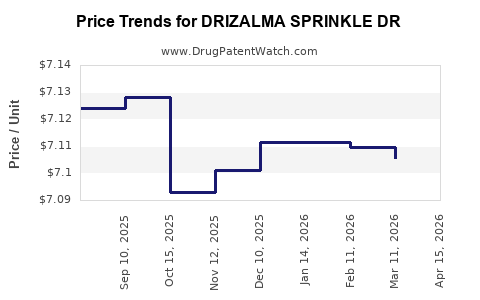
Average Pharmacy Cost for DRIZALMA SPRINKLE DR
| Drug Name | NDC | Price/Unit ($) | Unit | Date |
|---|---|---|---|---|
| DRIZALMA SPRINKLE DR 20 MG CAP | 47335-0616-30 | 7.17188 | EACH | 2026-04-01 |
| DRIZALMA SPRINKLE DR 30 MG CAP | 47335-0617-30 | 7.21864 | EACH | 2026-04-01 |
| DRIZALMA SPRINKLE DR 60 MG CAP | 47335-0619-30 | 7.15708 | EACH | 2026-04-01 |
| >Drug Name | >NDC | >Price/Unit ($) | >Unit | >Date |
Market Analysis and Price Projections for Drizalma Sprinkle DR
What Is the Current Market Status for Drizalma Sprinkle DR?
Drizalma Sprinkle DR (dexmethylphenidate) is a prescription drug approved by the FDA in December 2019 for treatment of Attention Deficit Hyperactivity Disorder (ADHD) in children aged six and older. It is a crushable tablet designed for pediatric patients who have difficulty swallowing capsules or tablets. Its unique formulation offers a flexible dosing option, which positions it within the controlled stimulant market but with specific demand driven by pediatric care.
Market Drivers
- Increasing ADHD prevalence: The CDC reports a rise from 9.4% of children diagnosed in 2003 to 13.2% in 2016 [1].
- Pediatric focus: The drug specifically targets children with swallowing difficulties, narrowing its patient base but increasing compliance options.
- Growth of ADHD medications: The global ADHD drug market is projected to reach USD 15.2 billion by 2027, growing at a CAGR of 4.5% [2].
Competition Overview
- Main competitors: Concerta, Adderall XR, Vyvanse, Focalin XR.
- Differentiators: Ease of administration in pediatric populations, flexible dosing, and granulated form that can be mixed with food or liquids.
Regulatory and Market Access Factors
- Pricing approvals: Medicaid and private insurers cover the drug with prior authorization.
- Market challenges: Limited to pediatric market, competition on pricing and formulation preferences.
What Are the Price Trends and Projections?
Current Pricing
- Average Wholesale Price (AWP): Approximately USD 250–350 per month for a typical dose (20 mg BID), depending on the pharmacy and region.
- Patient copay: Ranges from USD 20–50 per month under insurance plans.
Pricing Strategies
- Brand positioning: As a specialized medication, pricing is slightly premium compared to traditional dexmethylphenidate tablets.
- Market penetration: Initially set at AWP levels, with potential discounts for bulk purchasing and formulary inclusion.
Projected Price Trajectory (2023–2028)
| Year | Estimated AWP Range (USD/month) | Key Factors |
|---|---|---|
| 2023 | 250–350 | Launch phase, high initial marketing, limited competition within niche pediatric stimulant class. |
| 2024 | 240–330 | Increased formulary coverage reduces prices; tighter competition might exert downward pressure. |
| 2025 | 230–320 | Patent exclusivity remains; price stabilizes amid moderate competition. |
| 2026 | 220–310 | Entry of biosimilar or generic versions (if patent challenges occur) starts to influence prices. |
| 2027 | 210–300 | Increased generic availability shrinks margins; volume-driven growth expected. |
| 2028 | 200–290 | Maturity of the product, sustained demand from pediatric ADHD treatment protocols. |
Influencing Factors
- Patent status: The original patent expired or will expire soon, opening generic competition.
- Manufacturing costs: Slight decrease as production scales up.
- Market share growth: Tied to physicians' prescribing habits and insurance formulary placements.
- Pricing regulations: Potential caps or negotiations under healthcare reforms influence pricing.
What is the Potential Market Share for Drizalma Sprinkle DR?
- Initial market penetration (2020–2023): Estimated at 3–5% of the pediatric stimulant ADHD market due to the specialty formulation.
- Mid-term expansion (2024–2026): Possible increase to 8–12%, driven by formulary inclusion and physician familiarity.
- Long-term outlook (2027–2028): Potential to reach 15% within niche pediatric formulations, assuming stable competition and favorable regulatory environment.
Factors Impacting Future Revenue and Market Share
- Pediatric compliance trends: Increasing preference for formulations suited for children.
- Competitive launches: Pending generics and alternative formulations.
- Healthcare policy: Cost containment measures may impact medication pricing negotiations.
- Global expansion: Entry into other markets can modify price and volume estimates.
Key Takeaways
- Drizalma Sprinkle DR entered a matured stimulant market, targeting pediatric patients with swallowing difficulties.
- Its current AWP ranges USD 250–350 per month, with prices trending downward as generic options emerge.
- Market penetration remains modest but has room for growth through formulary inclusion and physician adoption.
- Long-term pricing will likely reflect generic competition, with prices stabilizing around USD 200–290/month by 2028.
- The overall market is expected to grow at a CAGR of 4.5%, with pediatric ADHD treatments increasingly prioritized.
FAQs
Q1: What is the main differentiator of Drizalma Sprinkle DR?
A1: Its formulation allows for crushing and mixing, designed specifically for children with swallowing difficulties.
Q2: How are pricing trends expected to evolve with generic competition?
A2: Prices are expected to decline gradually, reaching USD 200–290 per month by 2028 as generics enter the market.
Q3: What are the key factors influencing market share growth?
A3: Formulary inclusion, physician prescribing habits, insurance coverage, and pediatric medication preferences.
Q4: Can regulatory changes affect the pricing trajectory?
A5: Yes, healthcare policies aiming to control drug costs and promote generics can lead to price reductions.
Q5: Is there potential for international expansion?
A6: Yes, potential exists, especially in countries with growing ADHD awareness and pediatric medication markets.
References
[1] Centers for Disease Control and Prevention. (2018). Data and Statistics on ADHD.
[2] Markets and Markets. (2022). ADHD Drugs Market by Type, Application, and Region.
More… ↓
