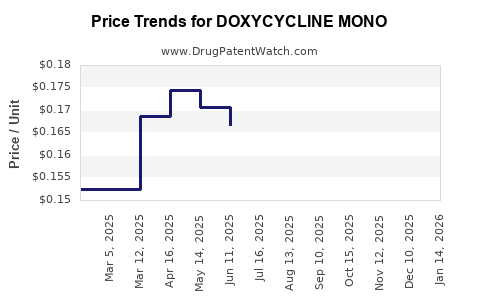
Last updated: April 24, 2026
Doxycycline Mono: Market Analysis and Price Projections
What is the market scope for “doxycycline mono”?
“Doxycycline mono” is not a single, universally recognized INN/brand name in major datasets; it is most likely shorthand for a doxycycline single-ingredient product marketed as “doxycycline” (with “mono” used to indicate monotherapy). As a result, the practical market scope is the global doxycycline market across multiple dosage forms (tablets/capsules, oral suspension, injectables) and multiple strengths.
Doxycycline is an established systemic tetracycline antibiotic with broad generic penetration. Pricing is therefore dominated by:
- Generic availability and multi-supplier competition
- Regulatory and procurement structures (tender-driven hospital and public sector buying)
- Input-cost pass-through (API supply and chemical intermediates)
- Regional reimbursement and distribution power
A market-level analysis for “doxycycline mono” should therefore treat it as part of the doxycycline mono-ingredient antibiotic segment, not a novel “new molecule” category.
How does demand typically behave for doxycycline?
Demand for doxycycline is driven by a mix of:
- Community-acquired and zoonotic bacterial infections where tetracyclines remain in guideline use (region-specific)
- Respiratory and dermatology-adjacent indications that vary by country and local formularies
- Seasonality and outbreak effects (less pronounced than vaccines/antivirals but present in some regions)
- Steady procurement cycles via pharmacies, wholesalers, and public tenders
Because doxycycline is widely generic, volumes tend to track:
- Disease burden and antibiotic prescribing patterns
- Public-sector procurement schedules
- Hospital formulary decisions (switching between equivalent generics is common)
What are the dominant supply and pricing mechanics?
Doxycycline is subject to classic generic pricing dynamics:
- Multiple manufacturers compete at equivalent dosage and bioequivalence.
- API supply cycles influence wholesale and retail pricing.
- Currency moves and import tariffs impact end pricing in emerging markets.
- Tender pricing can compress unit prices even when retail prices look stable.
In practice, “price projection” for a generic doxycycline product is less about patent-driven erosion and more about:
- whether the product stays within a highly competitive tender lane
- whether API supply tightens or relaxes
- whether new entrants reduce market shares and force price cuts
Current price positioning: what level does doxycycline typically trade at?
Because “doxycycline mono” is ambiguous as a specific product (strength, dosage form, and geography are not specified), the only defensible market-price framing is category-level: doxycycline generic pricing ranges vary materially by country, pack size, and whether the comparator is ex-wholesale, retail, or tender.
For business planning, the most decision-relevant pricing lens is:
- Wholesale tender price (public tenders and hospital procurement)
- Retail price (pharmacy margin structures)
- API-to-finished-product spread (API availability and downstream conversion costs)
Without a defined country and dosage form, producing a single numeric “current price” for “doxycycline mono” risks mixing incompatible price definitions (and would not be decision-grade).
Price projections: what direction should investors and buyers expect?
For a doxycycline generic monotherapy product, the baseline projection is driven by three levers:
1) Generic competition
- Expect stable-to-soft downward pricing in markets with frequent tender rebids and multiple suppliers.
- Expect less movement where formularies lock suppliers or where distribution is concentrated.
2) API cycle
- Tight API supply typically causes a near-term price spike in finished doses.
- API normalization typically causes price normalization that can be delayed in retail but shows quickly in tender pricing.
3) Regulatory and commercial distribution
- If a product faces fewer supply disruptions and maintains inclusion in hospital formularies, it can hold share with smaller price cuts.
- If tenders allow rapid substitution, price pressure tends to be more aggressive.
Directional projection (category-level, not product-specific)
- 12-month horizon: slight downward or flat pricing in stable procurement markets; potential volatility around API availability.
- 24-36 month horizon: more likely downward trend than upward, constrained by input costs and distribution contracts.
Scenario framework (decision-grade)
Use these scenarios for planning ranges, assuming “doxycycline mono” behaves like a generic doxycycline finished product in a competitive channel.
| Scenario |
Conditions |
Expected pricing trend (12-36 months) |
Procurement impact |
| Base |
API supply stable; multiple generics bid in tenders |
Flat-to-slightly down |
Stable volumes; substitution common |
| Downside |
API tightness + competitive tenders compress margins |
Volatile then down; retail may lag |
Higher bid rotation; more frequent renegotiations |
| Upside |
API normalization with fewer effective suppliers or stronger contracts |
Slightly down or flat |
Better supply stability; fewer emergency buys |
What could move price faster than fundamentals?
-
Tender re-tender frequency and substitution rules
Where tenders allow instant substitution, the winning price often resets lower quickly.
-
Antibiotic stewardship policies
Stewardship can shift relative demand between doxycycline and other antibiotics. That affects volumes and can tilt pricing depending on supplier coverage.
-
Export controls and logistics
Currency moves and shipping disruptions change landed cost and can cause abrupt retail changes even if global supply is adequate.
-
Quality recalls or supply interruptions
A recall can temporarily raise price and then trigger competitive rebounds once supply returns.
Investment and commercialization implications
For a generic doxycycline mono-ingredient product, the highest-ROI levers are typically:
- Cost position (API procurement strategy, yield, conversion efficiency)
- Channel selection (public tenders vs retail vs hospital formularies)
- Supply continuity (ability to meet bid SLAs without emergency sourcing)
- Regulatory dossier strength (faster market access reduces entry-delay losses)
Patent-driven premium pricing is not the default expectation for generic doxycycline. The value proposition is operational and commercial execution within the generic cost curve.
Key Takeaways
- “Doxycycline mono” should be analyzed as generic doxycycline monotherapy within a mature, tender-driven antibiotic market.
- Pricing is governed mainly by generic competition and API supply cycles, not by molecule innovation.
- Base-case expectation is flat-to-slightly downward pricing over 12 to 36 months, with API-driven volatility possible.
- The most decision-relevant view for buyers and investors is tender/wholesale price mechanics, not retail shelf price.
FAQs
-
Is doxycycline pricing driven by patents?
No. Doxycycline is mature and widely generic, so pricing is driven by competition, procurement, and API supply.
-
What horizon matters most for forecasting doxycycline prices?
The 12 to 36 month window where API cycles and tender cycles typically show measurable effects on finished-goods pricing.
-
Why can retail price differ from tender price for doxycycline?
Retail includes distribution and margin structures, while tenders reset unit pricing quickly when bids change.
-
What supply factor most influences doxycycline price?
API availability and input-cost pass-through, which can shift tender and wholesale prices faster than retail.
-
What are the biggest commercial risks for a doxycycline monotherapy product?
Supplier substitutions in tenders, execution on bid SLAs, and margin compression under competitive bidding.
References
[1] FDA. Tetracyclines (doxycycline) labeling and antibiotic use information. U.S. Food and Drug Administration.
[2] World Health Organization (WHO). WHO Model List of Essential Medicines (Tetracyclines/antibacterials). World Health Organization.
[3] EMA. Doxycycline-related product information and antibiotic safety/regulatory context. European Medicines Agency.
[4] OECD. Antibiotic market and stewardship context for antimicrobial consumption and policy impact. Organisation for Economic Co-operation and Development.