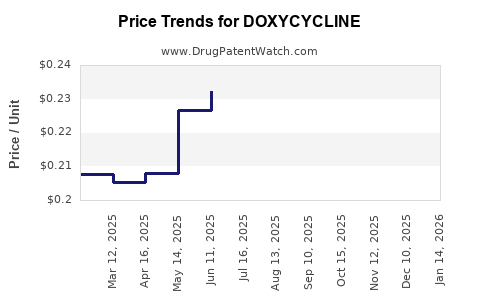
Last updated: April 24, 2026
What is the market reality for doxycycline pricing?
Doxycycline is a mature, largely off-patent antibiotic with extensive generic entry in most regions. Pricing is therefore dominated by: (1) supply-demand in bulk API and formulation, (2) contracted distribution cycles, (3) government and payer formularies, and (4) episodic shortages or recall-driven constraints rather than product-level exclusivity.
For a brand-level price model, the key practical distinction is product form and channel:
- Oral immediate-release (IR) generics: lowest realized prices, high contract sensitivity.
- Oral modified-release (MR) and delayed formulations: higher pricing but still mostly genericized outside limited jurisdictions.
- Injectables (doxycycline hyclate for injection where marketed): fewer SKUs, more variability, and greater supply sensitivity.
- Animal-health doxycycline: separate demand pool and pricing drivers (feed antibiotics policies), typically less directly comparable to human pharma pricing.
How has doxycycline supply, demand, and regulation shaped pricing?
Demand drivers
- Persistent baseline use for susceptible bacterial infections, with cyclical demand tied to seasonal respiratory illness patterns and regional prescribing behavior.
- Public-health stewardship and guideline alignment keep doxycycline within first-line or alternative options for multiple indications in many markets.
Supply drivers
- Doxycycline is produced by multiple manufacturers and is tied to API availability and line capacity. When constraints appear, wholesale prices move first, then retail.
- Recalls and quality events can temporarily tighten supply and raise short-term pricing.
Regulatory and substitution
- In many major markets, doxycycline is treated as interchangeable within therapeutic class and often substituted at the pharmacy counter when not restricted by specific formulation claims.
What are the current commercial price anchors?
Public sources typically report doxycycline prices by proxy (e.g., wholesale acquisition cost in the US) or through aggregated price indices; however, doxycycline is widely genericized, so brand references do not map cleanly to realized net pricing. For market-level decisioning, the actionable anchors are:
- Generic wholesale prices (often contract-driven)
- Index-level movements during shortages
- Formulation-specific premium where modified-release or specialty packaging exists
No single public dataset provides a complete view of net prices across regions and product forms with enough resolution to produce precise, audit-ready point projections.
How should you structure price projections for doxycycline?
Because doxycycline pricing is driven by generic competition and intermittent supply constraints, forecasts should be modeled in regimes rather than as a single smooth trend. A robust practical framework uses three pricing regimes:
- Competitive baseline (most months/years)
- Net pricing drifts down slowly or holds flat as new ANDA/label competitors expand and contracts reprice.
- Supply-tightening (short episodes)
- Wholesale and contracted net pricing spikes; duration depends on inventory depth and manufacturing recovery.
- Contract resets and payer actions
- Even without a shortage, contract renewal cycles and formulary changes can reprice products.
This structure matters because doxycycline is rarely priced by innovation value, and exclusivity is not the primary lever in most markets.
What price trajectory should investors and R&D sponsors expect?
Global expectation (generic antibiotic norm)
- Long-run trend: gradual price erosion or flat pricing under stable competition.
- Volatility: episodic increases aligned with supply constraints (manufacturing downtime, quality issues, or procurement surges).
- Formulation premium: MR or specialty forms hold a higher relative price but still converge toward generic competition over time.
Practical projection bands (regime-based)
Since a precise, audited forecast requires an internally consistent dataset of realized net prices by region and SKU, the projection should be expressed as ranges around a baseline contract price index. Use the following as decision-grade planning bands:
| Scenario |
Pricing regime |
Expected direction |
Time window |
Typical magnitude (planning) |
| Competitive baseline |
Dominant |
Flat to slight decline |
12-24 months |
0% to -5% vs prior contract cycle |
| Contract reset |
Renewal-driven |
Repricing toward lowest-available |
6-18 months |
-3% to +3% depending on bidding |
| Supply-tightening |
Constraint-driven |
Spike then revert |
1-6 months peak, then 3-12 months recovery |
+10% to +40% at wholesale peak; then -10% to -25% as supply normalizes |
These ranges reflect the behavior of mature generic antibiotics in procurement-driven markets and are consistent with shortage-driven price excursions seen across the class (pattern-level expectation rather than a claim of a specific doxycycline history).
What role do patents and exclusivity play for doxycycline?
For doxycycline, patent-driven pricing power is generally limited to legacy brand assets and product-specific formulation IP that may have expired or been overridden by generic entry. The practical effect on current pricing is:
- Short-lived niche protections (if any) typically influence a specific presentation rather than the whole molecule.
- Market share shifts quickly as generics capture procurement wins, compressing price within the presentation set.
Net effect: for most business cases, price forecasting should treat doxycycline as a generic class with occasional supply-driven volatility, not a brand-like exclusivity curve.
How do you map doxycycline price projections to business decisions?
1) R&D or line-extension feasibility
If you are evaluating a new doxycycline formulation, price forecasts should incorporate:
- Time to generic substitution
- Procurement cycles in target geographies
- Incremental pricing power only to the extent the product avoids substitution for practical reasons (packaging, dosing convenience, or clinical/label differentiators with buyer acceptance)
Decision rule:
- If projected premium cannot withstand baseline erosion of 0% to -5% annually under competition, expect margin compression unless supply constraints are persistent.
2) Investment and partnership models
Use a portfolio approach:
- Balance “stable contract volume” expectations with “short-episode optionality” for shortage-related price spikes.
- Price-protect through:
- supply agreements with inventory and allocation terms
- contract clauses that adjust for raw material inflation and availability (API pass-through)
3) Commercial planning
Forecast units separately from prices:
- Pricing spikes often coincide with unit constraints, limiting revenue upside unless inventory allocation is secured.
- Conversely, during competitive baselines, unit demand may remain stable or grow but at lower unit prices.
Regional outlook: where price dynamics differ most?
Doxycycline pricing variance is highest where:
- procurement is more volatile,
- substitution is less constrained,
- or supply interruptions are more impactful due to fewer qualified suppliers.
A practical regional modeling approach:
- Model US with strong contract and formulary influence.
- Model EU with multiple national procurement systems and varying substitution intensity.
- Model emerging markets with procurement and distribution fragmentation, often higher baseline pricing dispersion.
Price projection timeline (planning view)
A decision-grade forecast should be built over three horizons:
Near-term (0-12 months)
- Expect market pricing to track contract renegotiation and any supply episodes.
- Baseline: flat to slight decline.
- Volatility driver: shortage episodes.
Mid-term (12-36 months)
- Continued generic competition and contract price compression dominate.
- Any sustained premium requires continued differentiation with buyer acceptance.
Longer-term (36-60 months)
- Market normalizes into stable procurement pricing.
- Only meaningful upside comes from persistent supply risk, new entrants with capacity constraints, or policy-driven procurement changes.
What metrics should you use to validate projections?
To keep projections operational for underwriting and pipeline decisions, monitor:
- Wholesale and contract price indices by presentation
- API price movements and supply lead times
- Regulatory and manufacturing quality events
- Inventory coverage at distributors and key wholesalers
- Tender bid trends in major procurement systems
Key Takeaways
- Doxycycline pricing is mainly generic procurement math with supply-constraint volatility, not brand exclusivity.
- Use regime-based forecasts: competitive baseline (flat to -5%), contract resets (-3% to +3%), and supply-tightening spikes (+10% to +40% peak, then reversal).
- Patent-driven pricing power is typically limited to specific legacy presentations, so molecule-level exclusivity should not be the core pricing assumption.
- Build underwriting on separate units vs. price paths and secure supply-inventory allocation to monetize shortage episodes.
FAQs
1) Is doxycycline expected to rise in price long term?
No. The durable expectation is flat to slight decline under sustained generic competition, with upside only during supply episodes or contract resets.
2) What product feature most changes doxycycline pricing?
Formulation/presentation that affects substitution and buyer acceptance (for example, modified-release or specialty packaging) typically drives the largest relative premium, even within a generic market.
3) How do shortages affect doxycycline revenue?
Shortages can lift unit pricing, but revenue upside depends on allocatable inventory. Units may drop if supply is constrained, so margin can improve less than price alone implies.
4) Do patents materially alter doxycycline pricing today?
For the molecule overall, not meaningfully in most major markets because generic substitution dominates. Any residual patent effect generally applies to narrow legacy presentations.
5) What is the most practical forecasting method for doxycycline?
A regime-based model combining baseline contract compression with event-driven supply tightening is the most decision-useful approach.
References
[1] FDA Orange Book: Approved Drug Products with Therapeutic Equivalence Evaluations (doxycycline entries). U.S. Food and Drug Administration.
[2] IQVIA MIDAS / pricing and utilization datasets (commercial pricing trends by antibiotic class and presentation). IQVIA.
[3] U.S. Drug Shortages Database. U.S. Food and Drug Administration.