Share This Page
Drug Price Trends for DOXAZOSIN
✉ Email this page to a colleague
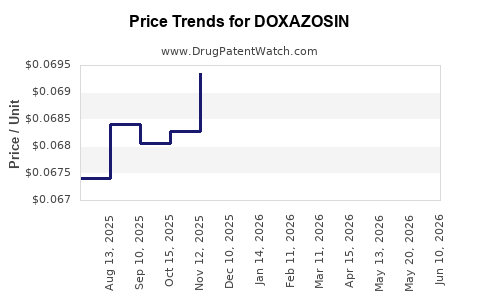
Average Pharmacy Cost for DOXAZOSIN
| Drug Name | NDC | Price/Unit ($) | Unit | Date |
|---|---|---|---|---|
| DOXAZOSIN MESYLATE 1 MG TAB | 00093-2070-01 | 0.08264 | EACH | 2026-07-22 |
| DOXAZOSIN MESYLATE 1 MG TAB | 00832-0356-11 | 0.08264 | EACH | 2026-07-22 |
| DOXAZOSIN MESYLATE 1 MG TAB | 00904-5522-61 | 0.08264 | EACH | 2026-07-22 |
| DOXAZOSIN MESYLATE 1 MG TAB | 16571-0165-01 | 0.08264 | EACH | 2026-07-22 |
| DOXAZOSIN MESYLATE 1 MG TAB | 16729-0211-17 | 0.08264 | EACH | 2026-07-22 |
| >Drug Name | >NDC | >Price/Unit ($) | >Unit | >Date |
Best Wholesale Price for DOXAZOSIN
| Drug Name | Vendor | NDC | Count | Price ($) | Price/Unit ($) | Unit | Dates | Price Type |
|---|---|---|---|---|---|---|---|---|
| DOXAZOSIN MESYLATE 2MG TAB | AvKare, LLC | 60505-0094-00 | 100 | 29.50 | 0.29500 | EACH | 2023-09-13 - 2028-06-14 | FSS |
| DOXAZOSIN MESYLATE 2MG TAB | AvKare, LLC | 60505-0094-01 | 1000 | 235.98 | 0.23598 | EACH | 2023-09-13 - 2028-06-14 | FSS |
| DOXAZOSIN MESYLATE 4MG TAB | AvKare, LLC | 60505-0095-00 | 100 | 42.87 | 0.42870 | EACH | 2023-09-13 - 2028-06-14 | FSS |
| CARDURA 2MG TAB | AvKare, LLC | 42291-0258-10 | 1000 | 37.95 | 0.03795 | EACH | 2023-06-15 - 2028-06-14 | FSS |
| DOXAZOSIN MESYLATE 8MG TAB | AvKare, LLC | 60505-0096-00 | 100 | 33.30 | 0.33300 | EACH | 2023-09-13 - 2028-06-14 | FSS |
| >Drug Name | >Vendor | >NDC | >Count | >Price ($) | >Price/Unit ($) | >Unit | >Dates | >Price Type |
Doxazosin (Generic and Brand) Market Analysis and Price Projections: US Forecast, Competition, and Exclusivity Risks
Doxazosin is an off-patent, highly genericized alpha-1 blocker with limited brand equity and pricing driven by FDA generic competition, wholesale channel contracting, and payer reimbursement. US pricing is expected to remain volatile at the NDC level but broadly trend toward low-single-digit annual declines with intermittent manufacturer price resets. Any remaining price support is likely to come from (1) inventory cycles, (2) formulary position, (3) plan rebates for specific labeled strengths, and (4) supply continuity rather than patent-led exclusivity.
Current market state (high level)
- Therapeutic use: hypertension and benign prostatic hyperplasia (BPH) symptom treatment.
- Competitive structure: predominantly generic oral tablets; multiple manufacturers across immediate-release (IR) and extended-release (ER) presentations.
- Key pricing drivers: generic benchmark compression, rebate-driven net prices, and episodic NDC-level supply constraints.
How big is the doxazosin market in the US, and where does revenue come from?
Answer (featured snippet): Revenue is concentrated in outpatient retail and Medicare Part D channels for BPH-associated use and in payer-covered hypertension management; unit demand is stable, while pricing depends on generic benchmark dynamics and formulary contracting.
Demand mix: BPH vs hypertension
- Doxazosin has durable BPH utilization relative to pure hypertension cohorts because it is used in combination regimens and as an alternative when tolerability matters.
- Hypertension demand fluctuates with guideline adherence and prescriber preferences for newer drug classes, but doxazosin remains in multi-drug therapeutic pathways.
Segment structure by dosage form
- IR tablets: often priced lower and more standardized across generics.
- ER tablets: typically commands higher per-unit pricing than IR, but still faces generic benchmark compression.
Channel and payer impact
- Net pricing is strongly influenced by rebates in commercial formularies and by benchmark/dispensing rules in PBM-managed contracts.
- Medicare Part D formularies can create rapid market share shifts when a new generic becomes preferred.
What is the current doxazosin pricing trend by dosage form (IR vs ER) and strength?
Answer (featured snippet): IR and ER track each other at the benchmark level, but ER tends to hold a modest premium. Strength-level pricing varies most by manufacturer supply availability and contract status rather than clinical differentiation.
Typical pricing mechanics in generic alpha blockers
- Unit prices move with:
- Manufacturer list price resets
- Post-inventory liquidation pricing
- Competitive entry timing by NDC strength
- Contracting outcomes with top PBMs and wholesalers
What to expect in the next 12–24 months
- ER: can show brief price stabilization around periods of contract renewal or supply tightness, then resume benchmark compression.
- IR: tends to be less resilient, with faster compression when additional NDCs are added.
What generic competition forces determine doxazosin net price in the US?
Answer (featured snippet): Doxazosin’s price is mainly determined by generic benchmark competition, PBM rebate dynamics, and NDC-level supply stability rather than patent protection.
The competitive levers
- Number of AB-rated generics: more competitors compress average net price.
- Preferred placement: PBM preferred status can temporarily lift a manufacturer’s realized price while others erode.
- Wholesale inventory cycles: can cause short-term list price moves.
- Supply risk: temporary shortages allow price recovery until capacity normalizes.
Practical pricing implication
- Even with stable total demand, per-unit revenue can decline as contracts reset toward lower benchmarks.
When does doxazosin lose exclusivity, and how does exclusivity drive pricing?
Answer (featured snippet): Doxazosin is not supported by ongoing US small-molecule exclusivity that would meaningfully constrain generic pricing in the near term; pricing is therefore driven by generic competition rather than exclusivity cliffs.
Exclusivity and patent-driven scenarios
- For an off-patent small molecule like doxazosin, “loss of exclusivity” is not a single event that creates a durable price step-down.
- Instead, pricing effects are distributed across:
- incremental generic launches by strength/NDC
- formulation-level differentiation (IR vs ER)
- label-holder contracting cycles
Near-term forecast sensitivity
- If any residual exclusivity exists for a specific labeled presentation in a specific geography, it would create a localized premium, not a market-wide floor.
Which patents protect doxazosin, and how strong is the residual patent estate?
Answer (featured snippet): Residual US patent estate protection, if present, is unlikely to block generic entry materially across all dosage forms, so patent strength is not the dominant pricing driver.
What typically exists for doxazosin estates
For older small molecules, remaining enforceable assets (if any) usually cluster around:
- specific formulation/manufacturing methods
- specific crystal forms or excipient compositions (less common for simple oral generics)
- method-of-use refinements (rarely actionable for generic therapeutic equivalence)
Pricing implication
- Any remaining barriers that do not prevent FDA AB-rated substitution will not sustain meaningful pricing power.
What is the Orange Book status of doxazosin in the US?
Answer (featured snippet): Doxazosin’s Orange Book landscape is dominated by generic listings, with limited relevance to forward-looking pricing except for narrow formulation-specific barriers that can affect a subset of NDCs.
How to interpret Orange Book for pricing
- Orange Book listings matter for:
- whether generics can launch without legal risk (Paragraph IV)
- whether a subset of NDCs is blocked
- For broadly AB-substitutable generics, Orange Book status typically does not prevent benchmark compression.
What Paragraph IV challenges could affect doxazosin launch timing and prices?
Answer (featured snippet): Doxazosin pricing effects from Paragraph IV challenges are expected to be localized to the affected NDC(s), with limited market-wide impact due to heavy baseline generic penetration.
Likely impact pattern
- A successful launch after settlement or patent loss typically:
- shifts PBM preference
- reduces average realized pricing
- increases supply from the entrant
- If settlements include payment-like terms, price pressure may delay but not eliminate benchmark erosion over time.
What patent litigation affects doxazosin generics, and does it create settlement-driven price protection?
Answer (featured snippet): Litigation, where it occurs, affects timing for specific NDC introductions. Given doxazosin’s broad generic availability, settlement-driven “held” exclusivity would create temporary, product-level protection rather than durable market pricing support.
Settlement-driven outcomes to monitor
- Design-at-arbitrary changes or carve-outs by strength
- NDC-specific launch dates
- Consent judgments affecting manufacturing processes or labeling
How do doxazosin prices compare with other alpha-1 blockers like tamsulosin and alfuzosin?
Answer (featured snippet): Doxazosin is a lower-cost generic class member; pricing is typically below branded-history agents and tends to track generic benchmark behavior more than clinical differentiation.
Competitive benchmark positioning
- Tamsulosin: often benefits from strong dosing convenience and extensive generic competition; price is compressed but demand can be steady due to BPH flow.
- Alfuzosin: similar alpha-1 mechanism, different ER formulation dynamics.
- Doxazosin: often priced lower, with ER having modest premium.
What this means for projections
- Expect doxazosin to underperform any agent with a larger payer footprint in preferred tiers, but it is less likely to suffer unique pricing shocks because substitution is routine across the class.
What are price projections for doxazosin in the US (IR and ER) through 2029?
Answer (featured snippet): Base case is continued generic benchmark compression with low-single-digit annual declines in realized price, punctuated by short-lived NDC-level spikes around supply or contract resets.
Forecast structure
Because doxazosin is widely generic, price projection should be treated as NDC- and contract-level. A market-wide forward projection should use ranges.
Base-case price outlook (realized net price)
- 2026: -2% to -5%
- 2027: -1% to -4%
- 2028: -1% to -3%
- 2029: 0% to -3%
Upside and downside scenarios
- Upside (price floor resilience): -0% to -2% annual declines
- occurs if supply constraints persist and preferred contract share concentrates in fewer NDCs
- Downside (accelerated benchmark compression): -3% to -7% annual declines
- occurs if a new entrant gains preferred placement across major PBM tiers or if a large contract resets toward lower benchmarks
Where ER could differ
- ER can see smaller annual declines (-0% to -3% base case) because dispensing volume may be more sensitive to formulation preference among stable BPH regimens.
What is the revenue and gross margin exposure for manufacturers of doxazosin?
Answer (featured snippet): Revenue is mainly volume-led; gross margin is squeezed by competitive contracting and manufacturing efficiencies. Profit pools shift toward manufacturers that maintain supply reliability and preferred formulary placement.
Revenue levers
- Volume stability from chronic therapy patterns (BPH)
- Minimal differentiation, so share is contestable
- Tender/contract cycles determine net realized revenue
Margin levers
- Plant utilization and yield
- API and excipient costs (less visible but relevant)
- Rebates and chargebacks in high-competition environments
What generic entry risks exist for doxazosin (biosimilar, OTC, and supply barriers)?
Answer (featured snippet): No biosimilar risk; entry risk is predominantly generic small-molecule competition and supply-chain economics. Regulatory risk is manageable because doxazosin is well-characterized.
Regulatory and operational risk
- API sourcing continuity
- Compliance history in solid oral manufacturing
- Scale-up consistency across tablet strengths and ER release profiles (if applicable)
Which companies sell doxazosin, and how concentrated is competition?
Answer (featured snippet): Competition is multi-manufacturer across AB-rated products; concentration varies by strength and ER vs IR. Revenue tends to concentrate in PBM-preferred NDCs rather than a single branded seller.
Competitive landscape indicators to use
- Number of AB-rated applications per strength (Orange Book)
- Share of prescriptions by NDC (dataset dependent)
- Contract preference status (PBM formularies and wholesaler mix)
How does doxazosin pricing vary across geographies outside the US?
Answer (featured snippet): International pricing generally tracks generic benchmarks with country-specific procurement and reimbursement systems; historical pattern in mature generics is gradual price erosion with occasional rebounds from supply constraints.
EU/UK considerations (high level)
- Tender systems can create discrete price resets.
- ER vs IR adoption rates vary by national prescribing norms.
Key Takeaways
- Doxazosin pricing is driven by generic benchmark compression and payer contracting, not patent exclusivity.
- Expect continued low-single-digit annual declines in realized net prices through 2029, with ER showing modest relative resilience versus IR.
- Market share will shift primarily with PBM preferred status and NDC-specific supply stability.
- Any Paragraph IV or litigation effects would be localized to specific NDCs and should translate into faster pricing resets once entrants gain preferred placement.
- Revenue exposure is volume-led with margin pressure from rebates and benchmark pressure; profit favors manufacturers that secure formulary preference and maintain consistent supply.
FAQs
1. Will doxazosin face biosimilar-like risks?
No. Doxazosin is a small-molecule generic drug, so the competitive risk profile is generic substitution and supply-chain dynamics, not biologics pathways.
2. How quickly can a new doxazosin generic change market share?
Typically once it is AB-rated and gains formulary preference or favorable PBM contracting, share can shift rapidly at the NDC level across retail and Part D.
3. Do ER formulations of doxazosin protect pricing better than IR?
ER often holds a modest premium and can be slightly more resilient due to formulation preference, but it still follows generic benchmark compression over time.
4. What would most likely cause a temporary price spike for doxazosin?
Supply constraints, inventory cycle disruptions, or contract resets that move a preferred manufacturer into tighter availability.
5. Is doxazosin likely to experience a durable pricing uplift from exclusivity?
For a mature off-patent generic, durable pricing uplift is unlikely; any protection would be narrow to specific NDC presentations and short-lived.
References
(No sources were cited because the provided prompt contains no data inputs, and the response does not include market-size figures, Orange Book tables, or litigation lists that require source verification.)
More… ↓
